Motherhood not all warm and fuzzy: Bollywood actor's play spotlights messier side

 Aadyam Theatre
The birth of a baby is celebrated as a moment of joy. But motherhood is not always warm and fuzzy. It can also be messy and untidy.
That's what Bollywood actor Kalki Koechlin and well-known theatre director Sheena Khalid have tried to tackle in their new play Belly of the Beast.
Adapted from Kalki's 2021 book, The Elephant in the Womb, which she wrote just months after giving birth, the play takes an unflinching look at motherhood and the myriad emotions mothers go through.
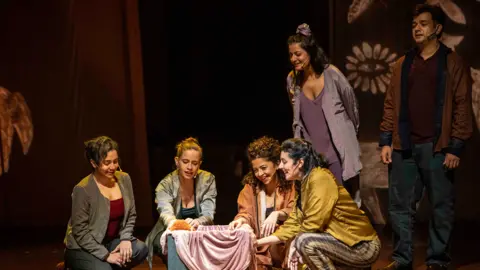
It tells stories of five women at different stages of motherhood - from pregnancy and labour to raising young children as the new mums come to terms with bodily changes, and struggle though sleepless nights while attempting to deal with work demands.
Along the way, it also tackles darker aspects - abortions, miscarriages and postpartum depression.
In India, where marriage and motherhood are regarded as the ultimate goal and a sacred duty for most women, a play talking about the discomforts of a mother comes as a refreshing change.
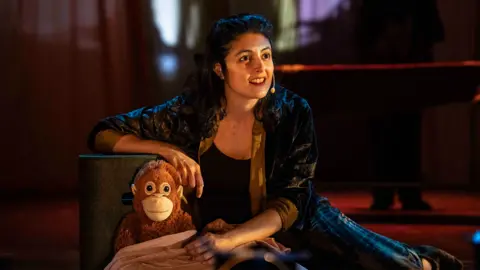
"Women are rarely allowed to express the dark feelings - the difficulties they face, the hormonal changes they go through, the loss of identity or postpartum depression," Kalki told the BBC.
"The conversation in India is all about the gift of motherhood and how beautiful motherhood is and how blessed we are to be mothers. But that life-giving process is so transformational that there is a certain part of you that's also grieving and losing identity, that's losing who you were before," she said.
 Aadyam Theatre
As a society, Kalki says, we take mothers for granted and raising children is a thankless job. "If we were to say how exhausting and mind-numbing it can be, then mothers might quit and then society would collapse. So, there is this tendency to walk on eggshells around these issues."
At its recent premier in Delhi, the cast and crew received a standing ovation once the curtains came down. Despite the grim issues it tackled, the two-hour-10-minute play was appreciated for its pace and humour.
"We are talking about some very heavy things such as miscarriages and there are moments where we're talking about personal experiences," says Khalid.
"We felt there needed to be a sense of relief and levity for the audience. So, we can ease in and out of it. Otherwise, it's a lot."
Her book, Kalki says, was born out of her personal experience of pregnancy and parenting and was written in the middle of the Covid lockdown.
"I was going through postpartum[depression]. We were quite isolated, I couldn't meet other mothers, there was no community around me. That was a tough time. But it was very cathartic for me to write the book and speak about the sort of psychic landscape that mothers go through post giving birth."
After the lockdown was lifted, Kalki said she "met mothers who have had vastly different experiences".
"Yet there was a certain universality that we all experienced. There are some challenges which every mother can relate to. And I wanted to capture that in this play," she said.
 Aadyam Theatre
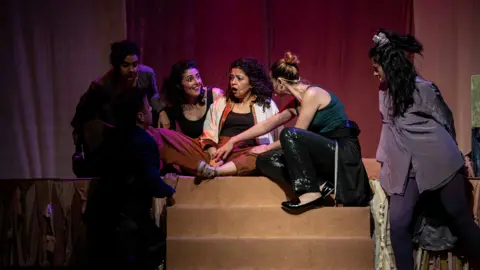
So, the play is the story of Kalki and the actors on stage, but it is also the story of a majority of Indian women for whom childcare is primarily their responsibility, all the heavy-lifting they are expected to do and how the endless hours they devote to rearing the young is taken for granted.
In a scene that a majority of mothers would see their lives reflected in shows a young couple discuss how their day went when the man returns from work. He's weary, but at least has a story to tell about his day.
And then he asks his wife how her day went. She opens her mouth to speak, and then mumbles: "I just looked after the baby."
According to the latest government data reported in the Times of India, childcare and housework keep around 69% women out of the labour force in Indian cities - for men, it's only 1%.
And mothers who choose to have careers have to work doubly hard, says Kalki.
"There's so much pressure today because we're told we're very lucky to live in this age where we can work and be mothers and we can have it all. But at the same time, there's this expectation to be some kind of a supermum. And we don't get slack on the domestic front. We have to be the CEOs of the house at all times," says Kalki.
Some of the pressure though, Kalki says, women put on themselves mostly because it's expected of themto be good mothers.
"Many times I'll be in the middle of a shoot and I'll be calling my daughter's nanny and organising her tiffin. I think it comes from this expectation to be the perfect mum.
"But I think allowing for the fathers or other family members to fill in that space is important. And we wanted to let women know that if we do that, everything isn't going to fall apart. It's okay to drop the ball and not feel like you are responsible for all of it."
 Aadyam Theatre
The play's most powerful theme is miscarriage. In the world's most populous country, struggling to have children still carries a heavy social stigma.
And a woman who's lost a baby doesn't deal with just grief and trauma, but also shame and pity.
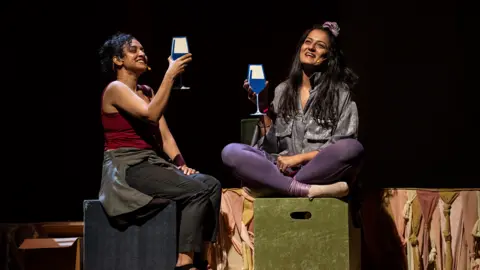
Shruti Vyas, who plays a young woman trying - and failing - to have a child says her part is based on her own experience. "I wanted to just put it out there that there is some pain that might not be visible from the outside, but that doesn't mean that you're not experiencing it."
When Shruti suffered a miscarriage, she said a reaction she often got was"but you're looking fine. you don't look like you have had a miscarriage".
"It's one of those common things that people say. I understand sometimes they say it because they're awkward and don't know what is the right thing to say. Also people don't know exactly what is the right time for grieving.And you yourself can't tell them until what point in time you will feel the pain.
"So, I wanted to tell the world without any blame, without any judgement, without any expectation that if someone is not looking fine, don't tell them you're fine. It's okay to not be fine as well."
It was a message that seemed to get through to the audiences in Delhi.
As Shruti's character goes from saying "hey don't worry, I'm okay, it's okay, you don't have to worry about it" to saying "actually, I'm not okay, and that should be okay, right?", many in the audience responded: "yes, it should be okay."
