India is turning to ancient water systems as modern ones run dry

 Alamy
AlamyWater scarcity and climate change is driving communities to restore traditional water structures built centuries ago, bringing them back into use in the 21st Century.
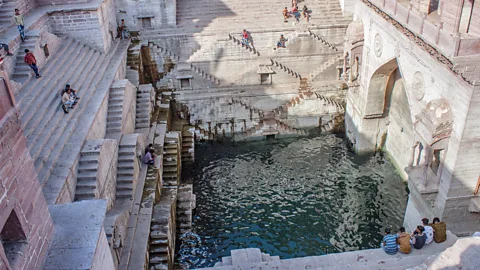
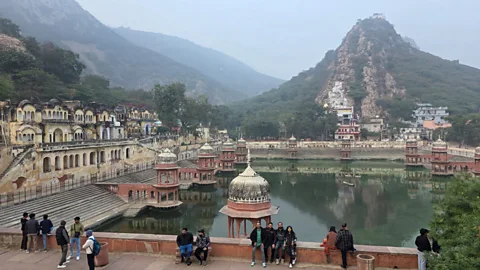
In 2025, water from the Moosi Rani Sagar, a stepwell in the city of Alwar in Rajasthan, India, spilled over the footpath for the first time in more than 30 years.
The stepwell, a large storage tank where water is accessed through flights of steps, is part of a historic water-harvesting system built in the early 1800s. Until 2021, water levels in the stepwell, which covers around 1.3 acres (0.5 hectares), were inconsistent and heavily contaminated. Today, though, it holds water at depths of up to 30ft (9m). Vijay Sarswat, a 60-year-old Alwar resident, says it rarely drops below 20ft (6m) even in the driest months of the year.
The restored stepwell is a testament to the idea that some of the most useful tools for managing water in a warming, increasingly erratic climate are millennia old and half-buried in silt.
Across India, hundreds of communities are reaching the same conclusion. Once viewed as cultural relics, long abandoned ways of managing water are now being recognised as climate-resilient systems that functioned for over 1,000 years – and are ready to be brought back into working use.
Ancient structures
In recent years, India is increasingly looking to revive ancient water structures as a way to help address the country's looming water crisis. In Moosi Rani Sagar's case, it was a consortium of non-profits that set out to restore the system in 2021, hoping to combat severe water scarcity and rescue the 200-year-old heritage landmark.
It's just one example of what new investment can do when it engages with traditional infrastructure, rather than replacing it. India's revived systems have many names: baori, johad, kund, tanka, nadi – all traditional structures which supplied most of rural India for centuries, with many falling out of use only in the last 200 years. They all work differently but share one purpose: to slow water down, allowing it to percolate into the soil.
 Ankit Mishra
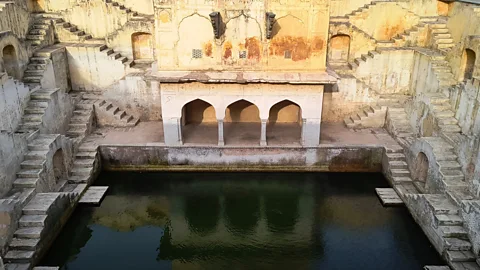
Baoris, or ancient stepwells – large scale tiers of carved stone with steps that descend down into the water table, allowing access to groundwater – are the most striking. Thousands of disused subterranean stepwells, built from the 7th to the mid-19th Centuries, famously dot India's landscape. From New Delhi to Jodphur, dozens have been restored in recent years.
India is home to 18% of the world's population but just 4% of its freshwater resources, much of it contaminated. The country pumps more groundwater – water stored in aquifers, replenished by the slow downward seep of rainfall – than any other nation, with groundwater supplying most of its rural drinking water and irrigation, supporting some 1.4 billion people. In some areas, though, far more water is extracted each year than is replenished by rainfall.
Climate change compounds the problem, with warmer air drying soils faster and making rainfall more intense – meaning more of what falls runs off before anything can soak in.
While modern open reservoirs like canals and dams can also help somewhat to restore groundwater, they are far less effective at doing so, and can lose water to the Sun at a surprisingly high rate. Open traditional structures like stepwells do not escape evaporation completely, but by helping to move water beyond reach of the Sun into aquifers they allow it to stay both cool and reachable by any well or handpump nearby.
Reviving a 'dark zone'
Stairwells are the most visually striking of India's ancient structures, though other far simpler designs are also proving invaluable.
For example, the revival of johads – simple, crescent-shaped earthen dams that hold monsoon runoff long enough for the water to percolate into the ground – has also seen strong results in addressing the water scarcity crisis in Alwar.
During British colonial rule, the johad network that once managed its landscape collapsed, as mining and logging stripped the forests above it and damaged its watershed. Deepening reliance on borewells drew water out without recharging it, and by the mid-1980s, rivers had dried up. Many men left to work in cities, leaving women and the elderly behind, and the government declared parts of it a "dark zone", meaning water extraction had passed what the aquifer was capable of replacing.
 Ankit Mishra
In 1985 Rajendra Singh, an Ayurvedic medicine practitioner, arrived in Alwar planning to set up a health clinic. But when locals in Gopalpura village told him water was a more urgent problem, he began building johads instead. The pilot project he set up worked almost immediately: when the 1986 monsoon arrived, the restored johad filled, and within the same season, wells across Gopalpura that had been dry for years had water again. Neighbouring villages saw what had happened and asked Tarun Bharat Sangh, the non-profit founded by Singh, to help them do the same.
The work spread. Between 1994 and 2007, more than 10,000 water harvesting structures were put up across Alwar, restoring perennial flow to five formerly seasonal rivers and benefiting some 250 villages. The Arvari River itself, dry outside the monsoon when Singh arrived, ran through the summer of 1996 for the first time in decades.
The revived practise scaled to more than 700 villages across Rajasthan, with communities rebuilding their gram sabhas – village-level general assemblies – alongside the previously abandoned earthworks.
Similar revivals are being seen across India. Marathwada, for example, in the western peninsular of India, sits on hard Deccan basalt rock that holds little groundwater and has to absorb what falls almost immediately or lose it to runoff. But a project in the late 2010s led more than 6,000 villages to build or restore their own soil and water conservation works, creating over 550 billion litres of storage, according to the non-profit Paani Foundation, which ran the initiative.
The contrast with local modern alternatives was visible. A borewell could extract water but not put it back; a canal brings water from a distant river but leaves the ground beneath the fields untouched. But johads, built by hand for a fraction of the cost of these, recharged the aquifer across the whole watershed – and kept doing so year after year.
A lost treasure
Many of these structures have survived in disuse for centuries. Researchers argue that while the structures remained, the British colonial administration in India dismantled the decentralised governance and water rights that maintained them. Nobody was left whose job it was to desilt them.
 Ankit Mishra
After independence, India invested heavily in modern infrastructure to extract and distribute water: large dams, canal networks and eventually electrified borewells. Inaugurating the Bhakra-Nangal canal system in 1954, Indian prime minister Jawaharlal Nehru called such projects the temples of new India. But very little of that ambition went into putting the ever depleting groundwater back.
In recent years, though, policy has swung around. Building johads, tankas, baoris and kunds is part of the Indian government's 2019 push to ensure every rural home has its own clean water tap. Another government programme has built 69,000 village ponds. Nationally, recharge from tanks, ponds and conservation structures rose from 14 billion cubic metres in 2017 to 25 billion in 2024.
More like this:
In 2020, the Indian government set out its master plan for artificial recharge, which aims to direct rainwater and runoff back into the ground to replenish depleted aquifers, rather than letting it drain away. Its vision includes construction of 14 million rainwater harvesting and recharge structures, capable of capturing 185 billion cubic metres of monsoon rainfall. Many of the structures it describes already exist, dug centuries ago by hand.
Before the village where Varsha, 67, lives dug a johad, her well would run inconsistently through the dry months. Now it holds water year-round, she says. Varsha never used to speak in her village assemblies, but now she has become a vocal advocate for the structures. What is needed now, she says, is regular desilting and more structures besides, so nobody depends on a single source.
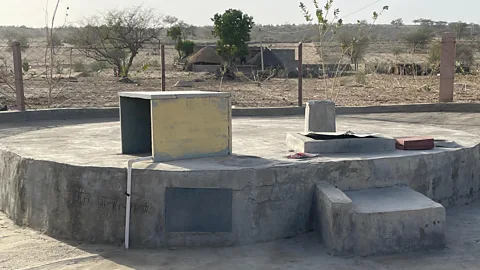
In fact, the knowledge of how important tankas and nadis were was never really lost in communities, says Pratap Moharana, a scientist at India's government desert research institution, the Central Arid Zone Research Institute (Cazri) in Jodhpur, because they often kept building them. What was lost was the political will to take it seriously.
Arun Krishnamurthy, the founder of the Environmentalist Foundation of India, part of the Moosi Rani Sagar stepwell restoration, has seen that gap from the inside. "No amount of money, technology or field effort can save stepwells," he says, "unless there is a strong civic discipline".
--
For essential climate news and hopeful developments to your inbox, sign up to the Future Earth newsletter, while The Essential List delivers a handpicked selection of features and insights twice a week.
