'It's love in the middle of a disaster': The couple who married in typhoon floods

 Aaron Favila/ Associated Press
One year ago, a couple got married in knee-deep water amid a powerful typhoon in the Philippines. The wedding photos quickly went viral as they revealed remarkable resilience in a warming world.
The rain kept pouring as the wedding car inched through knee-deep floodwaters to the church.
It was 22 July 2025 and Typhoon Wipha was battering the Philippines with 130km/h (80mph) winds. Jamaica Aguilar already knew it was flooded at the historic Barasoain Church in Malolos, an hour north of Manila, where her wedding was to take place.
"I remember praying and asking, please stop raining just for today so we can enjoy this," Aguilar recalls, nearly a year later. "And luckily, it stopped when I [stepped] outside the car."
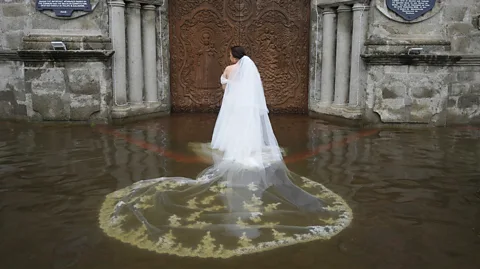
The make-up staff had warned her there would be news crews, but she had brushed them off, incredulous and nervous. Now she could see them. Stepping out of the car, she spread the train of her dress outside the church, as the media lined up.
"I was just nervous, and thinking to myself, this is it, this is the one," said Aguilar. "Although this is not how I planned it, there it is."
Aaron Favila, a photojournalist with the Associated Press, captured the moment, and his photos immediately exploded online. In April 2026, he won a prestigious prize at the World Press Photo 2026 for the images.
Fossil fuel emissions are driving up climate extremes. In practice, what this means is that the scene captured by Favila is likely to become more common: a bride having to walk down the aisle barefoot and through floodwaters, while almost 10 million people in her country reel from the impact of a tropical storm. The Philippines has a long history of dealing with and managing floods, but climate change is now rigging the game.
The night before
Aguilar and her fiancé Jade Rick Verdillo had attended a mass at Barasoian Church on the eve of their wedding.
Halfway through, it started raining heavily. Floodwaters moved through the wooden benches, covering the church floor. "We were watching the news non-stop, and it was saying [the rain] might get heavier," Verdillo says.
The couple stayed up until 03:00 reading forecasts and texting the wedding planners, the church and their guests. Would the storm wane? Should they cancel the wedding? Would guests be able to make it?
The planners and the church offered to reschedule, but not their party venue. "I jokingly said to them that as long as there's food for the guests, it's OK not to have the tables," says Verdillo.
In the end, they decided to push through: whatever the next day would bring, they were determined that the wedding would go ahead.
The wedding day
Favila almost missed capturing the wedding. He was 50km (31 miles) away in Manila, having lunch after putting together a breaking news package about flood-hit communities.
He heard about the flooded wedding just one hour before its scheduled start.
When he got the tip, he didn't hesitate. As the only photographer in the Manila bureau, he has covered many extreme weather events, "but never a wedding in floods".
Favila jumped into his company's car, but waist-deep floodwaters soon blocked it, so he left the driver and hitched a lift in a large rescue truck. When he saw the white gown in front of the church, he leaped off, but the bride's pre-ceremony photo session had ended.
"They were actually finished," he recalls. "The wedding organisers were waiting at the door."
Still, he managed to catch Aguilar's attention for a final few shots before she walked down the aisle.
"It's love in the middle of a disaster," he said. "You see the floods, and it's not a happy picture. So, it's a mixture of happy and sad and resilience. I think people connected with the photo because of that." (Listen to other extraordinary tales of romance from around the world here).
 Aaron Favila/ Associated Press
Down the aisle
Before the wedding, the couple had scrolled through dozens of "bride reveal" videos on TikTok. The moment when the groom and the bride see each other was special for them.
On their wedding day, it didn't work. "I was laughing inside my head because I couldn't see him because of the reporters in the middle of the church," Aguilar says.
Unable to see her fiancé, she focused on her steps. She was barefoot to improve her grip.
"I wasn't thinking about anything except, 'Please don't fall, please don't trip', because the tiles were getting slippery as I went deeper and deeper into the church," she says.
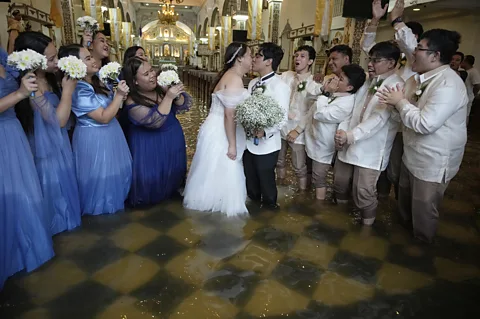
Still, there was a benefit of having so many TV cameras and photographers in the church, says Verdillo. Nearly half of the 100 guests couldn't make it through the flooded roads.
"If the [media] weren't there, I think our venue would have felt quite empty," he says.
Throughout the wedding, the waters kept rising. From the altar, the couple could see that many benches were misaligned, nudged by the currents.
As the ceremony wrapped up, they lined up for photos. It was impossible for them, however, to know which camera belonged to the official wedding photographer and which were media. "So we were just smiling at everyone's cameras," says Verdillo.
Shortly after the ceremony, the couple took doxycycline pills to prevent flood-borne diseases such as leptospirosis, and asked their guests to do the same.
The aftermath
That evening, Favila filed the photos and went to bed as the newlyweds partied with their guests (after Aguilar had changed out of her soaked, heavy dress). The next morning, the couple and the photographer found themselves at the heart of a viral story. Other weddings in the Philippines had been disrupted by floods, but did not receive the same international attention.
"His photos were what went viral," says Aguilar. "Especially the one of me outside the church. That's the one that got everybody's attention."
Favila kept getting tagged on social media. Strangers sent the couple photos of them on the front page of US newspapers. Someone compared their wedding to a scene in the movie Crazy Rich Asians, in which one of Singapore's richest brides marches through a pool of water.
Verdillo believes people found their story fascinating because it is relatable. "Problems are there. You cannot escape them. But what you can do is face them and move on with your life," he says.
Saffron O'Neill, a researcher at the University of Exeter in the UK who studies climate visuals, says she wasn't surprised the photos caught the world's attention.
"These photos are so unexpected in how they pair the usual visual signals we expect to see in wedding photography (the couple, the white dress, the church, gathered friends and family) in a totally unexpected situation – standing knee-deep in floodwaters," says O'Neill.
Favila believes his job as a photojournalist is to show people that climate change is happening now. "It's not like before when people said, 'Oh, in 10 years we will have great climate change effects'," he says. "I think the effects of climate change are happening now."
But the couple's story is not only about resilience. Flooding became a heavily political issue in the Philippines during the 2025 storm season, following massive protests about a mismanaged $9.2bn (£6.9bn) fund for flood defences. Government inquiries identified hundreds of "ghost projects", leading protestors to complain about backroom deals between politicians and companies. Senators, ministers and congresspeople have resigned or been fired in the aftermath.
Investment in flood defences is critical as the Philippines is among the world's most vulnerable countries to typhoons and climate change is making these stronger. Warmer ocean temperatures due to global warming cause typhoons to become stronger and more damaging. Every decade since 2000 has seen a 17% to 19% increase in typhoon-related rainfall in the country.
More like this:
Aguilar and Verdillo live in Navotas, a coastal area in northwest Manila, an area which is highly vulnerable to extreme weather and flooding. "They are slowly developing projects against flooding, but the rise of the sea level in Navotas is much faster than the effort the government is putting in," says Verdillo.
After the couple furnished their house in 2025, their first typhoon season together took a darker turn. After water entered their house, their new refrigerator and washing machine broke down and their sofa and bed were completely soaked.
This year, they have added additional precautions, like raising the refrigerator up higher. Looking back at his childhood, Verdillo realises he had normalised flooding, but he says this is not tenable. "Now that I'm older," he says. "I don't want my children to experience the same thing."
When they look back on their wedding day, Aguilar and Verdillo see it as a special moment.
"If you had told me beforehand that my wedding was going to be flooded, I would have said 'no way'," says Verdillo. "But now, honestly, I wouldn't change anything about that day."
--
For essential climate news and hopeful developments to your inbox, sign up to the Future Earth newsletter, while The Essential List delivers a handpicked selection of features and insights twice a week.
