Scotland was the 'murder capital of Europe'. Then it started treating violence like a disease

 Getty Images
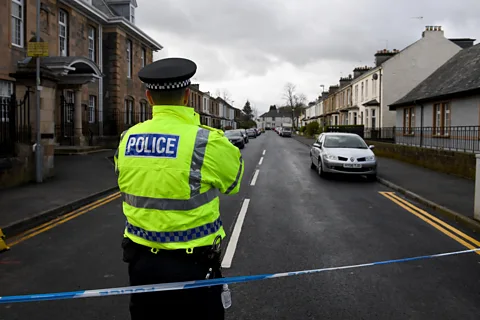
In the early 2000s you were three times more likely to be assaulted in Scotland than in the US. But when the Scottish authorities started looking at violent crime as a public health problem, levels plummeted and the country now ranks among some of the safest in the world.
It was no ordinary day in court. There was no jury, no witnesses or defendants at Glasgow Sheriff Court on 24 October 2008. Instead, in front of the judge, who was dressed in full regalia, were 85 rival gang members from the east end of Glasgow, Scotland's biggest city.
For decades, the area had been plagued by territorial youth gangs, organised crime and fights over drugs and weapons, with knife crime an almost daily occurrence.
Despite their ongoing feuds, the assembled gang members fell silent as they were addressed in turn by a range of speakers. A mother described seeing her son's unrecognisable face after a gang-related machete attack at age 13. An American basketball player recalled losing his brother to gun violence. Doctors and surgeons described brutal lacerations and permanent disfigurements.
The message was clear: the violence has to stop.
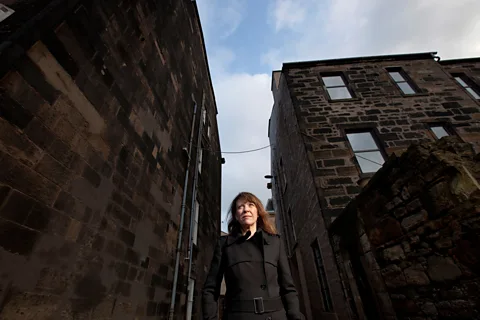
"If I was the chief constable [of Strathclyde Police], I probably wouldn't have let us do that," reflects Karyn McCluskey, co-founder and former director of the Scottish Violence Reduction Unit (SVRU), a specialist unit set up by the police in 2005 and extended into a nationwide initiative the following year by the Scottish government. The unit was behind the unusual spectacle of that day.
"He must have thought we were bonkers," she says. "That day, we had police horses at the court, boats going up and down the [river] Clyde, because it was a really risky thing to do. But there was a permissiveness around trying to do something."
That something seemed to work. The gang members in attendance were given a number to call afterwards for support if they wanted to end their involvement in violence; after 10 similar sessions attended by 473 young people, almost 400 of them had called it.
The courtroom intervention was the first of what would be called Scotland's "self-referral sessions", part of the country's efforts to curb record rates of violence which plagued the nation, and particularly Glasgow.
Between 2003-2005, the city had the highest murder rate of any in Europe. The United Nations declared Scotland the most violent country in the developed world, with Scots almost three times as likely to be assaulted as Americans. Newspapers were routinely filled with reports of gruesome murders and bloody gang fights.
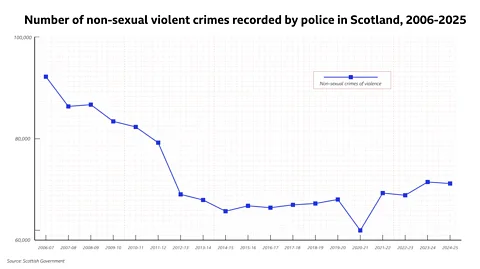
Over the following decade, the homicide rate would fall by 56% in Glasgow and 38% in Scotland more widely. Violent crime as a whole declined by almost a third across the country between 2006 and 2015. Today the number of homicides in Scotland is at its lowest level in over 20 years. Numbers of serious assaults and attempted murders have undergone a similar decline.
While the statistics hide the individual stories of tragedy and horror of any violent crime, it is still a remarkable turnaround.
Scotland now ranks somewhere in the middle of European countries for murders, with lower levels per capita than the likes of Sweden, France or England and Wales. How did a nation once beleaguered by knives, gangs and slayings make such a decisive change?
In short, it changed the way it saw violence as a problem – shifting it from being solely a criminal justice issue to one that was also about public health.
"Scotland had the image [in the early 2000s] of the hard, drunk man and a particular reputation for gang activity and knife crime that had been there for generations, all the way back to 18th-Century razor gangs," says Will Linden, deputy director at the SVRU and one of its first employees. In 2003, Linden was working as a police analyst under McCluskey, then Head of Intelligence Analysis for Strathclyde Police, when their department was asked to produce a report on reducing homicide figures.
"When we looked at the data, there was a realisation that most homicides were almost happenstance," Linden says. "They weren't preplanned or connected to organised crime, it was usually just a couple of people getting involved in a fight where one pulls out a knife and stabs the other. We started to see that you couldn't have a strategy for dealing with homicide without looking at violence in its entirety and not just at policing."
The crisis in Glasgow was such that the Chief Constable leading the force at the time, William Rae, gave McCluskey and her colleague John Carnochan, deputy head of the Criminal Investigation Department, almost free reign to try and solve the problem. Rae set up the team that would become the Violence Reduction Unit within the police force but on its fringes, enabling the force to simultaneously take credit for successes and distance itself from failures.
"We got a bit of latitude and we were allowed to fail," says McCluskey, "There was a recognition that when something is so terrible, you have to reinvent everything."
 Alamy
AlamyFrom its outset, the SVRU took a public health approach to violence, characterising it more like a disease than a crime. They chose to focus on prevention and intervention rather than responding after the fact. McCluskey likens this approach to dealing with measles: treating those already infected, vaccinating groups at particularly high risk and working to prevent contagion in the wider community.
It was a decision that was instrumental in the success that followed.
In its simplest guise, a public health approach to tackling violence starts with gathering evidence to identify and understand the problem, before examining the factors that put people at risk and those which protect them.
Nearly two thirds of all violence happens to just 1% of Scotland's population. Risk factors include being a young man from a socially deprived area, as well as things like unemployment, poverty and growing up in an unstable family environment. Factors that appear to protect against violence include staying in education and having strong parental relationships.
Interventions – everything from initiatives like the one in the Sheriff Court, to peer support groups, educational programmes and partnerships with social work, doctors and teachers, are then developed to reduce risk and increase protection. These are tested, implemented and scaled up where they are successful – and then the cycle begins again.
But many of the ideas implemented by the SVRU were borrowed from elsewhere in the world. The idea of tackling violence as a public health problem began in the US in the 1970s. It was then adopted by World Health Organization in 1996 when it declared violence a major worldwide public health problem.
Key to the SVRU's approach, however, was taking what had been learned elsewhere and applying it to Scotland's unique situation.
Its self-referral sessions mentioned near the start of this article were modelled on a gang violence programme in Cincinnati, Ohio, which itself came out of the Chicago Project for Violence Prevention. The latter similarly took a public health approach to violence in a city which had experienced a dramatic rise in homicides, more than half of them related to gang activity.
 Alamy
Alamy"What we became really skilled at was the implementation of other ideas within the specific context of Scotland," says Linden. "You can't just lift something that works in Chicago or Finland and lay it down in Glasgow, or something that works in Glasgow and lay it down in Edinburgh. You have to understand the scale and nature of your own problem in order to make it work."
For the SVRU, this meant getting out of the police station and into hospitals, schools, social work departments, youth work and communities. Dentists were trained to intervene – recognising violence-related injury, documenting it as such and signposting patients to sources of help while they were still in the chair. And education chiefs were convinced to stop excluding pupils: in 2022/23, there were fewer than 12,000 exclusions in Scotland compared to a high of almost 45,000 in 2006/7.
As the word spread, others got on board. In 2008, Christine Goodall, an oral surgeon, and two colleagues established the charity Medics Against Violence. When Goodall began her career in maxillofacial surgery in the late 1990s in Glasgow, services were overwhelmed with patients suffering facial trauma as a result of violence. Decades earlier, the city had even given its name to one such injury: the "Glasgow smile", a wound caused by slashing a victim's mouth to their ear.
In the early 2000s, the NHS worked with the SVRU on initiatives such as providing alcohol support within trauma clinics. These worked well, says Goodall, "but I started thinking there was probably more we could do".
"If you're only talking to patients who already have injuries, you're kind of shutting the stable door after the horse has bolted," she says. Medics Against Violence established an education project in schools and a "Hospital Navigators" programme, where trained support workers intervene when patients with injuries from violence turn up at an emergency department. Both still exist today.
Is violence normal?
Listen to forensic psychiatrist Gwen Adshead as she asks four important questions about violence as part of the BBC Reith Lectures. Is it normal? What's the relationship between trauma and violence? Is there such a thing as Evil? And can we change violent minds?
There was also wider culture change as the SVRU's work reframed the debate about violence into discussion around public health, says Alistair Fraser, a professor of criminology at the University of Glasgow. There was a "growing chorus" of support for the approach as health leaders, educators, community organisations and the early SNP government got involved.
"What I think you saw was the SVRU changing the terms of the debate and people all starting to sing from the same hymn sheet," says Fraser.
The changing conversation on violence reduction mapped helpfully onto other emerging frameworks around childrens' rights and wellbeing, Fraser says. It also tapped into Scotland's enduring vision of itself, helped by the establishment of the Scottish Parliament in 1999, as a uniquely caring, welfare-oriented and egalitarian country.
Scotland's success at reducing violence has now become an example that is admired worldwide. Scotland's closest neighbours were also paying attention.
Since 2019, VRUs have been established in 20 police force areas across England and Wales with the support of the SVRU. This includes London, which accounted for almost a third of all knife offences in England and Wales last year. Early evaluations have found a reduction in the most serious forms of violence in areas where a VRU operates.
 Alamy
AlamyToday, the SVRU remains part of Police Scotland and receives £1.1m ($1.45m) in funding from the Scottish Government each year.
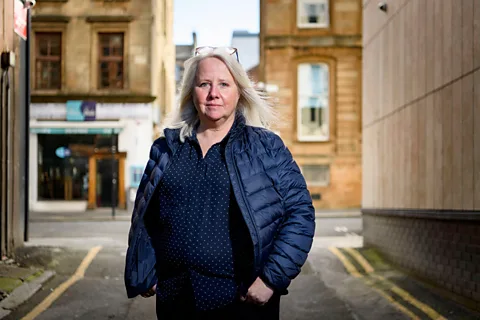
When Kelly, 30, became a parent, she struggled with her mental and physical health. She had grown up in a difficult home environment and found it difficult to manage stress and regulate her own emotions – all risk factors for violence. The BBC has changed Kelly's name at her request to protect her identity.
In 2024, recognising the need to make her family home feel calmer, Kelly joined a nursery peer support group run by the SVRU as part of its early intervention work, designed to reduce intergenerational cycles of violence.
"I felt really isolated before joining the group," she says. "I often felt overwhelmed. My confidence was low and I spent a lot of time at home, which started to affect my relationships with my partner, my children and others around me."
But over time, things began to change. "The group helped me understand how my past experiences were affecting both me and my family," she recalls. "I started to process things I hadn't dealt with before… I can see now how breaking those patterns can help create a more positive environment for my children."
The group has improved Kelly's relationships with her partner and her own mother, she says. Her home feels more supportive and she has become less isolated after forming connections with other parents. Now, she hopes to get back into work and wants to contribute to supporting others in her community.
 BBC/ Scottish Government
There is still more work to do: a 2024 study found that reduction in serious violence had slowed in recent years, in part due to a lack of "safe spaces" for young people.
Jimmy Paul, the SVRU's director since 2023, also highlights the dangers of social media, the lasting effects of the Covid-19 pandemic and the fact that nearly one in four of Scotland's children grow up in poverty.
"There's more we can do and we believe violence is preventable and not inevitable, so we need to focus on that as we face these new challenges," says Paul. He points to ongoing long-term work in schools, partnerships with homelessness charities and efforts by the SVRU to use data to identify particular areas of concern where they can intervene. "We've still got that role to play as a catalyst for the 'growing chorus' and helping others see their role in violence reduction."
More like this:
McCluskey is now chief executive of Community Justice Scotland, a non-departmental public body which is funded by the Scottish Government but independent and evidence-driven. She agrees and points out people in their 30s and 40s now make up the majority of those accused of murder in Scotland rather than teenagers and young adults. It's a trend that might require new interventions. But she is also keen to acknowledge how much has changed.
And, she says, while the names of many people affected by violence in various ways will stay with her forever, she has lost count of how many people's lives have been changed by Scotland's violence reduction movement.
Sometimes, McCluskey says, she walks down the street in Glasgow and spots someone she first met years ago when they were embroiled in violence.
"I might catch their eye, but they don't engage," she says. "Then they'll text me at night and say, 'look, I've got a different life now: I've got a new partner, I've got a kid, I've got a job'," she says. "So we don't say anything in that moment. We just look at each other and acknowledge that we were part of something together."
--
If you liked this story, sign up for The Essential List newsletter – a handpicked selection of features, videos and can't-miss news, delivered to your inbox twice a week.
