'One of the Third Reich's most fearsome weapons': The daring mission to smuggle a V2 rocket out of Nazi-occupied Poland

 Getty Images
In 1977, the BBC looked back at the summer of 1944, when Allied agents spirited away pieces of Hitler's "wonder weapon" – by hiding them in the apartment of a German officer.
On 6 August 1944, the Soviet Union's Red Army reached the village of Blizna, northwest of Rzeszów in Poland, liberating it from Nazi occupation. A remote rural settlement surrounded by agricultural fields and dense pine forest, it might have seemed to be of little military significance. Yet deep craters on the woodland floor, metal debris and fake farmhouses hinted at its secret purpose.
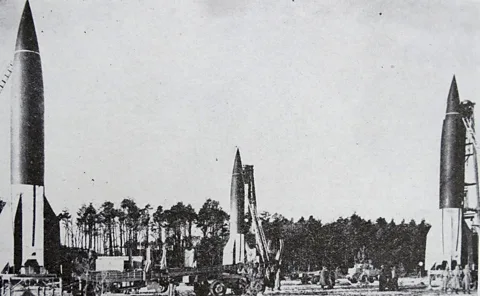
Before the Nazis had retreated a few days before, Blizna had been the test launch site for a new weapon, one that Adolf Hitler hoped would turn the tide of the war against the Western Allies. Known by the Germans as the Vergeltungswaffe (Vengeance Weapon) 2, the V2 rocket was the world's first modern ballistic weapon. Designed by the engineer Wernher von Braun, with a range of approximately 170 miles (280km) and a warhead weighing one tonne, the rocket's supersonic speed and high flight altitude made it a "wonder weapon", capable of exploding without warning in the cities it targeted.
But in the summer of 1944, parts of the V2 were smuggled from Poland to Britain in one of World War Two's most audacious covert missions.
The Nazis began developing the V2 in 1936. However, British intelligence hadn't been aware of the rocket's existence until early 1943, as experts told the BBC in the 1977 documentary The Secret War. "There'd been a little information before 1939 that the Germans might be developing long-range rockets," said Dr RV Jones, the Chief of Scientific Air Intelligence. "Then we heard nothing more until December 1942, when a new agent, who turned out to be a Danish chemical engineer, told us he'd overheard a conversation in Berlin between two engineers who said that there was a new weapon being developed and tried up on the Baltic coast."
The turning point came in 1943, when two German generals who had been captured separately were brought to Britain for interrogation – and then allowed to talk alone together, not suspecting that the room was bugged. They debated why the rockets hadn't been used yet, saying that something must have gone wrong because they'd been told more than a year earlier that the weapons would be ready in only a few months. According to Jones, one of them said, "Well, we're somewhere near London, and we've heard no bang, so nothing could have happened."
As Jones recalled in 1977, "[Intelligence analyst] Charles Frank… was just sitting opposite me, and he suddenly looked up from reading the interrogation report and said, 'Look, we'd better take those rockets seriously.'"
The British discovered the Nazis' secret V2 research centre at Peenemünde, on an island close to the Baltic coast, and bombed it in August 1943. After the air raid, the Nazis moved their testing, training, and launch site for the V2 rocket away from Germany. They chose a location further east in Poland, about 150 miles (240km) south of Warsaw, protected by forest cover. Blizna was considered so strategically important that it was visited in the following months by both Hitler and his architect of the Holocaust, Heinrich Himmler.
Yet there was a flaw in the V2 test weapons that was to delay their deployment by almost a year. Most of them broke up in mid-air, just short of their target 200 miles (320km) away, near the river Bug in East Poland. A special detachment of German troops was stationed there to recover the pieces of the fallen rockets for analysis by scientists.
As the narrator of The Secret War William Woollard recounted in 1977, however, "The main disadvantage of this new location was that the local civilian population was less than enthusiastic about German secret weapons falling on them from out of the sky. They'd been asked by the Polish resistance movement to try to collect the wreckage before the Germans got to it."
In May 1944, a V2 rocket crashed – relatively intact – into the marshy banks of the river Bug. Local villagers covered it with reeds and called in a Polish resistance leader, Lieutenant Tadeusz Jakobski. "It was here that the rocket landed without exploding," he told the BBC from the site 33 years later. "The Germans failed to find it, and after a few days they stopped looking altogether. We then pulled the rocket up to the bank, and the team of experts came from Warsaw to dismantle it."
The parts were loaded into sacks, which were hidden under vegetables and transported on carts to Warsaw along little-used country roads – shadowed by armed partisans in the woods. Despite constant security checks in the Polish capital, the rocket fragments were successfully smuggled into the city, and the scientists tasked with analysing electronic components included the physicist, Professor Janusz Groszkowski. With fears that his laboratory at the university might be searched by the Gestapo, the resistance decided that a private apartment would be better suited for his work – the apartment of an unsuspecting German officer.
The electronic units were hidden by night in one of the officer's own suitcases. "Before my visit, this case was taken from the room of the officers to the special room prepared for me to make [my] investigation," Groshkowski told the BBC. He worked for hours at a time in the small room, with the constant danger of the officer returning unexpectedly.
Yet, Groszkowski recounted, "[That] never happened during my stay there." Resistance agents were monitoring the German officer. "The servant asked him by telephone what he wished to have for the dinner… to make sure that he was at that time in his office in the airport," said the physicist. "But if he said, for instance, that he's ready to come earlier, I would [disappear]."
More like this:
The subterfuge in Warsaw was followed by a top-secret operation to extract the components, codenamed Wildhorn III (or Operation Most III). On the night of 25 July, an RAF Dakota transport plane fitted with additional fuel tanks to allow for a flight time of 18 hours landed at an abandoned airfield near the Polish village of Wał-Ruda – in territory surrounded by German military units. It was to be loaded with 19 suitcases containing key V2 fragments, technical blueprints, and scientific reports.
In History
In History is a series which uses the BBC's unique audio and video archive to explore historical events that still resonate today. Sign up to the accompanying weekly newsletter.
Informed about the operation through encrypted codes broadcast over BBC radio, the partisans emerged from nearby woods as the Dakota landed just after midnight. However, once the cargo was loaded, the plane was unable to take off, its wheels stuck in the muddy ground. Twice everything was unloaded, and attempts were made to wedge straw and planks under the wheels to add traction, some partisans digging the mud away from the wheels with their bare hands. At one point, the operation's commanders believed they would have to evacuate the passengers and burn the aircraft. The crew even splashed gasoline on the landing gear. But the plane finally succeeded in taking off.
The only way to beat the V2
The daring Allied airlift had allowed one of the Third Reich's most fearsome weapons to be spirited out of Nazi-occupied Europe, from right under the noses of the German army. The V2 rocket arrived safely in London on 28 July 1944, and British intelligence began to analyse Hitler's "wonder weapon".
"Moving the whole rocket was unnecessary and impossible – V2s weighed about 12.5 tonnes and were 14m (46ft) long – but the Poles meticulously stripped it down so that all the essential components were included on the flight back to Britain," Guy Walters, the historian and author of Stealing Hitler's Rocket, tells the BBC. "These pieces were absolutely vital because for the first time the British scientists were able to get their hands on parts that hadn't been partially destroyed."
The covert mission had provided crucial information about a terror weapon that was to strike London for the first time less than six weeks later. "What the British didn't know was whether the rocket had a guidance system. If it had a guidance system, then work could be done to jam it remotely, thereby causing the rockets to go off course. What the stolen rockets taught the Brits was that the rocket did not have a guidance system, which thereby saved British scientists oodles of time from trying to develop countermeasures. The only real way to beat the V2 therefore was to win the war."
--
For more stories and never-before-published radio scripts to your inbox, sign up to the In History newsletter, while The Essential List delivers a handpicked selection of features and insights twice a week.
