The 1939 president's picnic that led to the US-UK 'special relationship'

 Alamy
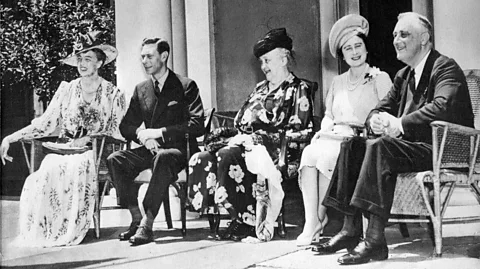
AlamyAs the Nazis were advancing in Europe, President Roosevelt invited King George VI and his consort for a visit to his country home. It was the first time that a British monarch had set foot on US soil. Over hot dogs and beers, the conversations that took place helped shape the course of history – as a new play explores.
In early 1939, US President Franklin D Roosevelt followed events in Europe with growing dismay. In March, the Nazi army invaded Czechoslovakia, shattering the Munich Agreement brokered a mere six months previously. British Prime Minister Neville Chamberlain's bid for "peace in our time" had come to nothing.
Roosevelt, 57, was certain Britain would soon be forced to stand up militarily to Adolf Hitler, and the US's aid in the armed struggle would be vital. But the president knew, also, that a majority of his fellow citizens were strict isolationists – they wanted nothing to do with another European war.
His solution? Roosevelt – or FDR as he was widely known – invited the young King George VI and his consort Queen Elizabeth to his beloved country home in upstate New York. A reigning British monarch had never before visited the US. The president envisioned a casual, "just folks" occasion to demonstrate to Americans how the royal couple were not grand remote figures, but friendly representatives of a democratic nation that deserved support.
The focal point of the weekend visit was to be an outdoor picnic in the grounds of the Roosevelt estate, at which hot dogs – that decidedly un-regal US summer favourite – would be served. The historic meet-up is the subject of a new play, Springwood, at London's Hampstead Theatre, praised as a "timely tale of a British monarch's mission to the US" by The Guardian. So how did this moment help shape history – and why does it resonate particularly right now?
 Manuel Harlin
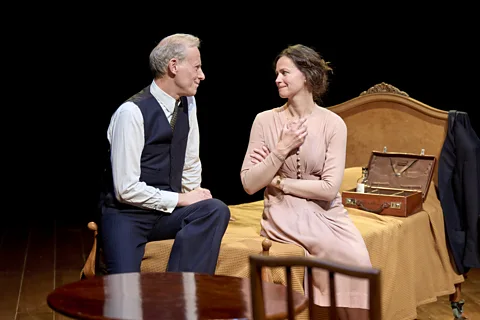
Playwright Richard Nelson chose as his title the official name of the house in the Hudson Valley village of Hyde Park where the president was born in 1882, and where his elderly mother still resided at the time of the royal visit. Nelson, who lives nearby, previously wrote a screenplay about that long-ago June weekend. It was made into a movie – Hyde Park on the Hudson, starring Bill Murray as the president – released in 2013. The playwright was inspired to return to the material because "today we are in a somewhat similar situation as in 1939, what with the war in Ukraine," Nelson tells the BBC. "Then, as now, there is a large element in the United States which is isolationist."
In his movie script the action was narrated by Daisy Suckley, FDR's distant cousin and close friend. Nelson's new play focuses more tightly on the political – and emotional – stakes for the two couples, royal and presidential.
King George VI, 43, was prone to bashfulness and insecurity. Thrust on to the throne in December 1936 when his older brother abdicated in order to marry the twice-divorced American Wallis Simpson, he felt ill-prepared for his role. He suffered from a stutter, which made public speaking difficult. And he suspected he came up short in comparison with the former king, known after the abdication as the Duke of Windsor. "Especially in America," Diane Kunz, a historian who has taught at Yale, explains to the BBC, "the Duke of Windsor was considered the superstar royal, a popular modern guy, while his younger brother looked a bit dull and old-fashioned".
 Getty Images
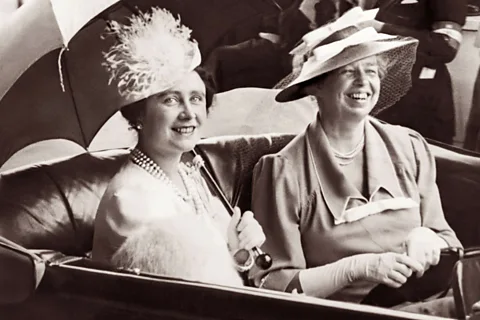
Queen Elizabeth, then 38, also worried about US attitudes, Kunz notes. Would people resent her because she was a queen, a role denied to the former Mrs Simpson, now the Duchess of Windsor? Also, she was not particularly chic. Would people believe she properly looked the part?
Eleanor Roosevelt as First Lady, fully embraced her husband's goal, and recognised his methods. Of the royal visit she wrote in her 1949 memoir This I Remember: "My husband always loved taking people he liked home with him. I think he felt he knew them better once they had been at Hyde Park."
But Eleanor was not the official hostess for the weekend – that role belonged to her imperious mother-in-law Sara Roosevelt, 84, and as so often in her life, the first lady had to bow to the older woman's wishes.
A cheerful kickoff
The president, however, did buck the house rules on occasion. According to Sarah Bradford's 1989 biography of the king, when the royal couple arrived at Hyde Park after a sweaty 90-mile drive from New York City, FDR had a tray of cocktails waiting. "My mother thinks you should have a cup of tea; she doesn't approve of cocktails," the president told the king.
The monarch replied, reaching for a drink, "Neither does my mother ". It was a cheerful kickoff to what turned out to be a remarkably convivial and productive weekend – just as FDR had envisioned.
After dinner the king and the president (with Canadian Prime Minister Mackenzie King also in attendance) talked over the international situation, and FDR's ideas for helping Britain without violating US neutrality laws. In Springwood Nelson also imagines a second private conversation between the two men discussing their physical challenges: the king had his stutter while FDR could no longer walk after a bout with polio when he was 39 years old.
The scene is a touching and dramatic way to convey the immediate ease and pleasure the king experienced in the president's company. He had never before had a chance to talk politics with a world leader, and found FDR "so easy to get to know and never makes one feel shy," as he later wrote. He took careful notes of the president's thoughts and ideas, and carried those notes with him for the duration of the war.
'Self-consciously regal'
Meanwhile the first lady enjoyed the queen's company, recalling later in her memoir This I Remember, "She was perfect… gracious, informed, saying the right thing, and kind." But the queen, mother of Queen Elizabeth II and grandmother of King Charles, did strike Eleanor "as a little self-consciously regal".
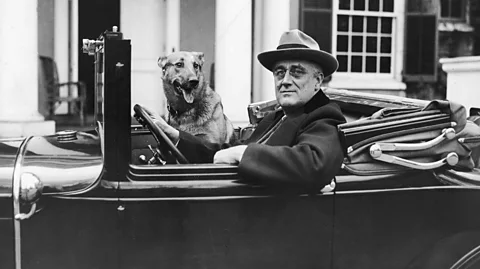
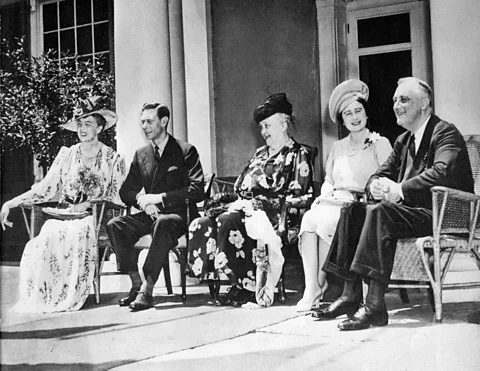
The picnic took place the next day, 11 June, after the Roosevelts and the royals attended Sunday service at St James Church, Hyde Park. According to Sally Beddell Smith's book George VI and Elizabeth: The Marriage that Shaped the Monarchy, Roosevelt drove the king and queen to Top Cottage, his hideaway three miles from the main house, in his car, specially equipped with hand controls, and the whole party – Roosevelt farm servants and a few neighbours were included – ate outside the cottage under the high trees.
 Alamy
AlamyThe king removed his tie, chomped down on his hot dogs, drank beer, filmed some home movies, and afterwards, according to The New York Times "clinched the informality of the outing by going swimming with the president in the spring-fed tile pool". The queen, unlike her husband, resorted to a knife and fork to eat her hot dog. And she didn't swim, relaxing instead in the shade.
The royal couple departed that evening, heading for Canada and a boat home. The first lady recalled in her memoir an "incredibly moving" scene. As the king and queen stood on the rear platform of their train, in the twilight, people in the crowd at Hyde Park station began singing Auld Lang Syne – the Scottish folk ballad about long friendships. The president called out: "Good luck! All the luck in the world!"
More like this:
For their part, the royals were delighted with the visit. "The king and queen, having been quite nervous, left Hyde Park with the gratifying feeling that they conquered enemy territory and were imposters no longer," Kunz tells the BBC. "And the visit boosted the king's confidence in himself and his ability to do the job". This last proved vital once Germany invaded Poland and war was declared.
 Alamy
Alamy"My play is about aspiration," Nelson says of Springwood. "Roosevelt was an American president who understood his responsibility to protect the safety and humanity of the world… It's good to remember that there have been presidents like that."
President Roosevelt's one disappointment in the aftermath of the occasion was that although Americans now felt fondly towards the royals, he still faced an uphill battle on Capitol Hill trying to get direct aid for the British. Congress dragged its feet, agreeing to the Land-Lease Act only after two years in March 1941. It took the Japanese attack on Pearl Harbor that December for the full might of the United States to be lined up on the side of the Allies.
There's no doubt, though, that the visit was a watershed moment in US-UK relations. It was a soft-power triumph that laid the foundations for the "special relationship", and – despite a cultural difference or two – a feeling of mutual respect between the two countries.
--
If you liked this story, sign up for The Essential List newsletter – a handpicked selection of features, videos and can't-miss news, delivered to your inbox twice a week.
