'I locked myself in a toilet until we were afloat': The woman who stowed away on a ship to report on D-Day

 Getty Images
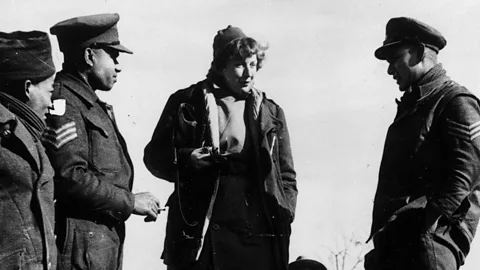
American journalist and author Martha Gellhorn tricked officers so that she could write firsthand dispatches from Normandy in June 1944. In 1991, she told the BBC about her daring subterfuge.
"Everyone was violently busy on that crowded, dangerous shore," writes Martha Gellhorn in a dispatch from the D-Day landings in June 1944. "We walked with the utmost care between the narrowly placed white tape lines that marked the mine-cleared path… The dust that rose in the grey night light seemed like the fog of war itself."
And then, she recalls something that makes the bleakest of moments a little more human. "We got off on to the grass, and it was perhaps the most surprising of all the day's surprises to smell the sweet smell of summer grass, a smell of cattle and peace and the sun that had warmed the Earth some other time, when summer was real."
It's an unexpectedly tender insight into the World War Two Allied landings on the Normandy beaches, revealing a quality of observation that marked out Gellhorn's writing. Her gift was to convey both the brutality and humanity of war in vivid accounts that focused more on everyday detail than troop movements or battle logistics.
During a career that spanned 60 years, the Missouri-born journalist and fiction writer covered conflicts including the Spanish Civil War, the Vietnam War, the invasions of Czechoslovakia and Finland, and the liberation of Dachau concentration camp. She also wrote for Vogue magazine and reported on the Great Depression for the US government, travelling through the Dust Bowl with the photographer Dorothea Lange.
Gellhorn's firsthand D-Day account came after a daring feat that reveals her strength of character. "I had sneaked on to a hospital ship," she told the BBC in 1991 at the age of 82, during a rare TV interview. "Somebody probably onshore asked me what I was doing, and I said, 'I'm just going on this ship to interview the nurses – a woman's feature.'
"You could always get by with that. It always sounded harmless and idiotic, and it worked a treat. 'I'm just doing the woman's angle,' and nobody's interested anymore. And then I just locked myself in a toilet until such time as we were afloat."
That strength of character also meant Gellhorn had an extraordinary personal life. She befriended the Roosevelts and stayed with them at the White House, cadged bed and breakfast from HG Wells, and married Ernest Hemingway – resolutely refusing to live under his shadow.
In competition with Hemingway
And throughout, she chronicled what happened in the darkest of times, in her own words becoming "a walking tape recorder with eyes" – noticing details that others might have missed in the heat of the moment, and powerfully describing how war affects ordinary lives.
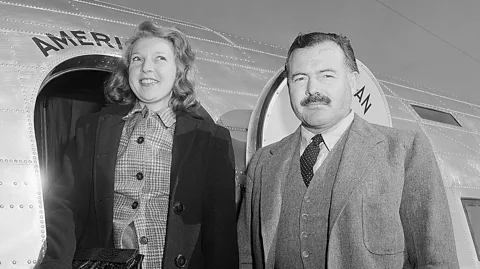
Gellhorn had been married to Hemingway for three years when she decided to travel to Europe in September of 1943. During their time living at Lookout Farm in Cuba, while he unsuccessfully hunted for German submarines using his fishing boat, she became increasingly restless.
 Getty Images
Hemingway had been the reason she began reporting on war – according to Gellhorn, "I went to Spain in March 1937 and became a war correspondent by accident." Her biographer Caroline Moorhead told the BBC that Gellhorn had travelled to Spain to be with him. "When she got there, Hemingway said, 'Why aren't you writing about the war?' And she said, 'Well, I don't know about weapons and battles.' So he said, 'Write about what you do know, which is people.'"
She had funded her trip to Spain in 1937 with payment for a Vogue article entitled Beauty Problems of the Middle-Aged Woman, which involved testing out a harsh chemical peel. Her next published article was called Only the Shells Whine, describing the reality of civilian life under siege in Madrid. She had found her vocation, telling a friend that she would "stick to misery which is my province… and the hell with the flesh".
In History
In History is a series which uses the BBC's unique audio and video archive to explore historical events that still resonate today. Sign up to the accompanying weekly newsletter.
Yet once they were married, in 1940, Hemingway wanted her to remain at home. She accompanied the US Fifth Army to the front in Monte Cassino, Italy in 1943, prompting him to cable her with the petulant question: "Are you a war correspondent or a wife in my bed?"
And by the time she returned to Cuba in 1944, the spouses were in competition with each other. Gellhorn had hoped to cover the D-Day invasion for the weekly magazine Collier's, but Hemingway stole the assignment, and while he flew to London, she ended up spending two weeks travelling to Europe aboard a Norwegian freighter filled with explosives.
Although the US military refused permission for female journalists to cover the Allied landings, Gellhorn wasn't deterred. "To me, all the people in the rear who make rules, they exist to be thwarted," she told the BBC in 1991. Her defiance meant she was on the first hospital ship to reach Normandy, arriving at Omaha Beach early on the morning of 7 June, and becoming the only woman correspondent on the ground at the D-Day landings.
Poetic snapshots and startling details
She was arrested by military police once she returned to London for travelling to Normandy without permission, and sent to a nurse's training camp. Yet she managed to hitch a lift to Italy with a British pilot to cover the Allied advance through Europe. "She didn't allow others – and herself – to let gender define her and her work," says the BBC's chief international correspondent Lyse Doucet. "In what was then a male-dominated profession, Gellhorn showed that women couldn't just report on war, they could excel at it."
Doucet believes Gellhorn has a lot to offer even now. "What drove her, what defined her journalism, still resonates today. For all that has changed in journalism since her time, the essence of good journalism is much the same as she saw it – with courage and moral clarity and her stubborn belief that the gold standard is on-the-ground, face-to-face journalism in the heat and dust, in the cold and dark."
More like this:
Being there allowed Gellhorn to bring to life the reality of Omaha beach in a way that Hemingway wasn't able to, having not set foot on shore (although his report ran first, on the cover of Collier's, a fortnight before hers). Her D-Day dispatch combined the terrifying magnificence of the scene with poetic snapshots of the minutiae.
Taking in the wider backdrop of troops unloading from ships, tanks clanking on the shore and "invisible planes flying behind the grey ceiling of cloud", she also picks out startling details, spotting a washing line strung up on a landing craft. "Between the loud explosions of mines being detonated on the beach, one could hear dance music coming from its radio. There were barrage balloons, looking like comic toy elephants, bouncing in the high wind above the massed ships."
Gellhorn's commitment to witnessing the horrors of conflict firsthand stayed with her throughout her life. Her 1959 collection of dispatches was called The Face of War to reflect that focus on the human experience of combat. "War happens to people, one by one," she writes in its introduction.
She was able to convey the sights, sounds – and smells – of wartime for ordinary civilians and soldiers. "It may seem obvious and essential now, but Gellhorn's focus on the people on the ground, not the powerful at the top, was her signature," says Doucet.
One striking line from her D-Day account relays how the young US soldiers were surprised by how much food there was in Normandy, unaware that the region was one of the great food-producing areas of France. "Everything was confused and astounding: first, there were the deadly bleak beaches, and then the villages where they were greeted with flowers and cookies – and often by snipers and booby traps."
It captures the nuance of how those who were there might have felt, beyond descriptions of military strategies or commanders' decisions. So too do her descriptions of the jokes shared by those on the beach. "One of the soldiers remarked that they had a nice foxhole about 50 yards inland and we were very welcome there, when the air raid started, if we didn't mind eating sand," she writes. "My companion, one of the stretcher-bearers from the ship, thanked them for their kind invitation and said that, on the other hand, we had guests aboard the LCT [landing craft, tank] and we would have to stay home this evening."
Those moments of humour reflect one way in which Gellhorn was able to withstand bearing witness to some of the greatest horrors of the 20th Century – an approach she describes in her essay The War in Finland. "The way people stay half-sane in war, I imagine, is to suspend a large part of their reasoning minds, lose most of their sensitivity, laugh when they get the smallest chance, and go a bit, but increasingly, crazy."
--
For more stories and never-before-published radio scripts to your inbox, sign up to the In History newsletter, while The Essential List delivers a handpicked selection of features and insights twice a week.
