'They ripped the best paintings out of their frames': The wealthy English heiress who stole art for the IRA

 Alamy
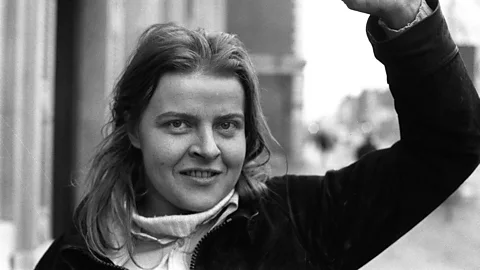
AlamyA former debutante groomed for a life of country houses, Rose Dugdale rejected her privileged background and joined the IRA. In April 1974, reported the BBC, she took part in "one of the largest art heists in history".
Born into privilege in 1941, Bridget Rose Dugdale looked destined for a life of comfort and convention. Taught by a French governess, educated at elite European finishing schools and ushered into high society as a debutante presented to the Queen, she was groomed for a life of country houses and social duty with a suitable husband of impeccable breeding.
Instead, by her mid-30s, Dugdale had burned every bridge to the world that made her. She gave away her inheritance, stole money from her own family, hijacked a helicopter to attack a police station, and played a central role in one of the largest art heists in history. It was a journey that would end with Dugdale helping to develop bombs for the IRA.
Dugdale's rejection of her establishment upbringing began when, as a debutante, she recoiled from its social ritual and extravagance. She was pushed reluctantly into taking part in the Season, a six-month whirl of parties and engagements designed to usher 17- and 18-year-old girls of the right wealth or background onto the marriage market. She later described her coming-out ball – her formal introduction into upper-class society – as "one of those pornographic affairs, which cost about what 60 old-age pensioners receive in six months".
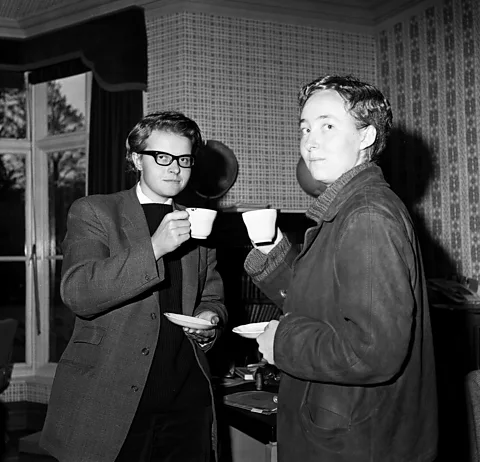
Contrary to her parents' plans for her, she went to the University of Oxford in 1959 to study philosophy, politics and economics. While she was there, she and a friend dressed in men's clothes to sneak into a debate at the male-only Oxford Union as a protest against the restriction. After a spell at a US university, she returned to London in 1964 to teach and to work as an economist in the Ministry of Aid and Overseas Development. The radical student riots of 1968 drew her towards the revolutionary left, and then came a pilgrimage to Cuba. Back in Britain, she immersed herself in radical politics, working quietly among deprived communities in Tottenham, north London, while concealing her own wealth. By 1973 she had given most of it away.
 Getty Images
Newly fixated on the Troubles in Northern Ireland, she helped organise a raid on her parents' home at their 800-acre estate in Devon, stealing about £82,000 worth of art and silver, equivalent to around £1.3m ($1.75m) today. Arrested and defiant in court, she told her father, who was in the witness box: "I love you, [but] at the same time, I hate everything you stand for." Addressing the judge, she said: "You have turned me from an intellectual recalcitrant into a freedom fighter." Rather than being made a political martyr, she walked away with a two-year suspended sentence.
Within months she had begun to foster links with the IRA. However, the militant Irish republicans were naturally suspicious of this upper-class English outsider and distanced themselves from her. In a bizarre escapade, she took part in an unsanctioned mission in January 1974 with some IRA-adjacent figures to hijack a helicopter in County Donegal.
They forced a civilian pilot to take off, with the aim of dropping milk churns filled with explosives on a police station just across the border in Northern Ireland, in Strabane, County Tyrone. But the helicopter was dangerously overloaded, and two churns had to be dumped into the sea after warnings that the aircraft might crash. The fuse was lit prematurely on another bomb and had to be pulled out in a panic. The final churn missed its intended target, dropping intact in a nearby garden and made safe by bomb disposal experts. Major Richard Earle of the British army later told the BBC's Midweek how soldiers referred mockingly to "this new military weapon, the air‑to‑ground milk churn".
Armed raiders burst into a stately home
But Dugdale soon became less of a joke. Back in England she was wanted over six arms-smuggling charges in Manchester, and the Army in Northern Ireland wanted her, too. By then she was operating with a loose network of Irish republicans, some in the IRA, some outside it. On the run and living in IRA safe houses in the Republic of Ireland, she was on the lookout for another opportunity to aid their violent armed campaign.
An article in the Daily Express on 27 February 1974 might have given her a few ideas. Under the headline, "Headaches for a wealthy man with an Old Master around the house," readers were informed how Sir Alfred Beit, 71, a member of the South African diamond family and a former Conservative MP, was one of only four private owners of works by Johannes Vermeer, the Dutch painter of The Girl with a Pearl Earring. "The Queen, a Rothschild and an American oil magnate are the others."
In History
In History is a series which uses the BBC's unique audio and video archive to explore historical events that still resonate today. Sign up to the accompanying weekly newsletter.
The article explained that while Sir Alfred was "wintering in South Africa", his Vermeer would be hanging in the National Gallery in Dublin. "On his return it will transfer to its usual place at his home on the Russborough estate in County Wicklow."
Late on 26 April 1974, four armed raiders burst into Sir Alfred and Lady Clementine Beit's stately home, striking him on the head with a revolver. The BBC's John Simpson reported: "Led by a woman with an accent which appeared to be French, they bundled Lady Beit into the cellar and tied up Sir Alfred and five of his staff, then proceeded to rip the best paintings out of their frames, apparently without any concern for their value."
Sir Alfred told Simpson: "I only heard one man, the one who knocked me on the head with the butt of his pistol and made some very offensive anti-capitalist remarks."
The woman with the suspiciously heavy French accent told her accomplices to grab the most valuable paintings in the collection: a Vermeer, a couple of Gabriël Metsus, a Goya, an early Velázquez, Frans Hals' Portrait of a Cavalier. "In one stroke, in a matter of minutes, you've lost one of the greatest collections of paintings in the world," said Simpson to Sir Alfred in the BBC's report. The baronet agreed, adding, "No money could possibly compensate for the loss of these beautiful objects."
The canvases taken by the gang were small enough to fit in their Ford Cortina estate car, and they sped off. Half an hour later, Sir Alfred struggled free and called the police, who set up roadblocks and put the airports and seaports on high alert.
A few days after that, a ransom demand arrived, calling for the transfer to a Northern Ireland prison of Marian and Dolours Price, two sisters jailed in England for an IRA car bomb attack on the Old Bailey in London in 1973.
Sir Alfred insisted that he would not have anything to do with the "violent and ruthless people who carried out the raid". Already wanted for the helicopter bombing, Dugdale was now also suspected of this robbery. Chief Superintendent James Murphy, who would later lead the ill-fated hunt for kidnapped racehorse Shergar, told reporters she had not been ruled out of his inquiries.
Married in the prison chapel
The search ended at a holiday cottage in Prison Cove, near Glandore in West Cork, about 190mi (306km) from where the paintings were taken. Two policemen were making routine door-to-door inquiries when they became suspicious. A local farmer told them he had rented the bungalow to a man and woman two days before the robbery had occurred. After calling for backup, the officers entered the empty property and spotted some documents referring to the paintings.
Supt Thomas Barrett told BBC News that when the woman returned home, she appeared flustered. A colleague told him of an interesting discovery outside. "In the car we found six bundles which appeared to be paintings. They were very well-packed and I feel they were ready for transport."
Dugdale recalled in 2012: "I remember I came out in my little wig and tried to speak French to let on that I was a foreign tourist, but apparently it didn't convince them."
More like this:
When she appeared in court for sentencing, she declared herself "proudly, incorruptibly guilty". She was jailed for nine years for receiving the stolen paintings, with another nine years to run concurrently for the helicopter hijack.
During her trial, she discovered that she was pregnant. The father was Eddie Gallagher, her accomplice in both crimes. Asked by Dugdale's biographer, Sean O'Driscoll, how their relationship developed, Gallagher said: "You know the way when you are thrown together and there is a shower of hounds chasing you to try and put you in prison, and you end up in the one bed. So what are you going to do, like? You can only talk for so long."
Dugdale gave birth to her son, Ruairi, in Limerick Prison, and, in 1978, Dugdale and Gallagher were married in the prison chapel.
Dugdale was released in 1980 and moved to Dublin to raise her son. While her early days as an IRA wannabe may have been faintly absurd, her later years took a deadlier turn. Sean O'Driscoll, author of Heiress, Rebel, Vigilante, Bomber: The Extraordinary Life of Rose Dugdale, told the BBC that there was evidence she was involved in developing IRA arms, describing how she regularly visited a County Mayo safe house where they would test weapons on the beach.
Dugdale died in March 2024, aged 83. That same month saw the release of Baltimore, a film depicting the art robbery, with Dugdale played by Imogen Poots. Dugdale was unrepentant to the end, telling O'Driscoll that "the happiest day of her life" was the helicopter hijacking. "It was the first time I felt like I was really at the centre of things, that I was really doing as I said I would do."
--
For more stories and never-before-published radio scripts to your inbox, sign up to the In History newsletter, while The Essential List delivers a handpicked selection of features and insights twice a week.
