The eye-popping churches of Communist Poland


 Maciej Lulko
Built under difficult conditions, the extraordinary Modernist edifices are an outstanding contribution to 20th-Century architecture, writes Clare Dowdy.
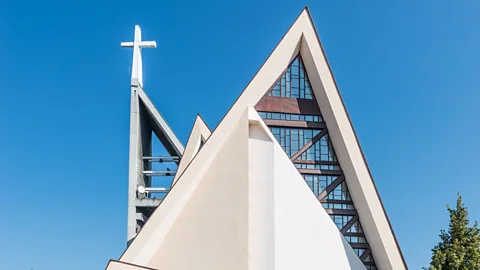
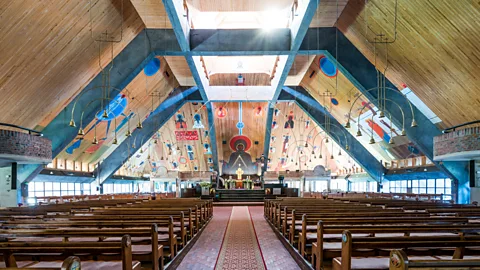
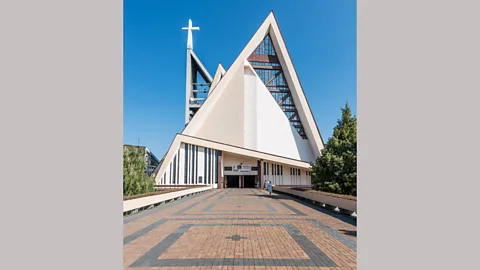
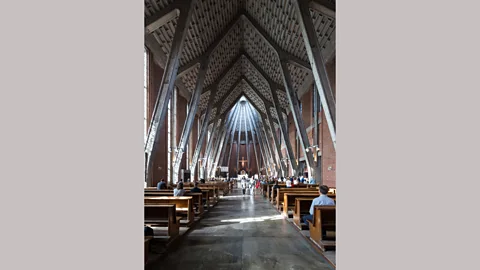
In towns and villages across Poland, 3,000 churches were built between 1945 and 1989. Bizarrely, this boom happened despite the fact that religion went against the ideology of the ruling Communist party. Neither legal nor prohibited, these churches – many of them eye-popping edifices that look as if they’ve arrived from outer space – were a godsend for architects.
More like this:
Under Polish Communism, there was no free-market economy. “It was impossible to set up an architectural practice,” explains Izabela Cichońska, co-author of the book Day-VII Architecture, that catalogues these churches.
 Igor Snopek
So architects – who spent their days in state design offices creating housing, schools, industrial facilities and cultural centres – worked on churches in their spare time. “It was a great opportunity for an architect to design, away from office structures,” she adds. “They could experiment with forms and take responsibility for their own designs, they could learn how to execute their own ideas and they had a chance to create their own working method.” In the long term, this would stand them in good stead.
Day-VII Architecture’s co-author Kuba Snopek backs this up: “For the most part, these buildings were created by a young generation of architects… who saw designing churches as a way to realise their creative ambitions. This kind of architecture thus needed an entirely new language of expression and postmodernism, which was infiltrating from the West.”
 Maciej Lulko
He and Cichońska spent a year and a half collecting data on these structures, many of which are unknown outside of their parish. This is the first time they have been treated as an architectural phenomenon. Despite or perhaps because of their quasi-clandestine nature, these buildings are “the most distinctive Polish contribution to the architectural heritage of the 20th Century,” says Snopek. “Through our project, we were trying to inflict a notion of pride, as many of these churches are the best pieces of architecture in their area.”
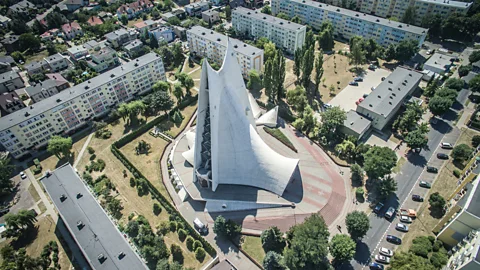
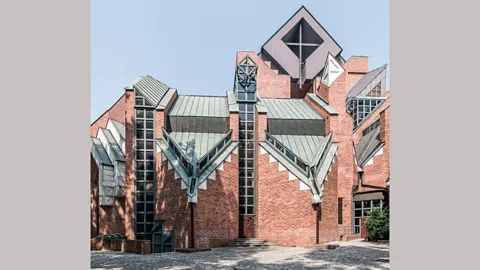
Most of them are in marked contrast to their concrete, Modernist, prefabricated neighbours: the vast housing estates that they served. Architect Wojciech Jarząbek – one of Poland’s leading representatives of postmodernism – compares the two experiences. “We had already had several years full of passionate work on a housing project for 23,000 inhabitants,” he says, “but this ended with strong frustration after seeing the very bad quality of execution, and not seeing on site any of the architectural details we had designed.” He wanted his Church of Our Lady, Queen of Peace in Wroclaw “to stand in contrast… to the surrounding architecture”.
 Maciej Lulko
Even when the housing and the neighbouring house of God had the same architect, the style was different. This was the case for Henryk Buszko and Aleksander Franta, who designed the Church of the Holy Cross and Our Lady Healer of the Sick in Katowice, which was surrounded by their own housing estate. “This example shows that 1980s Poland actually had two parallel architectures,” says Snopek, “one sponsored and controlled by the state, and the other by the Catholic Church.”
 Maciej Lulko
But if communism didn’t allow religion, how did these churches get the go-ahead? It was down to a mixture of strong faith and pragmatic politics. “All the PZPR (Communist Party) first secretaries in towns such as Glogów were deeply religious and became party secretaries just for the sake of having a career,” explains architect Jerzy Gurawski in Day-VII Architecture. He designed three churches including Glogów’s Church of the Blessed Virgin Mary, Queen of Poland. These functionaries needed somewhere to be married and to have their children baptised.
A new wave
Meanwhile, according to the authors, the biggest wave of church construction was triggered by a political event: the general walkouts organised by the influential labour union Solidarity in 1980. “In the aftermath of the strikes, the government made concessions to the Catholic Church,” explain the authors. “To alleviate the revolutionary mood… they began to issue previously unavailable building permits,” for churches.
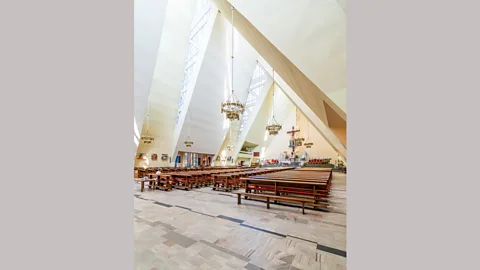
Despite the visual feast that the best of these churches represents, their construction is perhaps even more extraordinary than their design. State-controlled building equipment was not available, and nor was there access to building materials. Both had to be borrowed, scavenged or invented, Heath-Robinson-style.
 Maciej Lulko
As for labour, “those who opposed the regime rallied around the Church, and were inspired to support the construction of new places of worship,” relates architect Maciej Hawrylak in the book. Here, Solidarity indirectly helped again, winning free Saturdays (reducing the working week from six to five days), which allowed labourers spare time to work on their local church.
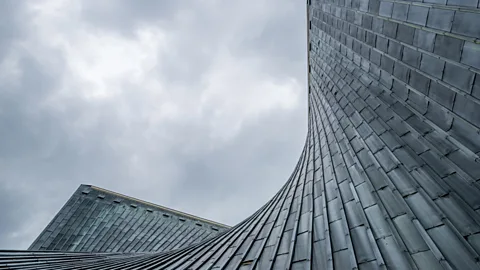
The hand-built methods using stone and brick were in sharp contrast to the concrete, prefabricated Modernism elsewhere on Polish building sites. “Given the lack of access to machinery, industry and modern-day materials, this move was both ideological and pragmatic,” according to the authors.
 Maciej Lulko
The results could be striking, such as the Church of Our Lady Queen of Peace in Wrocław by Jarząbek, Jan Matkowski and Wacław Hryniewicz, “a post-modernism form complemented by amazing stone and brick work”, says Snopek.
To rally volunteers, priests used the church pulpit on a weekly basis. Architect Marian Tunikowski recounts the unorthodox story of how his Church of Our Lady Queen of Poland in Świdnica got built. “Around 100 to 150 people arrived at the construction site, not knowing what they would do that day. Most of them had no practical experience in construction work.” As it was impossible to get hold of a crane, “this church emerged from a forest of timber scaffolding – just like in the Middle Ages,” he adds.
 Maciej Lulko
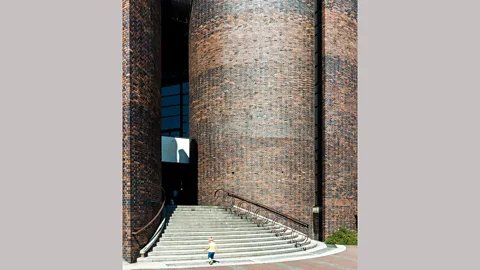
Stanisław Niemczyk – architect of five churches, including Church of the Holy Spirit in Tychy – had a similar experience when industrial cement mixers were unavailable. In the past, each household in Poland had a concrete mixer fashioned out of a bicycle wheel and a barrel, and these were put to use. “From dawn till dusk, we carried concrete in buckets until we managed to finish the frames,” he says in the book.
As well as being generally better paid than government work, church design could act as a springboard into a professional career in the 1990s, after the collapse of communism in 1989. “The vast majority of architectural offices (along with developers and small construction companies) who dominated the market in the 1990s had their roots in church construction,” says Snopek.
 Maciej Lulko
This was the case for Tunikowski, who set up his own practice. Likewise, Jarząbek, who went on to design the Solpol department store in Wrocław, seen as an icon of Polish postmodern architecture. “But the number one (project) in my portfolio is our church,” Jarząbek says.
Given the nature of the construction, building work often went on for years, and the last project wasn’t completed until 2004. They remain a snapshot in time, because no church has been built since this frenzied period. As Snopek puts it: “The country is saturated.”
Day-VII Architecture: A Catalogue of Polish Churches post 1945 is published by DOM
And if you liked this story, sign up for the weekly bbc.com features newsletter, called The Essential List, a handpicked selection of stories from BBC Future, Culture, Worklife and Travel, delivered to your inbox every Friday.
