“We say it is necessary to be united under the flag under which we are going to fight for our freedom.”
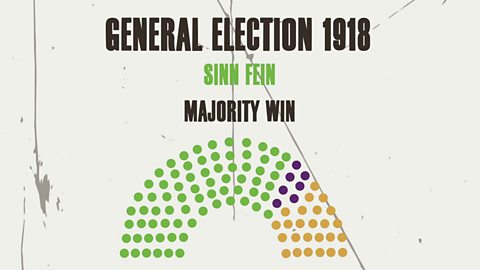
In the general election of 1918, the republican Sinn Fein party won a large majority. Their representatives did not go to Westminster.
They convened a new Irish parliament – the Dáil – in Dublin, declared Irish independence from Britain, and elected Éamon de Valera as president of the Republic.
Many Irish citizens stopped paying tax to the British government - donating instead to the Dáil’s Ministry of Finance.
The British government responded by declaring the Dáil to be an illegal parliament, and the Royal Irish Constabulary began to use heavy-handed tactics in an attempt to regain control.
The IRA - the nationalist paramilitaries fighting for the Dáil - responded by targeting army and police barracks and used the weapons they captured to arm more men.
In response, the British reinforced the RIC - recruiting five thousand ex-soldiers who had fought in World War One. They were known as the ‘Black and Tans’, and were led by ex British Army officers, known as the Auxiliaries.
Violence escalated into what became known as the Anglo-Irish War.
In 1920, in the town of Balbriggan, the IRA killed two police officers. The Black and Tans responded by burning over 50 homes and businesses, and beating two suspects to death.
As one Labour MP noted, British forces were engaged in “a policy of military terrorism”.
The IRA were equally brutal – shooting those they suspected of working with the British.
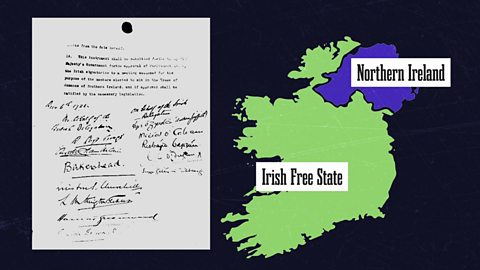
In 1920, Westminster passed the Government of Ireland Act. The act stated that Ireland would have home rule with a Parliament in Dublin. Irish matters would be decided in Ireland, but London would maintain overall control.
The Act also split the majority Protestant counties of Northern Ireland into a separate country with its own parliament.
But Irish Nationalists no longer saw the idea of Home Rule as an acceptable solution. On November 21st 1920, the IRA killed 14 people in a series of attacks across Dublin, targeting British intelligence agents.
The same afternoon, the RIC and the Black and Tans stormed a football match at Croke Park in Dublin. They opened fire on the crowd, killing and wounding nearly a hundred people. It became known as ‘Bloody Sunday’.
In 1921, after two years of conflict, the Anglo-Irish Treaty brought a ceasefire. The nation was divided, and both sides were exhausted by conflict - but a long term political settlement was still out of reach.
Description
After WW1, Ireland’s nationalist leaders had declared a republic. The fighting that followed became known as the Anglo-Irish War. This film explores the causes.
Now playing video 3 of 6