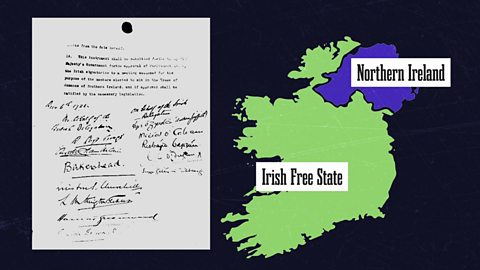
From its creation in 1921, Northern Ireland was very different to the rest of Ireland.
Two thirds of its population were Protestant and most were strongly Unionist - committed to remaining part of Britain.
With the Unionists strongly in control of the political system, the minority Catholic population were denied equal rights.
Most residents of Catholic areas were unable to vote. The boundaries of voting districts were carefully managed - so that all local council seats remained Unionist, even in largely Catholic areas.
The jobs in government and local government were reserved for protestants – and when council housing was allocated, protestants were given favourable treatment.
These inequalities led to stark sectarian divisions between the two populations of the country. By the 1960s, tensions were high.
In the Catholic communities, many people joined newly formed civil rights organisations, and began to campaign for equal rights.
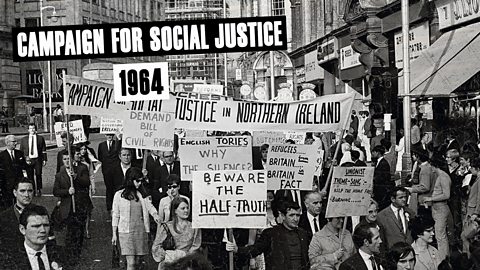
The Campaign for Social Justice was launched in 1964, demanding equal rights for Catholics in housing and jobs.
The Northern Ireland Civil Rights Association was set up in 1967 to fight unjust voting and employment laws. Its membership included moderate Unionists as well as Catholic Nationalists.
Inspired by the Black civil rights movement in the Southern states of the USA, big protest marches were organised across Northern Ireland.
The Unionist government saw these marches as a challenge to their authority – and they were often met with police brutality.
Tensions were also increased by the actions of paramilitary groups.
The IRA, who refused to accept that Northern Ireland should be part of Britain, had been targeting British Army buildings in attacks throughout the 1950s and early 60s.
Unionist groups saw their activity as a major threat to stability and peace - a threat that was increased by the demands of the new civil rights movement.
At the same time industrial decline was bringing economic hardship to Unionist communities. Some felt their problems were ignored by the civil rights groups, who were accused of being a front for nationalists.
In 1966, a new Protestant Unionist paramilitary unit was formed - the Ulster Volunteer Force.
When they fire-bombed a Catholic owned pub in Belfast that year, a new cycle of tit-for-tat attacks began.
Violence became the norm across Northern Ireland, in a protracted war between paramilitary groups - a war that would become known as The Troubles.
Description
By 1968, the increasing social tensions and inequalities between Catholics and Protestants was building to the long-running conflict known as The Troubles.
Now playing video 5 of 6