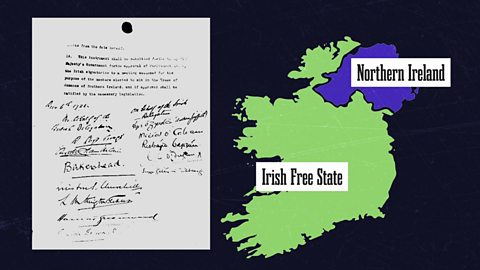
On the 6th December, 1921, the Anglo Irish Treaty was signed.
The treaty created two new nations – Northern Ireland, and the Irish Free State. Both would have their own parliaments, with limited powers, and both would remain part of the British Empire.
It also created a framework for peace – ending the fighting of the Anglo Irish War, which had lasted for 2 years.
The chief negotiator of the Irish Nationalist delegation was Michael Collins, who had led the IRA during the war.
The limited independence offered by the treaty wasn’t what he and his comrades had been fighting for.
But he believed that the treaty was the best deal Ireland could hope for at that time, and that it would lay the ground for full independence in the future.
He also knew that many of his fellow nationalists would not accept it, and would see him as a traitor.
When he signed, he commented that he was “signing my own death warrant”.
After weeks of fierce debate, the parliament of the Irish Republic - the Dáil - voted to accept the treaty.
The Irish Free State officially came into being on January 7th, 1922.
But it was a narrow victory – with close to half the delegates voting to reject the treaty.
Those who opposed the treaty were led by President of the Irish Republic Eamon de Valera, who immediately resigned when the vote passed.
The fight for freedom, he said, would continue - “and the Irish people, instead of fighting foreign soldiers, will have to fight the Irish soldiers of an Irish government set up by Irishmen."
The entire nationalist movement became split.
The members of the IRA who accepted the treaty became the national army of the Irish Free State. They were known as the ‘Regulars’.
The members who opposed it became the ‘Irregulars’.
Men who had been fighting alongside each other were now on opposing sides – led by Collins and de Valera, who had up to now been close friends.
In April 1922, the Irregular IRA occupied the Four Courts - Ireland’s most important law courts - in Dublin.
They wanted to provoke a crisis, and thought that if they forced the British to attack them, the Nationalist side would have to re-unite.
As the leader of the new Free State Army, Michael Collins felt compelled to prove that the government in Dublin was able to maintain control.
He gave the Irregulars an ultimatum to surrender – which they rejected.
On June 18th, 1922, Collins gave his forces the order to attack, using artillery borrowed from the British. The first shots of the Irish Civil War were fired.
Description
In 1922, the deep political divisions within the nationalist movements broke out into fierce fighting. This film explores the issues that led to the Irish Civil War.
Now playing video 4 of 6