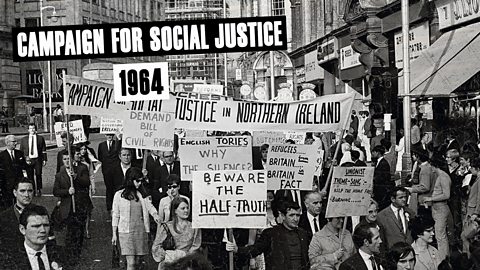
By 1968, the strictly controlled social order of Northern Ireland was being shaken.
While the Catholic civil rights movement was making its voice heard more strongly, the Protestant establishment was trying to make sure it could remain in power.
Finding political solutions was made very difficult by the fact that the Protestant and Catholic communities of Northern Ireland lived very separate lives.
Protestants and Catholics lived in separate housing estates, children went to segregated schools, and there was very little social mixing.
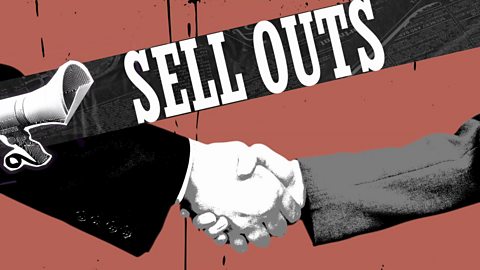
The sectarian traditions preached a distrust of the other side, and politicians who attempted compromise were easily accused of being sell-outs or traitors.
The rising tensions of the 1960s had seen paramilitary groups like the Ulster Volunteer Force and the Irish Republican Army position themselves as the defenders of their communities, with each side attacking the other.
As the paramilitaries on both sides engaged in violent attacks and sectarian murders, extremist beliefs and hatred became more entrenched.
Communities became more separated as peace walls were built to try to prevent conflict.
Since its creation in 1922, Northern Ireland had been governed by the Stormont Parliament, controlled by the Unionist parties.
But as violence worsened, the British government began to intervene directly.
The 1969 Downing Street Declaration stated that Northern Ireland would remain part of the UK unless a majority voted for change. It also promised equality of treatment for all citizen, and an end to the unfair political system that ensured Unionist control.
In 1969, the British Army were deployed onto the streets to keep the peace.
Initially, they were welcomed by the Catholic communities who had saw the largely Protestant Royal Ulster Constabulary as hostile.
In 1971, the army was given the power of internment - allowing them to imprison anyone suspected of terrorist activity without trial. It was a power they used almost entirely against Catholics and nationalists.
The internment policy only succeeded in increasing tension – and in 1972, the British government took a bolder measure.
The Northern Irish parliament was shut down, and Direct Rule was imposed from Westminster.
Further south, in Dublin the government of the Irish Republic proclaimed its insistence that Northern Ireland should become a part of a unified Ireland.
For many in the Unionist communities, this heightened the sense that they were losing control.
For Nationalists, internment and Direct Rule was further proof that the British state was at war with them.
On 30th January 1972, the Troubles became even more violent.
A civil rights group was marching in Derry to protest against the internment law. When some of the protestors threw stones at the British Army soldiers, they opened fire - first with rubber bullets, then with live rounds.
26 unarmed civilians were shot, and 13 killed instantly.
The day became known as Bloody Sunday.
The killings only served to further radicalise people on both sides. Paramilitary recruitment increased - and so did attacks.
Through the 1970s and into the 1980s, any path towards peace in Northern Ireland seemed impossible, and an entire generation grew up in the violent shadow of The Troubles.
Description
The deep divisions between the Protestant and Catholic communities in Northern Ireland made finding political solutions to ending The Troubles difficult. This film explores these issues.
Now playing video 6 of 6