Quick version
In 1919, the Dáil had stated Ireland's independence from Britain and declared that the countries were in an existing state of war. The ensuing conflict ran from 1919 to 1921 and is known as the Irish War of Independence or Anglo-Irish War.
- the newly-formed IRA targeted members of the Royal Irish Constabulary police force
- an auxiliary police force of ex-British Army men was formed that became known as the Black and Tans
Hundreds died in the conflict and many others were wounded or intimidated.
In November 1920, the British Parliament passed the Government of Ireland Act that partitioned six counties in the north of Ireland into a new self-governing entity – Northern Ireland.
On 21 November 1920, the IRA shot and killed 14 people suspected of being agents of British intelligence. As a reprisal, forces from the RIC, Black and Tans and Auxiliaries killed 14 civilians at a football game at Croke Park stadium. The day became known as Bloody Sunday.
Violence escalated on both sides. On 10 December 1920 martial law was proclaimed in Cork, Kerry, Limerick and Tipperary.
The Anglo-Irish Treaty of December 1921 finally brought the conflict to an end;
- An Irish Free State would be established.
- The new state would remain a dominion of the British Empire.
- Six counties in Ulster would form a separate self-governing entity - Northern Ireland.
The terms of the treaty divided the Irish republican movement and led to the Irish Civil War.
Learn in more depth
After Sinn Féin won an overwhelming majority at the 1918 General Election, in 1919 they set up their own provisional government, the Dáil Éireann. When the Dáil first met on 21 January 1919, it declared Irish independence, calling English rule an invasion:
We solemnly declare foreign government in Ireland to be an invasion of our national right which we will never tolerate, and we demand the evacuation of our country by the English Garrison. –Declaration of Independence
In response, the British Government declared the parliament to be illegal, leading to greater tensions.
On the same day the Dáil first met, two members of the Royal Irish Constabulary (RIC) were attacked and killed in Soloheadbeg, County Tipperary.
This marked the start of a guerrilla campaign of the newly-formed Irish Republican Army to attack British forces.
Britain attempted to treat the situation as a police matter, but as the IRA campaign grew, the British increased the size and strength of forces in Ireland. The growing conflict became known as the Irish War of Independence or Anglo-Irish War).
IRA campaigns, 1919 - 1921
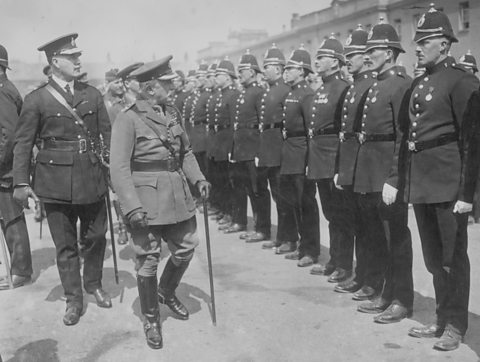 Image source, Walshe / Topical Press Agency / Getty
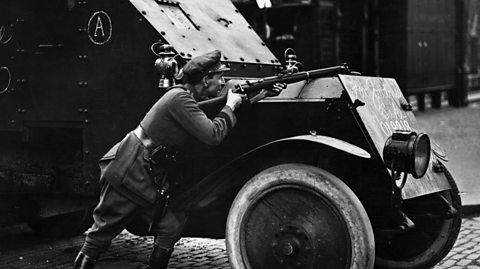
The Irish Republican Army was mostly formed of members of the Irish Volunteers. After the failure of the Easter Rising, and due to a lack of men, weapons and ammunition, they used guerrilla tactics against British forces and institutions rather than facing them in direct conflict. The Royal Irish Constabulary (RIC) was their principal target.
The IRA directly attacked RIC personnel and barracks, as well as intimidating and ostracising the constables, their families, and those who cooperated with them.
The pressures on the RIC were enormous. Altogether 682 of their number were injured, and 525 killed. In the first six months of 1920 alone, over 400 RIC barracks had been destroyed.
Inevitably this led to the RIC being weakened, and unable to deal with the violence of the IRA. Many constables resigned, and the RIC were essentially forced to withdraw from rural Ireland.
Image source, Walshe / Topical Press Agency / GettyStrength of the IRA
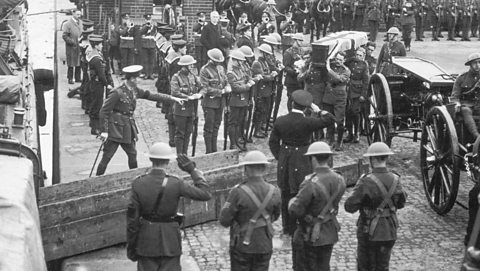 Image source, FPG / Getty
The IRA had a good deal of support:
- from groups such as Cumann na mBan (the Irish Women's Council), their women's wing, who provided food, shelter and medical aid to those volunteers on the run.
- Money and weapons, including Thomson sub machine guns, flowed from supporters in America.
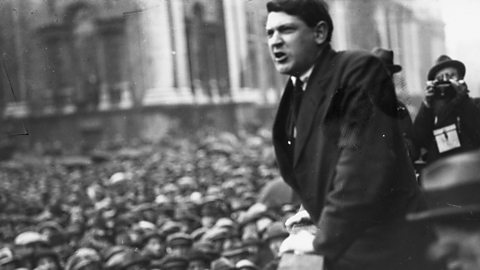
A key strength was their sophisticated intelligence wing headed by Michael Collins. Collins used a network of informants as sources; it penetrated even the centre of British rule at Dublin Castle and the police forces.
Collins set up the Squad, a group of hand picked agents who executed informants and assassinated policemen, particularly those involved in intelligence, from the Dublin Metropolitan Police.
In the course of the War of Independence, 15,000 volunteers were actively involved, with around 3,000 in service at any given time – enough to wage a significant campaign.
British reprisals were exploited as propaganda. Brutal treatment or killings carried out by the RIC and other forces were covered by independent journalists and contributed to growing criticism of the government's actions in Ireland, Britain and America.
Image source, FPG / GettyWeaknesses of the IRA
The IRA was not always as strong as it appeared, however.
Initially they did not have the full support of Sinn Féin and the Dáil. Many Sinn Féin members were opposed to IRA killings such as the ones during an IRA ambush of RIC forces at Soloheadbeg in 1919, for example.
Different branches of the IRA often acted independently and failed to work in a coordinated way. They lost support from many civilians due to the nature of their violence: 184 civilians were executed by the IRA on suspicion of spying for the British during the war.
Although, as noted, over 15,000 people engaged in IRA violence during the conflict, it’s estimated that this figure was only 3,000 at any one time, with over 5,500 volunteers arrested and in British custody by the spring of 1921.
Nevertheless, perception of their strength contributed to the British Government's decision to open negotiations in the summer of 1921, leading to a truce and, later, the Anglo-Irish Treaty of 1921.
The role of the Black and Tans
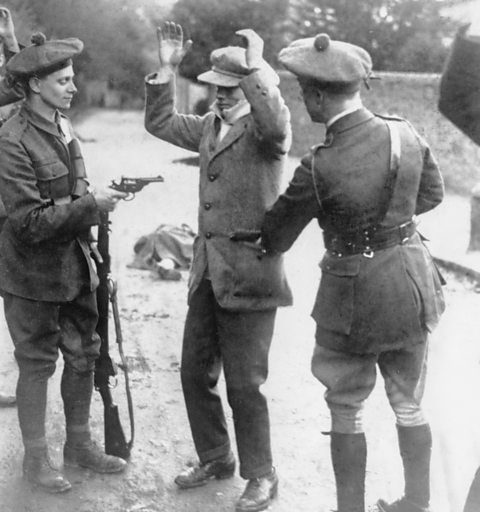 Image source, Topical Press Agency / Getty
Initially the conflict in Ireland was not regarded as a legitimate war, but instead a ‘policeman’s job’.
This meant that the Royal Irish Constabulary were responsible for trying to uphold British rule in the face of a type of violence they were not trained for.
The British Government responded in stages to the IRA's action:
- In autumn 1919, the RIC were equipped with motor vehicles, rockets, bombs and shotguns.
- By January 1920, the government launched a recruitment drive in Great Britain to attract ex-soldiers to join a new force to support the RIC.
- By the end of March 1920, an additional force of around 5,000'Black and Tans' (named after the colour of the makeshift uniforms) had been deployed to Ireland. Eventually this number rose to around 10,000.
This force quickly acquired an unenviable reputation for ill-discipline and brutal behaviour:
- Recruitment was rushed and selection procedures had been increasingly relaxed.
- Some of those who enlisted had been brutalised by war
- Most were ignorant of Ireland and ill-trained.
- They were attached to scattered RICA barracks, mainly in the south west, under no effective control from police or army officers.
The Black and Tans were associated with brutality and reprisals. For example, in September 1920, after the shooting of two police officers in Balbriggan, to the north of Dublin, the Black and Tans raided more than 50 homes and business in the town, looting or burning them. There were beatings of civilians, and two local men were killed. The incident became known as the ‘sack of Balbriggan’.
There was considerable international media coverage of atrocities committed by the Black and Tans, and The Times newspaper was particularly vocal in their condemnation. Their action was also criticised by opposition politicians in Westminster.
Image source, Topical Press Agency / GettyBritish response to violence in Ireland
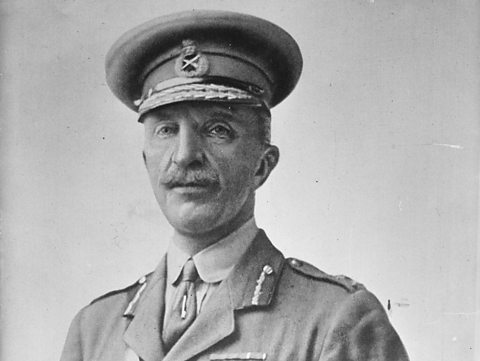 Image source, Sepia Times / Getty
Prime Minister Lloyd George let the reprisals of the Black and Tans continue. Field Marshal Wilson, an Irish Unionist and senior member of the British military, was critical of this approach, arguing that by supporting the poorly trained Black and Tans the British Government “embarked on a suicidal policy that would lead to the British being put out of Ireland”.
in July 1920 a second force, the Auxiliaries, was set up. They were better-paid than the Black and Tans and recruited from demobilised army officers. Eventually 1,900 men were enlisted and these were divided into 15 heavily armed and mobile companies, and deployed in the ten Irish counties where the IRA was most active.
Like the Black and Tans, its members were also ill-trained for guerrilla warfare, and knew little of Ireland. Though under nominal RICA control, they generally operated independently and they also established a reputation for drunkenness and brutality.
Meanwhile, during 1920, troop numbers in Ireland were steadily increased and their powers extended. In August, they were empowered to intern citizens without trial and court-martial those suspected of political offences.
These moves increased the feeling among Irish people that they were being oppressed, without doing much to stop the violence. It ought to be noted, however, that the British Government did take some steps to curb the violence, some of which saw limited success.
Viscount FitzAlan, a prominent Conservative politician, became the last Lord Lieutenant of Ireland – the most senior leader of British authority in Ireland. He was a Roman Catholic (the first to hold the post since the 1680s) and his appointment was seen as an effort to appeal to more moderate Irish people. FitzAlan was vehemently opposed to British attempts to ‘counter terror’, and he attempted to control the British crown forces in Ireland.
Approximately 18% of the Black and Tans were disciplined for their poor behaviour, and 8% dismissed. By this time, however, the damage had already been done.
Image source, Sepia Times / GettyGovernment of Ireland Act 1920
The most significant legislation that attempted to deal with the situation in Ireland was the Government of Ireland Act, agreed in Westminster in November 1920, and enacted on 23rd December 1920.
This partitioned Ireland in two, with North and South each having their own parliament.
Northern Ireland would consist of six counties. These would elect representatives to their parliament at Stormont in Belfast using Proportional Representation.
This did lead to some stability, particularly by quelling the fears of Unionists in the six counties. But it did nothing to suppress the tide of violence that had gripped Ireland by that point.
Nationalists in the north felt abandoned and fearful of their new status as a minority in the new Northern Ireland state.
Republicans across the island did not believe the new act went far enough, and were furious at the partition of Ireland.
Had the Government of Ireland Act been enacted in 1914, it might have been more positively viewed as a realistic compromise. But it didn’t take account of the radicalisation that had occurred during and after the war.
Bloody Sunday, 21 November 1920
On 21st November, Michael Collin's Squad carried out an organised attack on a group of British Intelligence officers, known as the Cairo Gang.
20 men were targeted in shootings at a range of addresses in and around Dublin. Fourteen men were killed, including six intelligence agents and two members of the Auxiliary Force.
Later that day, forces from the RIC, Black and Tans, and Auxiliaries were sent to a Gaelic football match at Croke Park. When they entered the ground, some fired indiscriminately into the crowd. 14 people were killed and 60-100 were injured.
That evening, two IRA members, Peadar Clancy and Dick McKee, and another man, Conor Clune, died in the custody of the Auxiliaries. The British Government claimed they were shot while trying to escape, but evidence suggested they had been tortured, and some saw their deaths as revenge killings.
On 9th December, two lorries transporting Auxiliaries were ambushed by an IRA ‘flying column’ in County Cork, killing all but one of the occupants.
On 10th December, the British Government felt compelled to declare martial law over much of south-west Ireland.
One day later Auxiliaries and Black and Tans entered Cork and sacked and burnt part of the city centre.
Later the British Government sanctioned ‘official reprisals’; if an IRA ‘outrage’ occurred, troops were given authority to blow up the property of those suspected of involvement.
The Anglo-Irish Treaty, 1921
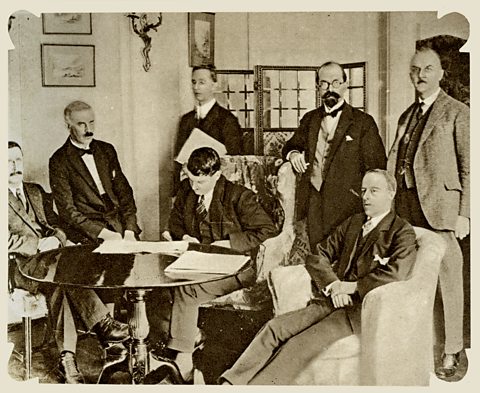 Image source, Culture Club / Getty
Signed in December 1921, the Anglo-Irish Treaty ended the hostilities and violence that had erupted in 1919.
Negotiated by senior figures of the British Government and Irish Parliament, the treaty acknowledged the creation of a sovereign Irish Free State that remained a dominion of the British Empire. It also provided an opt-out for the six Irish counties that had comprised the self-governing territory of Northern Ireland as recognised in the Government of Ireland Act 1920.
While the treaty ended the Anglo-Irish conflict, it led to deep division in the Irish republican movement. There were many, including the President of the Irish Republic, Éamon de Valera, who rejected the terms of the treaty. This divisions would result in the Irish Civil War.
Image source, Culture Club / GettyTest your knowledge
Quiz
Recap what you have learned
In 1919, the Dáil had stated Ireland's independence from Britain and declared that the countries were in an existing state of war. The ensuing conflict ran from 1919 to 1921 and is known as the Irish War of Independence or Anglo-Irish War.
- the newly-formed IRA targeted members of the Royal Irish Constabulary police force
- an auxiliary police force of ex-British Army men was formed that became known as the Black and Tans
Hundreds died in the conflict and many others were wounded or intimidated.
In November 1920, the British Parliament passed the Government of Ireland Act that partitioned six counties in the north of Ireland into a new self-governing entity – Northern Ireland.
On 21 November 1920, the IRA shot and killed 14 people suspected of being agents of British intelligence. As a reprisal, forces from the RIC, Black and Tans and Auxiliaries killed 14 civilians at a football game at Croke Park stadium. The day became known as Bloody Sunday.
Violence escalated on both sides. On 10 December 1920 martial law was proclaimed in Cork, Kerry, Limerick and Tipperary.
The Anglo-Irish Treaty of December 1921 finally brought the conflict to an end;
- An Irish Free State would be established.
- The new state would remain a dominion of the British Empire.
- Six counties in Ulster would form a separate self-governing entity - Northern Ireland.
The terms of the treaty divided the Irish republican movement and led to the Irish Civil War.
More on Britain and Ireland, 1900 - 1985
Find out more by working through a topic