Quick version
The period of history in Northern Ireland known as 'the Troubles' lasted from the late 1960s to 1998.
There are multiple issues that contributed to 'the Troubles':
- Irish Republicans wanted the reunification of Ireland, while Unionists wanted to preserve ties to the rest of the UK
- Protestants and Catholics had segregated communities and separate schools
- Catholics experienced discrimination politically, economically, and socially
As the Troubles continued:
- rival paramilitaries were formed such as the UVF and UDA, and the IRA and Provisional IRA.
- the British Army was deployed on the streets of Northern Ireland's cities
- over 3,000 people died
- bombings and terrorist acts were committed in Northern Ireland and the British mainland
Republican paramilitary prisoners as political prisoners started new types of protest including hunger strikes. The deaths of hunger strikers, such as Bobby Sands in 1981, led to increased opposition to British involvement in Northern Ireland.
Increased electoral success for Sinn Féin convinced many that their cause could be better advanced through democratic action rather than violence.
Video - Obstacles to peace in Northern Ireland
Watch this video to find out more about the obstacles to peace, from within Northern Ireland, and from Britain and Ireland.
By 1968, the strictly controlled social order of Northern Ireland was being shaken.
While the Catholic civil rights movement was making its voice heard more strongly, the Protestant establishment was trying to make sure it could remain in power.
Finding political solutions was made very difficult by the fact that the Protestant and Catholic communities of Northern Ireland lived very separate lives.
Protestants and Catholics lived in separate housing estates, children went to segregated schools, and there was very little social mixing.
The sectarian traditions preached a distrust of the other side, and politicians who attempted compromise were easily accused of being sell-outs or traitors.
The rising tensions of the 1960s had seen paramilitary groups like the Ulster Volunteer Force and the Irish Republican Army position themselves as the defenders of their communities, with each side attacking the other.
As the paramilitaries on both sides engaged in violent attacks and sectarian murders, extremist beliefs and hatred became more entrenched.
Communities became more separated as peace walls were built to try to prevent conflict.
Since its creation in 1922, Northern Ireland had been governed by the Stormont Parliament, controlled by the Unionist parties.
But as violence worsened, the British government began to intervene directly.
The 1969 Downing Street Declaration stated that Northern Ireland would remain part of the UK unless a majority voted for change. It also promised equality of treatment for all citizen, and an end to the unfair political system that ensured Unionist control.
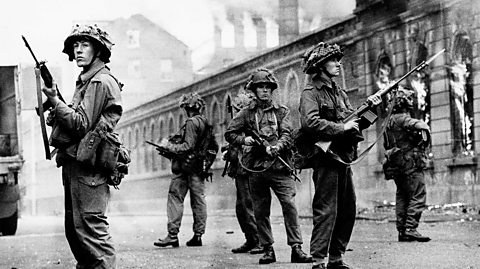
In 1969, the British Army were deployed onto the streets to keep the peace.
Initially, they were welcomed by the Catholic communities who had saw the largely Protestant Royal Ulster Constabulary as hostile.
In 1971, the army was given the power of internment - allowing them to imprison anyone suspected of terrorist activity without trial. It was a power they used almost entirely against Catholics and nationalists.
The internment policy only succeeded in increasing tension – and in 1972, the British government took a bolder measure.
The Northern Irish parliament was shut down, and Direct Rule was imposed from Westminster.
Further south, in Dublin the government of the Irish Republic proclaimed its insistence that Northern Ireland should become a part of a unified Ireland.
For many in the Unionist communities, this heightened the sense that they were losing control.
For Nationalists, internment and Direct Rule was further proof that the British state was at war with them.
On 30th January 1972, the Troubles became even more violent.
A civil rights group was marching in Derry to protest against the internment law. When some of the protestors threw stones at the British Army soldiers, they opened fire - first with rubber bullets, then with live rounds.
26 unarmed civilians were shot, and 13 killed instantly.
The day became known as Bloody Sunday.
The killings only served to further radicalise people on both sides. Paramilitary recruitment increased - and so did attacks.
Through the 1970s and into the 1980s, any path towards peace in Northern Ireland seemed impossible, and an entire generation grew up in the violent shadow of The Troubles.
Learn in more depth
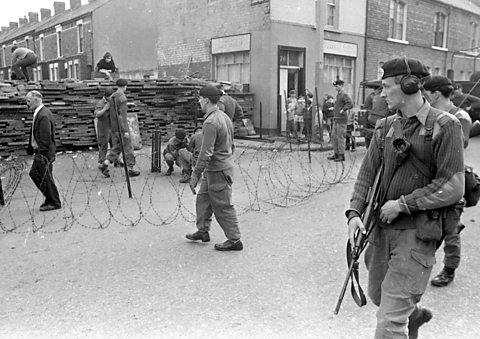 Image source, Independent News and Media / Getty
The period between the late 1960s and 1998 in Northern Ireland is often referred to as ‘the Troubles’. It was a period of conflict which saw 3,700 deaths and many times that number injured.
There were many complex reasons for the unrest and conflict:
- Nationalists in the North wanted reunification with the Irish Republic in the South
- Unionists in the North wanted to remain part of the United Kingdom
- the Unionist dominated Northern Ireland Parliament discriminated against the Catholic minority. This included gerrymandering, discrimination in employment and in housing
In 1967 the Northern Ireland Civil Rights Association was formed with a view to tackling these issues. Initially this group was led by people with a broad range of political perspectives, including a number of Unionists. Their demonstrations and leadership was increasingly dominated by republicans, with involvement from the IRA, which provoked a unionist backlash.
In 1968 and 1969 there were protests and riots that signalled the start of ‘the Troubles’.
Image source, Independent News and Media / GettyReligious and cultural differences in Northern Ireland
Sectarianism in Northern Ireland
During 'The Troubles' there was a Protestant majority in Northern Ireland. They were largely unionist and saw themselves as British. There was also a sizable Catholic minority. They were mostly nationalist and their beliefs aligned more with the Republic of Ireland.
Social and political division within a society based on religious or sectarian views and affiliations - often leading to hostility and conflict between these groups. between the two communities had existed for many centuries, going back to the Plantation of Ulster and the arrival of Scots and English Protestants in the 1600s. The communities had never really mixed and sectarianism meant the two communities were divided, and fearful of each other.
Sectarianism in Northern Ireland took several forms:
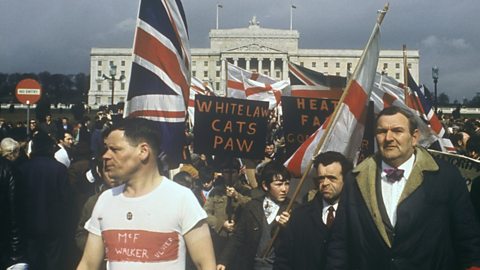
- Hostility and tension in certain communities or at ‘flashpoints’ between Catholic and Protestant areas. Hostility was often demonstrated through the flying of flags, to show that only one side of the community was welcome.
- Exclusion as some communities ‘stick together’ and don't associate with people from other groups.
- Discrimination as people were denied jobs or rights based on their religion.
Cultural division in Northern Ireland
There were also significant cultural differences between the two communities:
- Catholic communities were more likely to be involved in sports such as Gaelic football and hurling and the Irish language and activities such as Irish dancing were woven into their cultural heritage.
- Protestant communities were more likely to culturally engage with the Orange Order or Apprentice Boys, celebrating their heritage through marches, most notably on 12th July every year.
The marching season proved a particular flashpoint each year, especially where Protestant marches passed through or near to Catholic areas.
Segregation in Northern Ireland
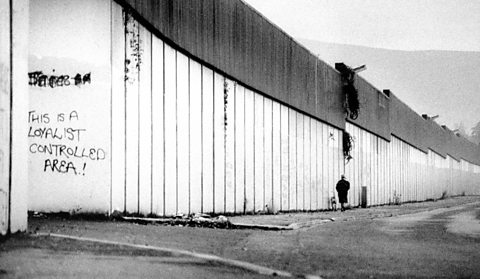 Image source, New York Daily News Archive / Getty
Differences between the two communities were cemented by segregated housing. This led to less mixing and therefore less understanding between Catholic and Protestant communities. As the Troubles progressed, the number of ‘mixed’ areas decreased.
This was reinforced by schooling that was also segregated along religious lines. Young people could grow up without really knowing or understanding people from a different community.
In 1969, when the British Army started building Peace Lines to prevent violence between the communities, these physical barriers only separated them more.
Image source, New York Daily News Archive / GettyPolitical leaders in Northern Ireland
The two communities were polarised further by politicians who used inflammatory language in their speeches.
- Reverend Ian Paisley, a Unionist leader, used oratory that was deliberately provocative.
- Gerry Adams, both the leader of Sinn Féin and allegedly a senior IRA official, used speeches to legitimise the use of violence.
Rhetoric on both sides reinforced differences between the two communities, and made them mistrustful of each other.
Suspicion, fear and hate grew, especially as paramilitary action increased. The IRA, UVF and other groups positioned themselves as defenders of their own communities at the same time as attacking the other.
The role of terrorism in Northern Ireland
A range of A person or organisation that operates like a military force, but is not part of a country's official armed forces. groups operated during this period. They were organised, secretive, and used a range of violent tactics, such as shootings, beatings, and bombings, in order to try to strengthen their causes.
Republican paramilitaries
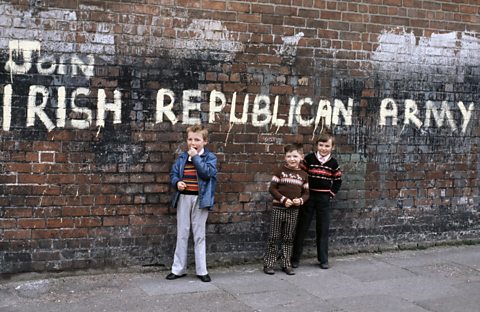 Image source, Michel ARTAULT / Getty
As paramilitary groups began to grow in size and support, splits began to emerge within some of them.
‘I Ran Away’ was an accusation levelled at the A republican paramilitary group which was determined to create an Irish Republic as proclaimed in the 1916 Easter Rising. because of its failure to defend Catholics during the violence of 1969.
Since the ending of its A campaign of violence waged by the Irish Republican Army (IRA) against targets in Northern Ireland which lasted from 1956 to 1962. in 1962, the IRA had become more interested in The ideas of Karl Marx who supported a system of rule where industries were run by the government for the good of the people..
However, some of its younger members were unhappy with this and wanted to take matters into their own hands, particularly the defence of People who believe their country should be independent from other nations. For example, Irish nationalists, who want Ireland to be fully independent of Britain. areas.
Towards the end of 1969, therefore, the IRA membership split and two new groups emerged: the Official IRA (OIRA) and the Provisional IRA (PIRA).
Official IRA
Made up mainly of older A republican paramilitary group which was determined to create an Irish Republic as proclaimed in the 1916 Easter Rising.members.
More interested in setting up an Irish A country which is not ruled by a king or queen. that would be run along The ideas of Karl Marx who supported a system of rule where industries were run by the government for the good of the people. lines.
Not as involved in the use of violence as the Irish republican paramilitary group formed when members split from the Official IRA (OIRA) in 1969., but until the group declared a ceasefire in May 1972 they still regarded violence as an option.
Provisional IRA
- Members believed that the Official IRA (OIRA) hadn’t done enough to protect the People who believe their country should be independent from other nations. For example, Irish nationalists, who want Ireland to be fully independent of Britain. community during the violence of the previous summer.
- With a younger membership, the Irish republican paramilitary group formed when members split from the Official IRA (OIRA) in 1969. saw itself as the defender of the minority community within Northern Ireland.
Towards the end of March 1970, the PIRA set out its objectives.
These were:
- The protection of the Catholic population.
- The achievement of Rights everyone is entitled to regardless of the colour of their skin, their beliefs, sexuality, sex or other personal characteristics. These rights could include - amongst other things - the right to vote, the right to free speech or the right to a good education..
- The destruction of the Northern Ireland Government.
- The creation of an Ireland free from British A system in which one country rules over other countries or territories, often by invasion or exerting power..
Image source, Michel ARTAULT / GettyIn terms of both size and activity, the most significant group was the Provisional IRA. Their objective was to achieve reunification with the rest of Ireland through force.
Often they targeted British security forces. In 1972 alone the PIRA was responsible for killing 100 soldiers, wounding another 500, and carrying out over 1,300 bombings.
Other republican terrorist groups also operated at this time, including the Official IRA, and the more left wing Irish National Liberation Army.
As the Troubles progressed, Republicans, particularly the PIRA, moved some of their activities to the British mainland.
Bombings, for example the pub bombings in Guilford and Birmingham by the PIRA in 1974, (killing 5 and 21 people respectively) stiffened the resolve of both British people and their governments not to ‘cave in’ to terrorism.
Clive Hanna describes his experiences of the Bloody Friday bombings in Belfast, 21 July 1972. Audio courtesy of Clive Hanna.
My name is Clive Hanna and I’m recording the events of 21st July 1972, on what became known as Bloody Friday.
I was working as an 18-year-old in the city centre of Belfast in that particular year. I’d started working in January, so I had heard car bombs going off many a time, but this clearly something well ramped up.
It was a lovely sunny day, and just into the afternoon we heard the first explosion. What we did was, there was about 30 of us working in the drawing office for the Ordnance Survey, and we all got below our desks, which had glass tops. By the end of that afternoon, every single glass desk was shattered. We hid in below them.
We counted about 18 or 19 bombs going off, and it was terrifying. We kept the windows open because that way it stopped glass from flying in. It went on for about two hours, but it was all over in about an hour and a half.
The transport system was very badly disrupted that day, and they let us go slightly early, and I usually got a train home, but I couldn’t. To give you the example, Great Victoria Street in Belfast, where the main train station was, was totally crowded. All buses and all trains were simply cancelled, where the bombs had hit the bus system and the train system.
The street itself, Great Victoria Street, is a great big broad street but it was crowded with people that afternoon, thousands upon thousands of people, and we had to walk on the roads. You could just see it looking down Great Victoria Street, it’s about a mile and half long and it was crowds of people having to take to the roads.
A lot of people had been sheltering in shops, and some had gone into pubs and gotten drunk during the bombing. So, it was just chaos. Complete absolute chaos. I had a 12 mile walk home that afternoon. It’s an afternoon I won’t forget, and it’s well etched into my memory.
One of the fellows I worked with, his father was killed in the incident. He was a bus driver, and he passed them coming in the road that particular morning. That was the last he saw of his dad.
We knew the Troubles had taken a turn, much for the worse, and Belfast city centre became, in the evenings after that especially, a complete ghost town. Just once work was finished, daytime, no-one wanted to go into the city centre.
I hope other people never have to go through the like of that again. It was just plain horrible.
Loyalist paramilitaries
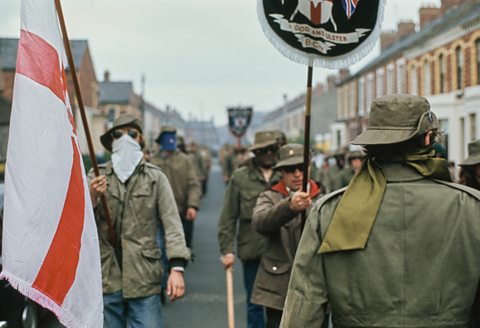 Image source, David Lomax / Getty
Unionist – or ‘Loyalist’ – paramilitaries began to emerge at this time in urban centres such as Belfast.
UVF
The Ulster Volunteer Force was by no means a new organisation. It could trace its origins back to the campaign against the Introduced into the Westminster Parliament in 1912, this Bill aimed to set up a Home Rule Parliament in Dublin..
The UVF:
- Re-emerged in the mid-1960s and grew in size as Northern Ireland Civil Rights Association’s campaign for Rights everyone is entitled to regardless of the colour of their skin, their beliefs, sexuality, sex or other personal characteristics. These rights could include - amongst other things - the right to vote, the right to free speech or the right to a good education. gained momentum.
- Re-emerged due to anger at the implications for Protestants of O’Neill’s reform programme.
- Believed that the ideal future lay in turning back the clock to the days of absolute unionist control of Northern Ireland.
- Sought to oppose the actions of A person who wants to establish an all Ireland republic completely independent of Britain.A person or organisation that operates like a military force, but is not part of a country's official armed forces. and to ensure that Northern Ireland remained a part of the United Kingdom.
The even larger Ulster Defence Association (UDA) was formed in 1971, with their paramilitary wing known as the Ulster Freedom Fighters (UFF).
These loyalist paramilitaries declared that their primary aim was to protect their community from republican paramilitaries, but the majority of their victims (approximately 500 people were killed by the UVF, 260 by the UDA) were Catholic civilians.
UDA
The Ulster Defence Association (UDA) was established in September 1971.
It:
- Aimed to defend A person who, in terms of culture, identity and politics, retains a strong loyalty to Britain and firmly opposes a united Ireland. areas from attacks by A person who wants to establish an all Ireland republic completely independent of Britain.A person or organisation that operates like a military force, but is not part of a country's official armed forces..
- Soon became very popular and within a year could claim a membership in excess of 30,000.
- Its size meant that the authorities saw the UDA as too large to ban.
Although the UDA was involved in attacks on members of the nationalist community, it remained a legal organisation for almost twenty years.
When such attacks took place, they were claimed using a cover name, the Ulster Freedom Fighters (UFF).
The UFF was outlawed in 1973.
Image source, David Lomax / GettyChanging republican strategy
The British Government policy of The UK Government policy of removing special category status for those convicted of terrorist crimes, and treating them in the same way as any other criminals, introduced in 1976.led to republican prisoners beginning a series of protests..
- the ‘blanket protest’ saw members of republican paramilitaries refuse to wear standard prison uniforms as a demand to be recognised as political prisoners
- the ‘dirty protest’ saw PIRA prisoners smearing excrement on the walls of prison cells in protest at having to The emptying by prisoners of their buckets of excrement when their cells are unlocked each morning.
- in 1980, the first hunger strikes began and a group of PIRA prisoners refused all food. The protest ended in confusion without achieving any concessions.
On 1 March 1981, a new hunger strike began with one prisoner, Bobby Sands refusing all food. New prisoners joined the strike at weekly intervals so as to maximise publicity and public sympathy.
On 5 March 1981, following the death of the MP for Fermanagh-South Tyrone, .Bobby Sands was put forward as a republican candidate for the seat.
On 9th April, Sands, standing as an Anti-H Block candidate, was elected as MP to The London location of the British government..
On 5 May, Sands died and over the next three and a half months, nine other prisoners lost their lives through hunger strike.
As time went on, without any concessions being granted, the families of those men still on hunger strike began to intervene to stop further deaths.
On 3 October 1981, the hunger strike was called off.
Within a few days of the strike’s end, the British Government announced concessions that meant terrorist prisoners were again treated differently from ordinary criminals.
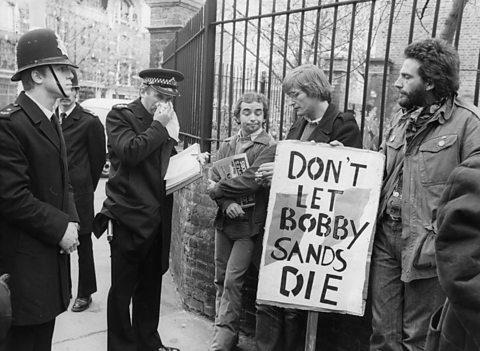 Image source, Central Press / Getty
Bobby Sands’ election as an MP suggested to republicans that becoming involved in politics might help them achieve their objectives.
In November 1981, An Irish republican party. Founded in Dublin in 1905, Sinn Féin came to prominence in the aftermath of the 1916 Easter Rising. Its subsequent growth in popularity led to Sinn Féin candidates winning the majority of Irish seats in the December 1918 General Election. Subject to a number of splits in subsequent years, the party maintained its association with the Irish Republican Army (IRA) and, post-1969, the Provisional Irish Republican Army (PIRA).. adopted the strategy of using both politics and violence to achieve its aims. This approach was called the The Armalite assault rifle (AR-18) and semi-automatic rifle (AR-180) were weapons used by the Provisional IRA during 'The Troubles' in Northern Ireland. and ballot box strategy.
Sinn Féin won seats and more votes in a number of elections. These included:
- Elections for a new Another name for a parliament. , held in October 1982.
- The 1983 General Election (where party leader Gerry Adams was elected MP for West Belfast).
- Local government elections, held in 1985.
The increase in An Irish republican party. Founded in Dublin in 1905, Sinn Féin came to prominence in the aftermath of the 1916 Easter Rising. Its subsequent growth in popularity led to Sinn Féin candidates winning the majority of Irish seats in the December 1918 General Election. Subject to a number of splits in subsequent years, the party maintained its association with the Irish Republican Army (IRA) and, post-1969, the Provisional Irish Republican Army (PIRA).. electoral support concerned both the British and Irish governments, as well as more moderate political parties in Northern Ireland including the An Irish nationalist party in Northern Ireland. When it was set up in August 1970, the SDLP was moderately left wing on social and economic issues. At the same time, the party sought political reforms within Northern Ireland and the eventual re-unification of Ireland. .
Both governments were worried that Sinn Féin might become Northern Ireland’s largest People who believe their country should be independent from other nations. For example, Irish nationalists, who want Ireland to be fully independent of Britain. party if something was not done.
At the same time, the levels of violence – while lower than the 1970s – still gave considerable cause for concern.
On 6 December 1982, 17 people, 11 of whom were soldiers, died when an Irish National Liberation Army (INLA) bomb exploded in Ballykelly, Co. Derry/Londonderry.
There were also bombing in mainland Great Britain:
- 20 July 1982: Eleven soldiers were killed by PIRA bombs in Hyde Park and Regent's Park, London,
- 17 December 1983: A PIRA car bomb killed six people outside Harrods department store, London.
- 12 October 1984: PIRA attempted to assassinate Prime Minister Margaret Thatcher, exploding a bomb in the Grand Brighton hotel during the Conservative Party conference. Five people were killed and Thatcher sustained minor injuries.
Image source, Central Press / GettyTest your knowledge
Quiz
Recap what you have learned
'The Troubles' lasted from the late 1960s to 1998.
Pre-existing issues contributed to 'the Troubles':
- Irish Republicans wanted the reunification of Ireland, while Unionists wanted to preserve ties to the rest of the UK
- Protestants and Catholics had segregated communities and separate schools
- Catholics experienced discrimination politically, economically, and socially
As the Troubles continued:
- rival paramilitaries were formed
- the British Army was deployed on the streets of Northern Ireland's cities
- bombings and terrorist acts were committed in Northern Ireland and the British mainland
Republican paramilitary prisoners as political prisoners started new types of protest including hunger strikes. The deaths of hunger strikers, such as Bobby Sands in 1981, led to increased opposition to British involvement in Northern Ireland.
Increased electoral success for Sinn Féin convinced many that their cause could be better advanced through democratic action rather than violence.
More on Britain and Ireland, 1900 - 1985
Find out more by working through a topic
- count12 of 14
- count14 of 14
- count1 of 14