Quick version
At this time two-thirds of the Northern Ireland population were Protestant. Unionist parties dominated in Northern Ireland.
Socially and politically, Catholics faced discrimination:
- Protestant and Catholic communities generally lived in separate areas.
- Council houses were allocated largely to Protestants.
- Catholics couldn't hold some government jobs.
- There was no 'one man one vote' system and some people had multiple votes.
- Landlords who owned several properties and business owners had multiple votes.
- University educated people had multiple votes.
- Electoral boundaries were 'gerrymandered' to keep Catholic communities marginalised.
The majority of house and business owners and university graduates were Protestant, and Catholics struggled to win representation in the Northern Ireland.
In the late 1960s, the Northern Ireland Civil Rights Association was formed fight for political representation for Catholics in Northern Ireland. It's aims were:
- 'One-man one vote' for local council elections.
- Fair allocation of council houses.
- End 'gerrymandering' of election ward boundaries.
- End religious discrimination in government jobs.
- End the Special Powers Act – the law that allowed the arrest of Irish people without trial.
- Disband the Ulster Special Constabulary – an almost exclusively Protestant reserve police force.
Video - The developing crisis in Northern Ireland in the 1960s
From its creation in 1921, Northern Ireland was very different to the rest of Ireland.
Two thirds of its population were Protestant and most were strongly Unionist - committed to remaining part of Britain.
With the Unionists strongly in control of the political system, the minority Catholic population were denied equal rights.
Most residents of Catholic areas were unable to vote. The boundaries of voting districts were carefully managed - so that all local council seats remained Unionist, even in largely Catholic areas.
The jobs in government and local government were reserved for protestants – and when council housing was allocated, protestants were given favourable treatment.
These inequalities led to stark sectarian divisions between the two populations of the country. By the 1960s, tensions were high.
In the Catholic communities, many people joined newly formed civil rights organisations, and began to campaign for equal rights.
The Campaign for Social Justice was launched in 1964, demanding equal rights for Catholics in housing and jobs.
The Northern Ireland Civil Rights Association was set up in 1967 to fight unjust voting and employment laws. Its membership included moderate Unionists as well as Catholic Nationalists.
Inspired by the Black civil rights movement in the Southern states of the USA, big protest marches were organised across Northern Ireland.
The Unionist government saw these marches as a challenge to their authority – and they were often met with police brutality.
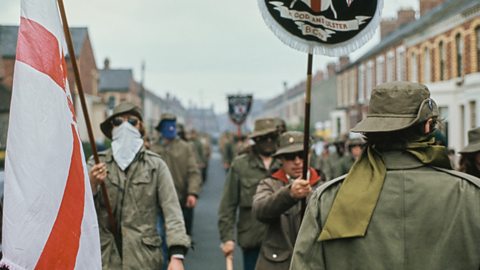
Tensions were also increased by the actions of paramilitary groups.
The IRA, who refused to accept that Northern Ireland should be part of Britain, had been targeting British Army buildings in attacks throughout the 1950s and early 60s.
Unionist groups saw their activity as a major threat to stability and peace - a threat that was increased by the demands of the new civil rights movement.
At the same time industrial decline was bringing economic hardship to Unionist communities. Some felt their problems were ignored by the civil rights groups, who were accused of being a front for nationalists.
In 1966, a new Protestant Unionist paramilitary unit was formed - the Ulster Volunteer Force.
When they fire-bombed a Catholic owned pub in Belfast that year, a new cycle of tit-for-tat attacks began.
Violence became the norm across Northern Ireland, in a protracted war between paramilitary groups - a war that would become known as The Troubles.
Learn in more depth
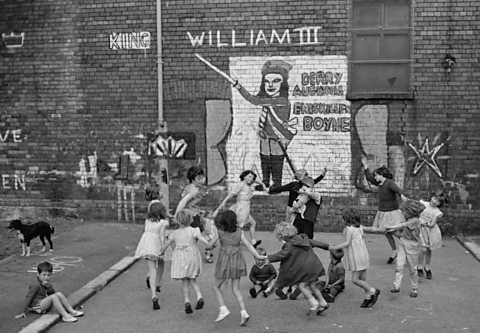 Image source, Slim Aarons / Getty
During this period, two-thirds of the Northern Ireland population were Protestant and one-thirdCatholic. This sizeable Protestant majority largely regarded themselves as British while the Catholic minority's beliefs aligned more with the predominantly Catholic Republic of Ireland.
Sectarian tensions between the two communities had existed for many centuries, going back to the Plantation of Ulster and the arrival of Scots and English Protestants in the 1600s. As such, therefore a significant barriers to overcome.
There were also significant cultural differences between the two communities:
- Catholic communities were more likely to be involved in sports such as Gaelic football and hurling.
- Catholic communities embraced the Irish language and Irish dancing.
- Protestant communities were more likely to culturally engage with the Orange Order or Apprentice Boys, celebrating their heritage through marches, most notably on 12th July every year.
Image source, Slim Aarons / GettyUnionist dominance in Northern Ireland
Since the partition of Ireland in 1921, Unionist parties had dominated in Northern Ireland. The Ulster Unionist Party (UUP) was the party of government from 1921 to 1972. Viscount Brookeborough was Prime Minister of Northern Ireland from 1943 until 1963.
The UUP controlled the parliament at Stormont with a large majority throughout this time, and the majority of MPs representing Northern Ireland in Westminster were from the UUP. They also controlled local government.
Unionist control was not only down to the size of the Protestant population.
Before 1969, local government elections were not held on a ‘one person, one vote’ basis:
- Ratepayers and their spouses had a vote, ie:
- homeowners
- landlords
- tenants in council housing
- Other adults did not have the vote (disenfranchised):
- renters of private housing
- lodgers
- adults living with their parents
- Landlords who owned multiple properties in several election wards had multiple votes – up to six in total.
- People with university degrees and business owners had an extra vote.
This meant that the poorest members of society often were not eligible to vote. This predominantly effected the Catholic community who were less likely to own their own property or businesses, and less likely to have attended university. Council houses were largely given to Protestant families, which also excluded Catholics from the vote.
To preserve Protestant majorities, the boundaries of election wards were subdivided and manipulated – known as gerrymandering – to divide up larger concentrations of Catholic communities and make them minorities, for example in Derry/Londonderry.
Economic issues in Northern Ireland
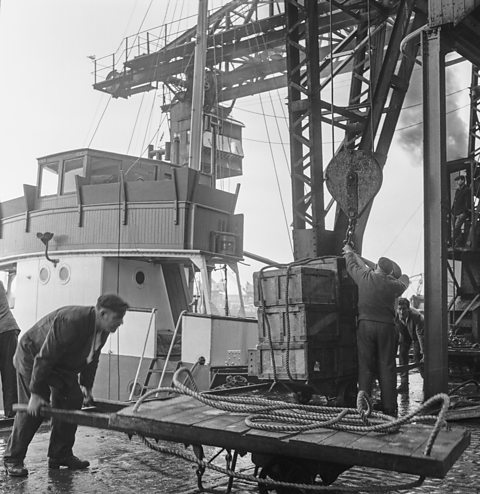 Image source, Mirrorpix / Getty
Northern Ireland had experienced an economic boom during World War II. Shipbuilding and linen industries and agriculture all contributed to the war effort.
By the 1960s, key industries were in decline. through global competition and changing demand.
Modernisation of farming and industry had led to increasing unemployment, including for working class Protestants. Brookeborough failed to address these economic issues. Increasing pressure from inside the UUP and UK Government forced Brookeborough to resign as Prime Minister.
Minister of Finance, Terence O’Neill became Northern Ireland's new Prime Minister. He brought new, more forward-looking and inclusive economic and social policies. This resulted in discontent from more conservative members of the UUP.
O'Neill introduced policies to improve infrastructure, support key industries and encourage investment. Employment discrimination in industries including shipbuilding and textiles meant the Protestant workforce was more protected that Catholics.
Unionist control of local councils meant that Catholics were routinely excluded from jobs in the public sector.
Despite government intervention, unemployment remained high (over 7%). To the west of Northern Ireland, where Catholics were a majority, the rate was higher (12.5%). In general, Catholics were more likely to be unemployed or in low-paid jobs.
Image source, Mirrorpix / GettyCultural and political difference in Northern Ireland
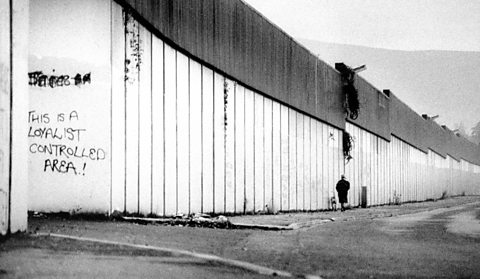 Image source, New York Daily News Archive / Getty
Northern Ireland's Catholic population was marginalised in all levels of government:
- Nationalists routinely took up 10 to 12 seats in the Northern Ireland Parliament, compared to around 40 Unionists.
- UK elections tended to return two Nationalist MPs, compared to 10 to 12 Unionists.
- Gerrymandering limited Nationalist involvement in local councils.
- Unionists excluded Nationalists from government and decision-making.
- Nationalists did not attend the Westminster Parliament, and sometimes boycotted meetings at Stormont.
- It wasn't until 1965 that the Nationalist Party took on role of official opposition in Stormont.
Nationalist rejection of partition left the Catholic population alienated from Stormont and Westminster government.Unionist concern about any movement towards nationalism meant the Protestant population was suspicious of Nationalist politicians, and any involvement or cooperation with the government in Ireland.
The Catholic community maintained its own institutions, such as the Church, separate Catholic schools, and their own clubs and cultural associations.
Differences between the two communities were cemented by segregated housing. This led to less mixing and therefore less understanding between Catholic and Protestant communities. As the Troubles progressed, the number of ‘mixed’ areas decreased.
This was reinforced by schooling that was also segregated along religious lines. Young people could grow up without really knowing or understanding people from a different community.
The two communities were polarised further by politicians who used inflammatory language in their speeches.
- the Reverend Ian Paisley, a Unionist leader, used oratory that was deliberately provocative.
- Gerry Adams, both the leader of Sinn Féin and allegedly a senior IRA official, used speeches to legitimise the use of violence.
Rhetoric on both sides reinforced differences between the two communities, and made them mistrustful of each other.
Image source, New York Daily News Archive / GettyO'Neil's social policies
Prime Minister Terence O'Neill knew that a modern, thriving Northern Ireland needed improved relations with the Republic of Ireland.
In January 1965, O’Neill met with the Taoiseach Seán Lemass at Stormont.
The two men discussed issues of common concern, such as the economy while their ministerial colleagues discussed issues such as tourism and electrical link-ups.
In December 1967, O’Neill travelled to Dublin to meet Lemass’ successor, Jack Lynch.
O'Neill also saw the importance of improved relationships between Protestant and Catholic communities:
- He met Cardinal William Conway. Archbishop of Armagh and, therefore, spiritual leader of the country’s Catholics.
- He offered the government’s official condolences when Pope John XXIII died in June 1963.
- He began to visit Catholic schools and hospitals, and increased their funding.
Sectarian violence
Tensions increased in 1966 with the commemorations for the 50th anniversary of the An armed rebellion, centred in Dublin during Easter 1916, by Irish republicans who wanted to end British rule in Ireland. and the World War One battle which lasted from 1 July to 18 November 1916..
Rioting broke out.
Then two Catholics were murdered in May and June 1966, the result of a series of gun attacks by the re-emergingA loyalist paramilitary organisation which could trace its origins back to 1912 and the fight against Home Rule in Ireland – it later re-emerged in 1966 and was active throughout the Northern Ireland 'Troubles'..
O’Neill responded by banning the organisation.
As the situation worsened, O’Neill found that his support within his own party was weakening.
- In September 1966, he revealed a plot by Ulster Unionist PartyA member of a party who sits in the rows of seats at the back of a parliament and who does not have an important position in the government or the Opposition. to remove him as leader.
- There were also growing rumours of opposition from Deputy Prime Minister, Brian Faulkner and Agriculture Minister, Harry West.
- By late 1967, O’Neill’s support within A person who believes the union between Britain and Northern Ireland should continue. in general and the Ulster Unionist Party in particular was dwindling.
- His party was divided over strategy, while opinion polls indicated increasing support within the unionist population for Rev Ian Paisley’s policies.
Civil rights in 1960s Northern Ireland
Video: An overview of the Northern Ireland Civil Rights Association
Title: Civil Rights: Marching for equality
Text on screen: The campaigners asked for reform in government as follows:
- One man, one vote
- Houses on need
- Jobs on merit
- An end to ‘gerrymandering’
- Repeal of the Special Powers Act
- The disbandment of the B-Specials (the police reserve force)
Reporter: Its demands are for reforms in Ulster’s way of governing itself. Particularly in local government. Its method, very new for Northern Ireland, is non-violent protest.
Reporter: What is the real complaint that you have in the civil rights movement?
John Hume, Civil Rights Campaigner, Derry, 1968: The real complaint is the minority rule in this city, and the feeling of the majority of its citizens that they are regarded as not fit to rule. This is done by the control of housing allocation, because the major, traditionally, has been the only person to allocate houses. This power has been held in his hands. He has allocated them on a segregated basis. He has segregated one religion from another, Catholic from Protestant, and in this way has turned a majority into a minority. Because two-thirds of this city are anti-Unionist, yet the Unionist party rule.
Ian Paisley, 1968: The whole civil rights association is a front movement for the destruction of the constitution of Northern Ireland.Reporter: It’s a front movement? There’s no merit in the case?Ian Paisley: There’s no merit whatsoever in the case in regard to discrimination because it’s the Protestants that are discriminated against. For instance. In the local newspaper here, the Belfast Telegraph, they refuse my Sunday evening advert, but they’ll not refuse an advert from a Roman Catholic Church.
William Craig, Minister for Home Affairs, 1968: Paisleyism represents a very extreme form of thinking in this country. Nevertheless, there is a great deal of moderate opinion that are opposed to the civil rights people and the way that they’re carrying out their campaign. And my anxiety is to keep the moderate section of the community happy, and to assure them that they can rely on the government and the forces of law and order to control the situation. I certainly do not want anything to happen
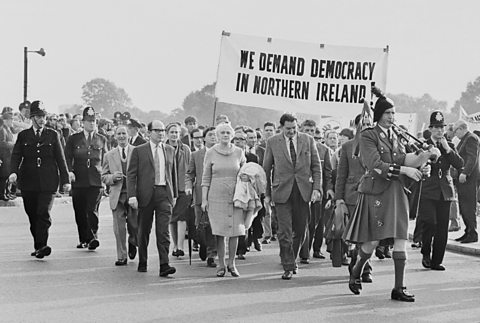 Image source, Express / Getty
The Northern Ireland Civil Rights Association (NICRA) was formed in early 1967, taking much of its inspiration from the ongoing civil rights campaigns against racial discrimination in America.
By 1967 in the US, a series of large scale marches and non-violent protests led by campaigners such as Martin Luther King Jnr had led the US Congress to pass laws outlawing public discrimination and guaranteeing voting rights for black Americans.
These successes were widely reported in Europe and watched closely by those in Northern Ireland wanting change.
The NICRA was formed with the intention of employing the same model of non-violent civil protest.
Image source, Express / GettyAims of the Northern Ireland Civil Rights Association
The NICRA claimed to be open to both Protestants and Catholics, although it was largely comprised of Catholics. It also stated that it was not trying to create a united Ireland.
Its aims were as follows:
- Achieve one-man one vote for local council elections. If this was introduced, anyone over the age of 18 would be allowed to vote.
- Ensure that local councils allocated council houses fairly.
- Stop the practice of gerrymandering election ward boundaries.
- Ensure that religion was not used as a factor when allocating government jobs.
- End the use of the Special Powers Act – the law that allowed the arrest of Irish people without trial.
- Disband the Ulster Special Constabulary – known as the 'B Specials', an almost exclusively Protestant reserve police force
- Introduce a system that allowed people to report local council violations in any of the above areas.
Responses to civil rights protests in Northern Ireland
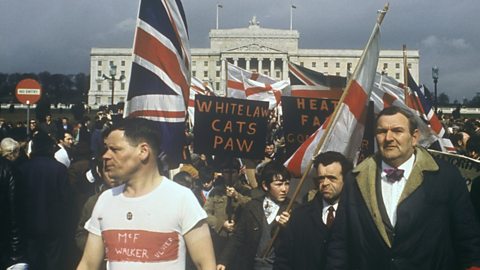
While NICRA gathered support from many among the Catholic communities and moderate Unionists of Northern Ireland, it also provoked angry responses from more hard line Unionists. Their fears were that NICRA:
- was a front to win support for a united Ireland
- would weaken Unionist control of Northern Ireland
Some NICRA protest marches were met with Unionist counter protests. Quite often violence resulted and there were several reasons for this:
- NICRA continued with marches even after they had been banned.
- Some marches went through Protestant areas and this was seen as provocative.
- Counter-demonstrations organised by Unionists sometimes came into contact with NICRA’s marches.
Ulster at the crossroads
In an attempt to address the rising tensions, on 22 November 1968 a Five Point Reform Programme was announced following discussions between the Northern Ireland Government and the British Government.
- A points system to ensure fairer allocation of council houses.
- Londonderry Corporation – Londonderry/Derry's local council – was to be replaced by a Development Commission.
- The removal of some parts of the 1922 Special Powers Act.
- The removal of additional votes for owners of businesses (along with other reforms to the operation of local government).
- The establishment of an ombudsman to examine complaints.
Despite these measures aimed at de-escalating tensions, the Prime Minister of Northern Ireland, Terence O'Neill, made a television announcement about the seriousness of the situation in the country.
He stated his opinion that the country faced a stark choice of peace within the United Kingdom, or being torn apart by riots and demonstrations.
Video: On 9 December 1968, Northern Ireland Prime Minister Terence O'Neill gave stern public address about the dangers faced by Northern Ireland's increasing sectarian tensions.
Onscreen text: The Prime Minister of Northern Ireland
Announcer: The Prime Minister of Northern Ireland, Captain, the Right Honourable Terence O’Neill.
Terence O’Neill: Ulster stands at the crossroads…
What kind of Ulster do you want? A happy and respected province in good standing with the rest of the United Kingdom, or a place continually torn apart by riots and demonstrations, and regarded by the rest of Britain as a political outcast? As always in a democracy, the choice is yours. Please, weigh well all that is at stake and make your voice heard in whatever way you think best so that we may know the views not of the few, but of the many.
Ulster stands at the crossroads.
Test your knowledge
Quiz
Recap what you have learned
Socially and politically, Catholics faced discrimination in Northern Ireland:
- Protestant and Catholic communities generally lived in separate areas.
- Council houses were allocated largely to Protestants.
- Catholics couldn't hold some government jobs.
- There was no 'one man one vote' system and some people had multiple votes.
- Landlords who owned several properties and business owners had multiple votes.
- University educated people had multiple votes.
- Electoral boundaries were 'gerrymandered' to keep Catholic communities marginalised.
The majority of house and business owners and university graduates were Protestant, and Catholics struggled to gain political representation.
Economic problems brought high unemployment to Catholic and Protestant communities and led to the election of Terence O'Neill as Prime Minister of Northern Ireland.
O'Neill's policies included improving relations with Catholic communities and with the Republic of Ireland. This concerned hard line Unionists and encouraged Catholics that change was possible.
In the late 1960s, the Northern Ireland Civil Rights Association was formed to gain political representation for Catholics in Northern Ireland. It's aims were:
- 'One-man one vote' for local council elections.
- Fair allocation of council houses.
- End 'gerrymandering' of election ward boundaries.
- End religious discrimination in government jobs.
- End the Special Powers Act – the law that allowed the arrest of Irish people without trial.
- Disband the Ulster Special Constabulary – an almost exclusively Protestant reserve police force.
More on Britain and Ireland, 1900 - 1985
Find out more by working through a topic
- count12 of 14
- count14 of 14