Quick version
The Anglo-Irish Treaty of 1921 ended the Anglo-Irish War but led divisions and the outbreak of the Irish Civil War of 1922.
- the British Government made more concessions than the Irish delegation expected
- Irish negotiators were given the right to accept terms on behalf of the Irish Republic
- President Éamon de Valera opposed the treaty and resigned in protest
The pro-treaty faction won the Irish General Election of 1922, boosting support for Michael Collins's Provisional Government.
In 1922 anti-treaty IRA forces engaged in acts of violence:
- Ireland's Four Courts building was occupied by armed soldiers
- Unionist MP, Sir Henry Wilson, was assassinated in London
- a general in the Irish National Army was kidnapped
Collins's actions to end the IRA occupation of Dublin's Four Courts occupation led to the beginning of the Irish Civil War.
Learn in more depth
Following the first convening of the Dáil Éireann in 1919, two years of fighting ensued between British forces and Irish republican forces; the Irish War of Independence.
In 1921, the Anglo-Irish Treaty was negotiated. It ended the hostilities but lead to deep divisions in the Irish republican movement. The following year, the Irish Civil War broke out.
This article explores:
- the role of the British Government
- the role of Michael Collins, leader of the Irish National Government
- the role of Éamon de Valera, President of the Irish Republic
Britain and the Anglo-Irish Treaty
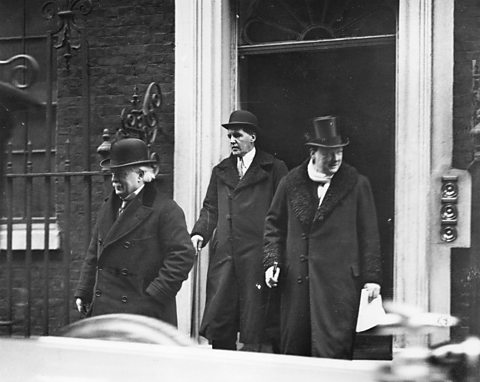 Image source, Central Press / Getty Images
The British side included David Lloyd George, Winston Churchill and Austen Chamberlain. It was far more experienced than the Irish side.
They treated the delegates from Sinn Féin with respect and seemed open to negotiations. This overcame some of the republicans' resentment of the British. This had previously tied the Irish rebels together.
The British were open to compromise on several points:
- ending direct rule of Ireland
- transferring control of law, finance and tax
- allowing the new Irish state to have its own police force and army
On other points the British would not move. The UK proposed that Ireland would be a dominion of the British Empire - a self-governing territory that would be loyal to the Crown. This was presented as a similar model to that of Canada. King George V would remain as head of state, represented by a Governor General.
Most controversially, the British insisted that members of the Irish parliament would have to swear an oath of allegiance to the British monarch.
Lloyd George felt that the people of Northern Ireland should not be coerced into being part of a united Ireland that they did not support. It was proposed that Northern Ireland would have a vote on whether it wished to join with the rest of Ireland, and that a Boundary Commission would look into the position of the border between Northern Ireland and Southern Ireland should Northern Ireland choose to remain separate.
Lloyd George used the threat of renewed conflict to pressure the Irish delegation into signing.
The British allowed a year after the Anglo-Irish Treaty was signed, up to the 6th December 1922, for all power to be handed over. This allowed for power to be dissolved incrementally.
Such an approach placated moderates, who were able to see evidence of change in Ireland, but infuriated radicals, who wished for things to be more immediate.
Image source, Central Press / Getty ImagesBritish response to republican violence
When there was an upsurge of IRA violence in the spring of 1922, the British Government chose not to intervene.
Things took a more dangerous turn when, on the 22 June, Field Marshall Sir Henry Wilson was assassinated by the IRA. A decorated war hero, Wilson was a serving MP, and that the assassination occurring in London made the situation even more serious for the British Government.
They threatened to reoccupy Ireland if the republican threat was not quashed by Collins and the Irish Government. The attack on the republican-held Four Courts in Dublin began just six days later, marking the start of the Irish Civil War.
However it was unlikely Collins bowed to British demands. It is more likely that the trigger instead was the kidnapping of a senior figure in the new Irish National Army, J.J. O’Connell, on the 26 June 1922.
Michael Collins and the Anglo-Irish Treaty
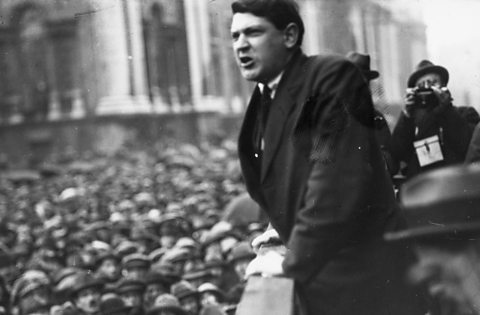 Image source, Independent News And Media / Getty Images
Michael Collins was head of IRA Intelligence. He saw himself as a military man rather than a politician. That changed when he became one of the Irish representatives during negotiations for the Treaty, along with Sinn Féin founder, Arthur Griffith.
Critics claimed that Collins was inexperienced when it came to negotiations, particularly in contrast to the British delegation., represented by the likes of David Lloyd George, Winston Churchill, and Austin Chamberlain.
When issues arose during the various meetings in London, Collins did not refer back to the cabinet in Dublin, as Irish President Éamon de Valera had requested. Critics have argued that this decision weakened the position of the Irish delegation, and led to the Treaty not securing as many concessions as many in Ireland would have liked.
While the treaty did not achieve everything Collins hoped, he saw it as a step towards an independent Ireland. He later said it brought 'freedom to achieve freedom’.
When Lloyd George raised the possibility of a return to conflict, Collins recognised the harm this would cause - the compromises of the treaty seemed preferable to him.
Image source, Independent News And Media / Getty ImagesMichael Collins as leader
Collins went on to lead the pro-treaty faction before it was ratified by the Dáil. Following the acceptance of the treaty, de Valera resigned as President leaving Collins to effectively run the government.
Collins stated that Britain was no longer the enemy. His belief that the treaty, despite not pleasing hardline republicans, was a starting point.
The decision to treat Britain as a partner to be working alongside was a departure from the previous years, and was unpopular to many who had fought during the 1919 – 21 Irish War of Independence.
Michael Collins: response to republican violence
The 1922 election was a decisive victory for those in favour of the treaty – 56 seats for the pro-treaty wing and 36 seats for the anti-treaty faction.
This gave Collins the authority to show strength against anti-treaty forces. Previously when local assassinations and kidnappings had occurred, or when pro-treaty garrisons had been attacked, he had tried to calm the situation and avoid conflict.
J.J. O Connell, Deputy Chief of Staff of the National Army, was kidnapped by the IRA on June 26 1922. Collins's response was immediate. He issued an ultimatum: unless the anti-treaty IRA left the Four Courts, returned those who had been kidnapped, and ceased their opposition to the government, they would be met with violence.
When the deadline passed without these demands being met, Collins ordered the bombardment of the Four Courts, the action that marked the start of the Irish Civil War.
Éamon de Valera and the Anglo-Irish Treaty
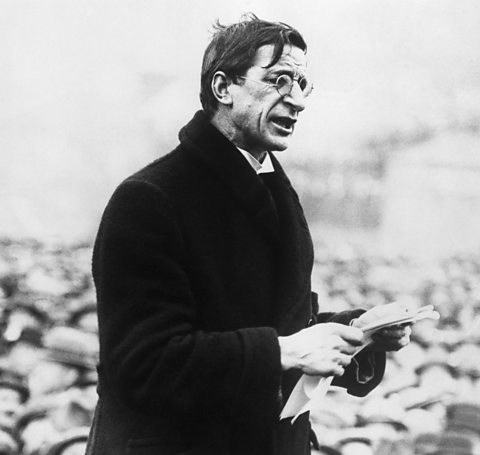 Image source, Bettmann / Getty Images
Irish President Éamon de Valera chose not to attend the Anglo-Irish Treaty negotiations in London at the end of 1921.
It was his decision to award the delegates plenipotentiary status – the ability to act on behalf of the government.
de Valera opposed any deal which would involve Ireland remaining part of the British Empire. He had instructed the Irish negotiating team to refer back to his cabinet on any question which created difficulties. When the Treaty was signed it had not been referred back to the Irish cabinet.
It has been suggested that some of his outrage at the treaty that they signed was down to his fury at feeling excluded from the process.
When the Irish delegates returned, de Valera issued a public statement which declared the agreement was in ‘violent conflict’ with the wishes of the majority of Irishmen. Coming from the hero of 1916, and the President of the Revolutionary Dáil (the parliament of the Irish Free State), his words must have made an impact with many in Ireland.
The treaty was ratified by the Dáil by an extremely narrow margin, revealing a deep split in both the parliament and the country at large. Rather than provide unity, de Valera’s subsequent resignation entrenched the divide.
Image source, Bettmann / Getty ImagesÉamon de Valera as leader
Éamon de Valera was a pivotal figure in Irish politics during the Anglo-Irish War and the Anglo-Irish Treaty negotiations. He would go on to become the undisputed political giant of Irish politics in the 20th century, serving as president three times.
However, historian Alvin Jackson suggests that “by May to June 1922 de Valera was increasingly marginalised by republican militants” who were not under his control.
In the run up to the 1922 General Election, de Valera entered an electoral pact with Collins. The pact was an agreement to attempt to maintain unity in the republican movement and it was Collins, and not de Valera, who broke that pact.
There is an argument that in those crucial weeks, it was not de Valera at the helm of the anti-treaty factions as they intensified their rural campaign against the Irish Government throughout 1922.
Éamon de Valera: response to republican violence
By leading the anti-treaty movement, de Valera provided it with legitimacy because of his standing in Irish politics, and popularity with the people.
De Valera went on a speaking tour of Ireland in the spring of 1922, where he continued to voice his concerns over the treaty, and engaged in violent rhetoric.
In one famous speech he declared the IRA would need to ‘wade through the blood of the soldiers of the Irish Government’. Such language helped to justify what would previously have seemed unthinkable: the IRA turning their weapons on fellow Irishmen.
Divisions within the Irish republican movement
When the Anglo-Irish treaty was presented to the Dáil to be debated, there was a split in opinion.
- Michael Collins led the faction arguing in support of the treaty.
- Éamon de Valera argued the faction opposing it.
- Sinn Féin was divided on the issue.
On January 7th, 1922, the Anglo-Irish Treaty was ratified by 64 votes to 57. Éamon de Valera resigned as President in protest, and was replaced by Arthur Griffith. Collins became chair of the new Provisional Government.
Divisions spread to the armed wing of the republican movement, the IRA. Generally, leaders at IRA headquarters followed Collins and were pro-treaty, but most local commanders were opposed.
The Collins faction formed the new National Army (sometimes referred to as the Free State Army). Those who were opposed to the Treaty became known as ‘Irregulars’. They formally split on the issue at a Convention on 26th March. At this same event, 16 IRA officers were elected in a direct challenge to Collins’ new National Army.
Although there had been sporadic violence throughout 1922, this intensified from April onwards. That month, Irregulars, led by Rory O’Connor, seized the Four Courts legal buildings in Dublin.
The Provisional Government did not step in, largely to avoid exacerbating tensions. Direct clashes were largely contained to isolated outbreaks in rural areas, although their frequency accelerated as summer approached.
On 26th June, four days after Sir Henry Wilson was assassinated, the IRA kidnapped General J.J. O’ Connell, the Deputy Chief of Staff in the National Army. The timing suggests it was this, rather than the assassination of Wilson, that prompted Collins to take action. The following day he issued an ultimatum to those in the Four Courts to withdraw, and on the 28th June he ordered that a bombardment commence.
Divisions within the republican movement are clearly at the heart of the Civil War that ensued, but these divisions did not make the Civil War inevitable.
The Republican movement had always been divided. There were strong differences on opinion over what the future of Ireland should look like.
- Arthur Griffiths was a ‘dual monarchist’.
- Éamon de Valera wished for a looser ‘extended association’ with the British crown.
- Cathal Brugha wanted no association with the British crown whatsoever.
Despite these divisions, the republican movement had managed to act as a unified force during the 1919 – 1921 campaign, suggesting that a political difference of opinion on its own need not have caused open war.
Test your knowledge
Quiz
Recap what you have learned
The Anglo-Irish Treaty of 1921 ended the two-year long Irish War of Independence but led to deep divisions in the republican movement. These resulted in the Irish Civil War of 1922.
- the British Government made more concessions than the Irish delegation expected
- Irish negotiators Michael Collins and Arthur Griffith were given the right to accept terms on behalf of the Irish Republic
- Prime Minister David Lloyd George raised the threat of a return to conflict if the treaty was not signed
- The treaty created the Irish Free State as a dominion of the British Empire, under the sovereignty of the British Crown.
- Northern Ireland was given a vote to decide if it wanted to be part of the Irish Free State
- President Éamon de Valera opposed the treaty and resigned in protest
The Irish General Election of 1922 saw the most seats won by the pro-treaty faction, boosting support for Michael Collins's Provisional Government.
In 1922 anti-treaty IRA forces engaged in acts of violence:
- Ireland's law courts – the Four Courts building – was occupied by armed soldiers
- Unionist MP, Sir Henry Wilson, was assassinated in London
- J. J. O'Connell, Deputy Chief of Staff in the National Army was kidnapped
With more political support, Collins took a harder line. His order to bombard the IRA's Four Courts and end the occupation led to the beginning of the Irish Civil War.
More on Britain and Ireland, 1900 - 1985
Find out more by working through a topic
- count12 of 14