Quick version
At the 1918 General Election the republican party, Sinn Féin, won an overwhelming majority:
- they formed an Irish parliament – the Dáil Éireann
- they declared independence from Britain and the formation of an Irish Free State
- they set up alternative institutions such as law courts
Irish Unionists saw this as a threat to their British identity. They wanted protection and support from the British Government.
The British Government declared the Dáil was illegal and it outlawed Sinn Féin.
But it also released all Irish political prisoners. This strengthening the movement against British rule.
Video - Ireland, 1918 to 1921
Watch this video to learn how growing tension after World War One led to the violence of the Irish War of Independence (Anglo-Irish War) before the Anglo-Irish Treaty was reached.
“We say it is necessary to be united under the flag under which we are going to fight for our freedom.”
In the general election of 1918, the republican Sinn Fein party won a large majority. Their representatives did not go to Westminster.
They convened a new Irish parliament – the Dáil – in Dublin, declared Irish independence from Britain, and elected Éamon de Valera as president of the Republic.
Many Irish citizens stopped paying tax to the British government - donating instead to the Dáil’s Ministry of Finance.
The British Government responded by declaring the Dáil to be an illegal parliament, and the Royal Irish Constabulary began to use heavy - handed tactics in an attempt to regain control.
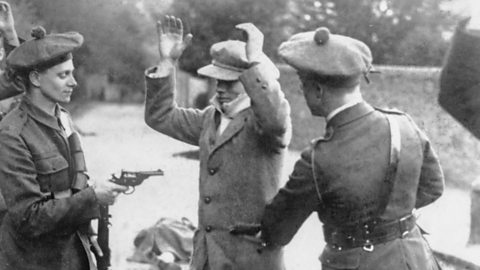
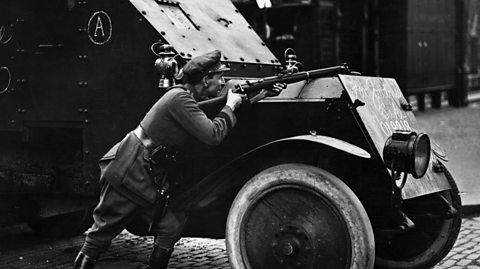
The IRA - the nationalist paramilitaries fighting for the Dáil - responded by targeting army and police barracks and used the weapons they captured to arm more men.
In response, the British reinforced the RIC - recruiting five thousand ex - soldiers who had fought in World War One. They were known as the ‘Black and Tans’, and were led by ex British Army officers, known as the Auxiliaries.
Violence escalated into what became known as the Anglo - Irish War. In 1920, in the town of Balbriggan, the IRA killed two police officers. The Black and Tans responded by burning over 50 homes and businesses, and beating two suspects to death.
As one Labour MP noted, British forces were engaged in “a policy of military terrorism”.
The IRA were equally brutal – shooting those they suspected of working with the British.
In 1920, Westminster passed the Government of Ireland Act. The act stated that Ireland would have home rule with a Parliament in Dublin.
Irish matters would be decided in Ireland, but London would maintain overall control.
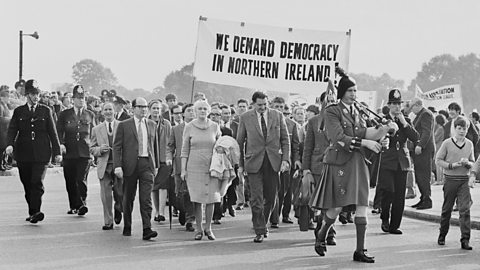
The Act also split the majority Protestant counties of Northern Ireland into a separate country with its own parliament.
But Irish Nationalists no longer saw the idea of Home Rule as an acceptable solution. On November 21st 1920, the IRA killed 14 people in a series of attacks across Dublin, targeting British intelligence agents.
The same afternoon, the RIC and the Black and Tans stormed a football match at Croke Park in Dublin. They opened fire on the crowd, killing and wounding nearly a hundred people. It became known as ‘Bloody Sunday’.
In 1921, after two years of conflict, the Anglo - Irish Treaty brought a ceasefire. The nation was divided, and both sides were exhausted by conflict - but a long term political settlement was still out of reach.
Learn in more depth
It is generally accepted that there was a significant amount of unrest against British rule before World War One. This can be seen in the widespread support for the Home Rule movement outside of North-East Ulster.
Such feelings intensified and became more radical during the war, as a result of events such as the Easter Rising and the anti-conscription campaign.
This radicalisation can be clearly seen in the 1918 General Election results that followed the war.
Ireland and the 1918 General Election
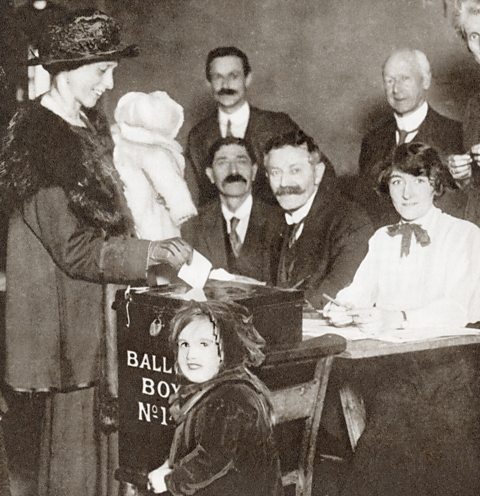 Image source, Universal History Archive / Getty
After the end of World War One in November 1918, a General Election was held. It was the first election in the United Kingdom of Great Britain and Ireland that allowed all men over the age of 21 to vote.
Sinn Féin, who had a more radical separatist agenda, secured 73 seats, whereas the more moderate Irish Parliamentary Party went from over 70 seats to just six.
Rather than securing a moderate Home Rule arrangement through parliamentary means, Sinn Féin advocated complete separation:
- withdrawing from the UK Parliament in Westminster
- establishing a constituent Irish assembly in Dublin
They also advocated using ‘any and every means available’ to remove British governance from Ireland. This included ‘military force’.
More people than ever were prepared to wage armed struggle against British rule, either by engaging in conflict themselves. or my supporting others who would.
It may be of note that the unemployment rate for demobilised servicemen in Ireland was 46%, compared to just 10% in the rest of the UK.
This could have increased resentment, and possibly even a willingness to take up arms against those who the soldiers had previously fought for.
This feeling existed not just in Ireland, but among the Irish a group of people who have come from their homeland to another place. in the USA. On a trip to the USA in 1920, Sinn Fein President Éamon de Valera was able to raise $5 million for the cause of ‘forcing the British out’.
Image source, Universal History Archive / GettyRole of the Dáil and the Declaration of Independence
Having won a majority in 1918 General Election, Sinn Féin established a new parliament for Ireland, the Dáil Éireann. This met at the Mansion House in Dublin. The Dáil was declared illegal by the British Government.
One of the first acts of Dáil Éireann was to issue a Declaration of Independence.
What did the Irish Declaration of Independence say?
Whereas the Irish people is by right a free people:
And Whereas for seven hundred years the Irish people has never ceased to repudiate and has repeatedly protested in arms against foreign usurpation:
And Whereas English rule in this country is, and always has been, based upon force and fraud and maintained by military occupation against the declared will of the people:
And Whereas the Irish Republic was proclaimed in Dublin on Easter Monday, 1916, by the Irish Republican Army acting on behalf of the Irish people:
And Whereas the Irish people is resolved to secure and maintain its complete independence in order to promote the common weal, to re-establish justice, to provide for future defence, to insure peace at home and goodwill with all nations and to constitute a national polity based upon the people's will with equal right and equal opportunity for every citizen:
And Whereas at the threshold of a new era in history the Irish electorate has in the General Election of December, 1918, seized the first occasion to declare by an overwhelming majority its firm allegiance to the Irish Republic:
Now, therefore, we, the elected Representatives of the ancient Irish people in National Parliament assembled, do, in the name of the Irish nation, ratify the establishment of the Irish Republic and pledge ourselves and our people to make this declaration effective by every means at our command:
We ordain that the elected Representatives of the Irish people alone have power to make laws binding on the people of Ireland, and that the Irish Parliament is the only Parliament to which that people will give its allegiance:
We solemnly declare foreign government in Ireland to be an invasion of our national right which we will never tolerate, and we demand the evacuation of our country by the English Garrison:
We claim for our national independence the recognition and support of every free nation in the world, and we proclaim that independence to be a condition precedent to international peace hereafter:
In the name of the Irish people we humbly commit our destiny to Almighty God who gave our fathers the courage and determination to persevere through long centuries of a ruthless tyranny, and strong in the justice of the cause which they have handed down to us, we ask His divine blessing on this the last stage of the struggle we have pledged ourselves to carry through to Freedom.
Alternative Irish institutions
In addition to setting up a formal parliament it was decided to establish Irish alternatives to other institutions of the British state. The hope was that the British versions would ‘wither away’.
Over 1000 law courts were set up by Sinn Féin as an alternative to the traditional justice system. Often a priest or lawyer presided over these courts. Their rule was enforced by the new Irish Republican Army.
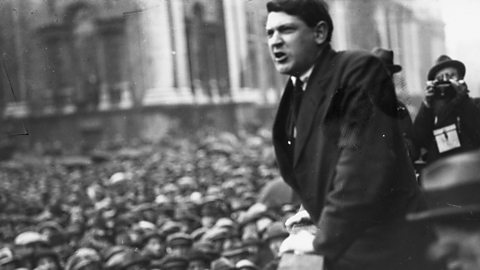
Taxes were to be diverted to the new Ministry of Finance, headed by Michael Collins. He was able to raise approximately £350,000, which supported the efforts of republicans fighting against the British in the ongoing Anglo-Irish War.
Weaknesses of the Dáil
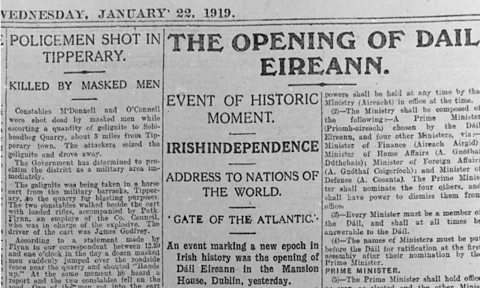 Image source, Hulton Archive / Getty
It is possible to overestimate the strength of Dáil Éireann.
- They failed to meet regularly, with only 21 sessions between 1919 and 1921.
- When they did meet, many members were absent, often because they were in prison or in hiding.
- Éamon de Valera himself was absent from Ireland between June 1919 and December 1920
The parliament lacked consistent leadership and was without the most respected and recognised Irish leader associated with it.
The Dáil failed to be recognised internationally. At the end of World War One, representatives of the Dáil were humiliated at the Versailles peace negotiations. When pleading the case for Ireland to be given national self-determination, the delegates from other nations did not recognise their legitimacy.
Although the nationalist/republican militia, the Irish Volunteers, had to take an oath to Dáil Éireann by August 1919, the Dáil had very little control over the Irish Volunteers.
Image source, Hulton Archive / GettyIrish Unionist attitudes after WW1
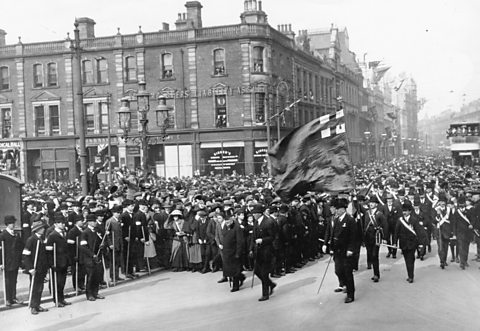 Image source, Hulton Archive / Getty
Attitudes of Irish Unionists also became more extreme after the World War One, particularly in Ulster.
In Ulster, Protestants made up 56% of the prewar population, but provided 73% of Irish recruits to the British war effort.
The Ulster Protestants were proud of the wartime actions of their 36th Ulster Division, and their service came to symbolise the loyalty of their community to the crown.
On the first day of the Battle of the Somme, 2,000 men of the 36th Ulster Division were killed on the first day alone. Almost half of Victoria Crosses awarded for bravery on that day were given to men of the 36th.
For many Ulster Protestants, this was seen as an argument that their ‘blood sacrifice’ ought to be rewarded by the exclusion of Ulster from Home Rule.
Of course, it was not only Ulster Protestants who fought and died for Britain: some 40,000 Irishmen of both religions did not return home.
However the Unionist community strongly believed that they, unlike the Catholic ‘rebels’ had proved themselves loyal to Britain, and expected to remain fully within the union when the war ended.
The contrast between the opposing views of unionists and nationalists were more Completely divided into groups with opposing views. than they had been before the war.
Image source, Hulton Archive / GettyResponse of the British Government
The response of the British Government to the unfolding crisis in Ireland was initially confused and contradictory.
The Dáil was declared illegal, and both Sinn Féin and the IRA outlawed.
However in March 1919, the British Government released all Irish political prisoners. But this strengthening the movement against the British and gave their political opponents a sense of legitimacy.
The lack of consistency in British action might be because the Ireland portfolio at this time was handled by a succession of junior ministers, Irish historian Ronan Fanning has argued this is because more established political figures would not touch such a difficult challenge.
Test your knowledge
Quiz
Recap what you have learned
At the 1918 General Election after the end of World War One, the republican Sinn Féin party won an overwhelming majority of Irish seats:
- they formed an Irish parliament – the Dáil Éireann
- they declared independence from Britain and the formation of an Irish Free State
- they set up alternative institutions such as law courts and a Ministry of Finance
Irish Unionists, many in Ulster, saw this as a threat to their British identity and wanted protection and support from the British Government.
The British Government declared the Dáil was illegal and it outlawed Sinn Féin.
But it also released all Irish political prisoners. This strengthening the movement against British rule.
More on Britain and Ireland, 1900 - 1985
Find out more by working through a topic
- count7 of 14