Quick version
With the outbreak of World War One in 1914, Ireland was politically divided on whether to support the British war effort.
- Nationalists, led by John Redmond, volunteered to fight in WW1 believing it would secure Home Rule for Ireland.
- Unionist, led by Edward Carson, volunteered as they saw themselves as British. They believed their loyalty would avoid Home Rule.
- Some republican groups refused to fight in British armed forces.
In total, around 250,000 Irishmen fought in WW1.
As the war progressed and casualty rates increased, political divisions about Ireland's role in the war grew.
- In 1916 republican forces staged an armed rising - the Easter Rising - capitalising on war resentment to declare a Irish republic.
- In 1918, there were large protests against conscription of Irish men into the British Army, led by senior republican figures.
Video - Ireland and WW1
Find out about how WW1 affected Ireland in our Higher History film.
May 1916, the Western Front… When the Irish soldiers of the 8th Royal Munster Fusiliers looked across to the enemy German trenches, they saw a large sign written in English. It read:
“Heavy uproar in Ireland. English guns are firing on your wives and children, 1st May 1916“
It was the first that most of the troops had heard of the armed revolt taking place in Dublin – the ‘Easter Rising’.
When war was declared in 1914, 140,000 Irish men had enlisted in the British Army. But different factions were signing up with very different hopes…
Before the war, Home Rule had been agreed upon, but postponed. It was a compromise – not full independence for Ireland, but a devolved Irish Parliament.
Unionists wanted to make sure that Ireland stayed fully British – and they believed their ‘blood sacrifice’ – fighting for Britain – would result in the idea of Home Rule being scrapped
But most Catholic Nationalists hoped the opposite – that their loyal service would mean the British government promise of Home Rule would have to be honoured.
Other Nationalists, though – those who demanded full independence – refused to fight for Britain. And as the war dragged on, popular support for their position grew.
Radical factions saw a chance - believing that “England’s difficulty is Ireland’s opportunity”. In April 1916, they attacked.
James Connolly of the Irish Citizen Army, and Patrick Pearse of the Irish Republican Brotherhood led 1,500 volunteers, storming key buildings around Dublin.
They hoped that people across the country would rise up and join them.
On Easter Monday, Pearse stood on the steps of the Dublin General Post Office, and read a Proclamation of Irish independence.
Six days later, with fighting having raged across Dublin, the rebels were out of ammunition, fourteen thousand British reinforcements had arrived, and Pearse ordered his surviving men to surrender.
By the evening, he was in prison, along with all the other leaders of the rising.
Irish public opinion was firmly against them.
But what happened in the following months changed Ireland forever…
When the British imposed martial law, arrested thousands of Nationalists, trying them in secret, and had the leaders of the Rising executed – the public mood shifted.
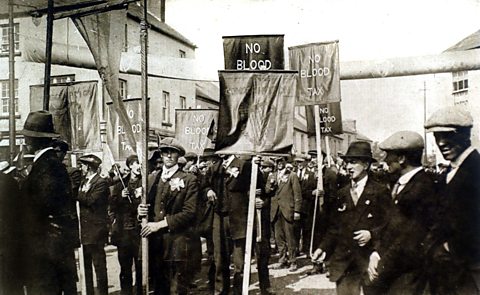
When forced army conscription was introduced, in 1918, it was fiercely resisted.
“We deny the right of the British government or any other external authority to impose compulsory military service in Ireland against the expressed will of the Irish people.”
The nationalist Sinn Fein party stood in the 1918 general election on a platform of claiming full Irish independence. They won a convincing majority.
Home Rule was now irrelevant – and the four years of war had changed everything.
Learn in more depth
Ireland and the outbreak of WW1
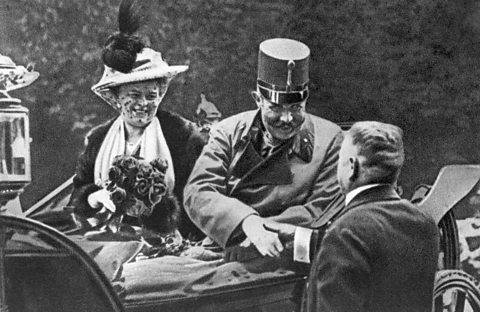 Image source, Bettmann / Getty
The outbreak of World War One in late summer 1914 paused the tensions in Ireland.
The Home Rule Act granting Ireland some degree of self-governance had been enacted in September 1914, but had been immediately suspended for the duration of the war.
At the time the act was brought it, it was unclear whether any part of the northern province of Ulster would be excluded from Irish Home Rule, but the problem was shelved until the end of the war.
The crisis in Ireland did not go away, however, between 1914 and 1918: it merely took on a new shape.
World War One changed the political landscape in Ireland in the following areas:
- Irish attitudes to World War One
- The impact of the Easter Rising
- The Anti-Conscription campaign
World War One caused significant changes in Irish attitudes, particularly for the Nationalist and Unionist communities.
Image source, Bettmann / GettyIrish nationalists and republicans and WW1
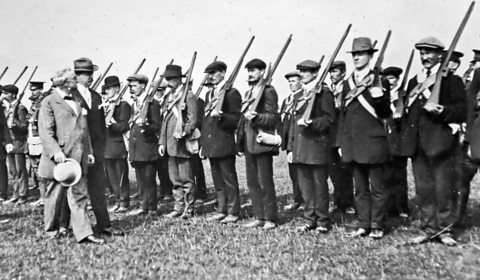 Image source, Independent News and Media / Getty
Led by John Redmond, leader of the Irish Parliamentary Party, most nationalists backed the war.
They hoped their loyalty to Britain during the war would be rewarded with the safe passage of the 1914 Home Rule Bill. This would allow a greater degree of self-governance for Ireland.
Just two days after the Home Rule Act officially became law, Redmond gave a speech calling on the nationalist paramilitary force, the Irish Volunteers, to do their ‘duty’.
A large number of nationalist volunteers, about 26,000, did join the British Army, and altogether about 250,000 Irishmen joined up to fight in World War One.
Image source, Independent News and Media / GettyChanges in nationalist and republican attitudes to WW1
Although the war caused some nationalists to become more sympathetic to the British, there wasn’t a significant change in the attitudes of less moderate republicans.
At the onset of the war, the Sinn Féin party and other republican leaders made it clear they would not be supporting the British.
Under Eoin MacNeil, a number of Irish Volunteers formed a new group, which rejected cooperation with the British.
This was a different position to the militia formed by John Redmond’s supporters, who became known as the National Volunteers. Under Redmond's direction, thousands of National Volunteer men fought in World War One.
Irish unionists and WW1
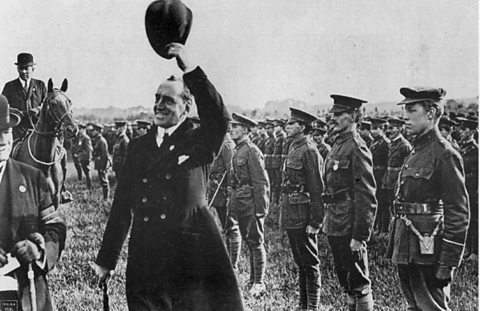 Image source, Photo 12 / Getty
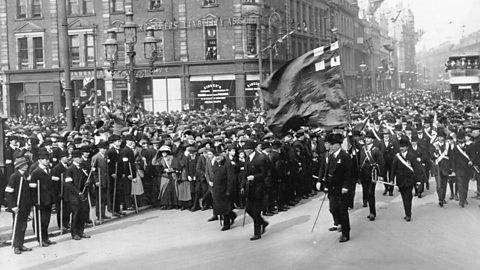
A more significant proportion of unionists in Ulster joined the British Army, with recruitment rates in Ulster matching the rest of Britain.
Unionists were more likely to wish to support the British cause because they saw themselves as British. Generally, the saw protecting Britain and the Empire as more important than their opposition to home rule. The unionist leader Edward Carson stated:
England’s difficulty is not Ulster’s opportunity, England’s difficulty is our difficulty.
Image source, Photo 12 / GettyChanges in Unionist attitudes to WW1
During the war, a largely Ulster Unionist Division, the ‘36th Division’, had been formed.
In the Battle of the Somme, 1916, this ‘Ulster Division’ famously advanced further than most others on the first day, at the cost of heavy sacrifices. On 1st July 1916 alone, the division saw 5000 wounded and 2000 dead.
The Unionists believed their community had paid a ‘blood sacrifice’ both on the Somme and on the Western Front as a whole.
They believed that as a reward for their patriotism the north-west of Ireland should be allowed to remain British after the war ended.
The Easter Rising, 1916
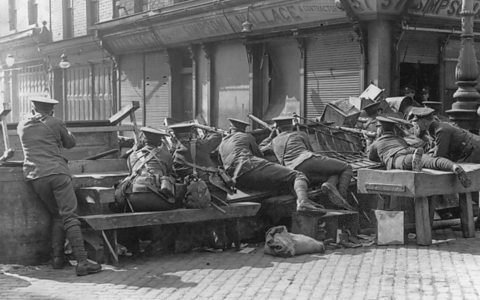 Image source, Ullstein Bild Dtl. / Getty
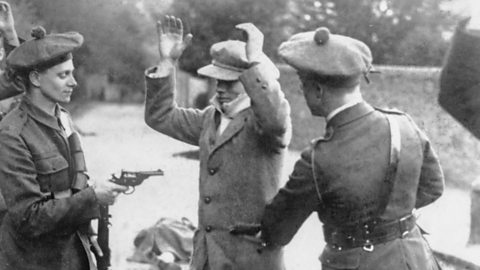
On Easter 1916, almost halfway through WW1, Irish republicans led an armed insurrection against British rule in Dublin.
Six days of fighting occurred before British forces eventually regained control and the Irish republican forces surrendered.
- 400 people died as a result of the fighting
- thousands of civilians were affected or injured
- large areas of Dublin were destroyed
Of the captured republican fighters, fifteen of the leading figures were executed by firing squad after short trials.
Initially, Irish public opinion had been hostile to the republicans involved in the Easter Rising.
After the executions, public opinion shifted to support and sympathy for the republicans.
Image source, Ullstein Bild Dtl. / GettyIreland and WW1 conscription
Ireland was deliberately excluded when Compulsory enrolment in the armed forces. was introduced in Britain in 1916, fearing it would provoke hostility.
Irish conscription in WW1
However, following heavy war losses in 1917, the British Government planned to conscript another 555,000 men. Of these men, 150,000 would come from Ireland.
On 17th April the British House of Commons passed the Military Service Bill, enforcing conscription for all men of military age in Ireland.
The move was opposed by nationalists of all shades, from the Irish Nationalist Party, to Sinn Féin, and even the Catholic Church.
The Irish Parliamentary Party immediately withdrew their MPs from parliament in protest.
In 1914, the IPP had driven the campaign for army recruitment. With their withdrawal from Westminster, it now looked as if they had been wrong to cooperate with the British government’s war effort. This lost the IPP support from the Irish public.
The Irish Anti-Conscription Campaign
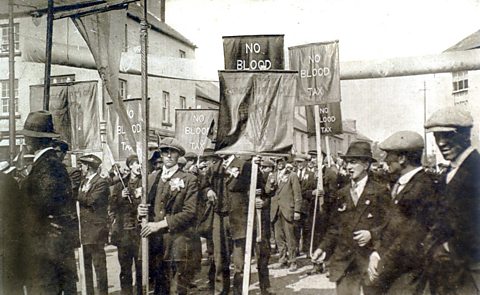 Image source, Photo 12 / Getty
An Irish Anti-Conscription Committee was organised by groups such as the IPP, Sinn Féin, the Catholic Church, and trade nnions.
One of their first actions was to ensure that an anti-conscription pledge was to be taken at the church door of every Catholic parish on Sunday, 21 April, 1918.
This was the idea of Sinn Féin leader Arthur Griffith. The wording of the pledge had been written by Éamon de Valera, President of Sinn Féin as well as one of the leaders of the Easter Rising.
A general strike of all trades was organised, beginning on April 23rd 1918. This was successful in convincing the British government not to apply the conscription legislation to Ireland.
Although the anti-conscription campaign had been a joint nationalist effort, involving the IPP, Sinn Féin, trade nnions and the Catholic Church, it was Sinn Féin that was credited with driving the movement.
Image source, Photo 12 / GettyTest your knowledge
Quiz
Recap what you have learned
Ireland was politically divided on whether to support the British war effort in World War One.
- Nationalists volunteered to fight in WW1 believing it would secure Home Rule for Ireland
- Unionist volunteered as they believed their loyalty would avoid Home Rule
- Some Republican groups refused to fight in British armed forces
In total, around 250,000 Irishmen fought in WW1.
As the war progressed and casualty rates increased, political divisions about Ireland's role in the war grew.
- In 1916 Republican forces staged an armed rising - the Easter Rising - capitalising on war resentment to declare a Irish republic
- In 1918, there large protests against conscription of Irish men into the British Army led by senior Republican figures
More on Britain and Ireland, 1900 - 1985
Find out more by working through a topic
- count4 of 14
- count5 of 14
- count7 of 14