Quick version
The Easter Rising began in April 1916 during the mid-point of World War One.
- it was planned by leading republic groups such as the Irish Republican Brotherhood, Irish Citizens Army, and the Irish Volunteers.
- Leaders hoped that unhappiness at the ongoing conflict of WW1 would bring them support.
- Republican forces captured key buildings such as Dublin's Post Office, the Four Courts legal centre, and key bridges in the city.
- Fighting lasted for six days.
- British artillery and reinforcements forced the surrender of the republicans.
- Over 400 people were killed and the city was badly damaged.
- Irish public sympathy was originally against the republicans.
- The execution of the leaders of the Easter Rising turned public sympathy against Britain.
Learn in more depth
In 1916, halfway through World War One, a relatively small number of Irish republicans led an armed insurrection against British rule in Dublin.
Although the rising failed, lasting a mere six days, it had long-reaching consequences and is one of the most famous events in modern Irish history.
The Easter Rising and WW1
 Image source, Sean Sexton / Getty
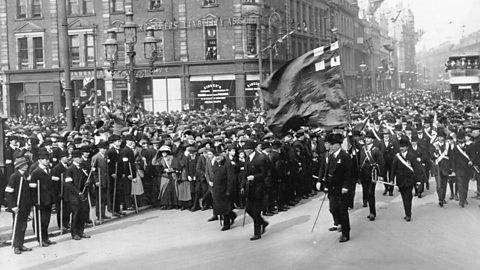
By 1916 many in Ireland were growing weary of the war. A small group of republicans decided to take advantage of the situation. They were inspired by a saying from 19th Century Irish leader, Daniel O'Connell:
England’s difficulty is Ireland’s opportunity.
While Britain was preoccupied with World War One, they saw an opportunity to take control of Ireland by force.
The rebels largely comprised the Irish Volunteers who, under Eoin MacNeill, had broken away from the more moderate National Volunteers.
The group also contained members of the Irish Republican Brotherhood. Leading them was Patrick Pearse, a school teacher from Dublin who was also an IRB member.
The rebellion was planned for Easter 1916, and was to be supplied with German weapons by Sir Roger Casement – an Anglo-Irish diplomat and former government official. In providing German weapons to British citizens during wartime, Casement was committing treason.
Despite the fact that the weapons (and Casement) were captured by the British in the week leading up to Easter, the planned rebellion went ahead on Easter Monday, 24th April, 1916.
Image source, Sean Sexton / GettyEvents of the Easter Rising, 1916
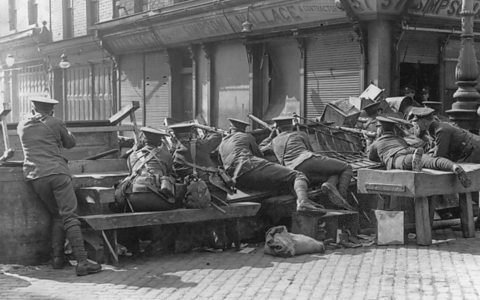 Image source, Ullstein Bild Dtl. / Getty
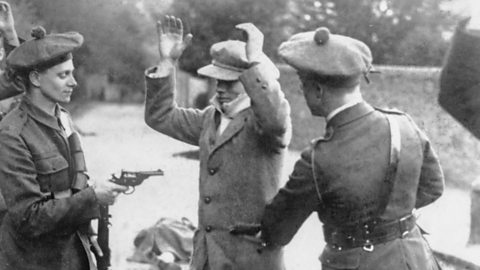
Around 1,500 ‘rebels’ took over Dublin's General Post Office and other key buildings in the city.
They then raised an Irish Flag (green, white and gold) and Patrick Pearse read the Proclamation of the Republic, a document claiming independence and the creation of a new Republic of Ireland:
we hereby proclaim the Irish Republic as a Sovereign Independent State, and we pledge our lives and the lives of our comrades in arms to the cause of its freedom, of its welfare, and of its exaltation among the nations.
They also occupied buildings of symbolic importance across the city such as the Four Courts building – the location of Ireland's most important legal courts.
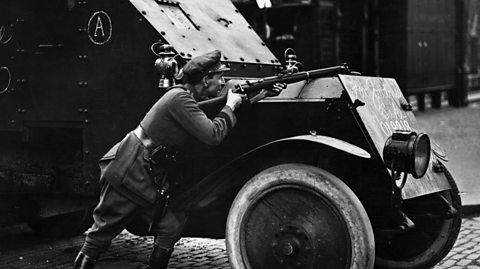
There was fighting in the streets of Dublin over the next six days as garrisoned British soldiers tried to dislodge the rebels.
Image source, Ullstein Bild Dtl. / GettyThe failure of the Easter Rising
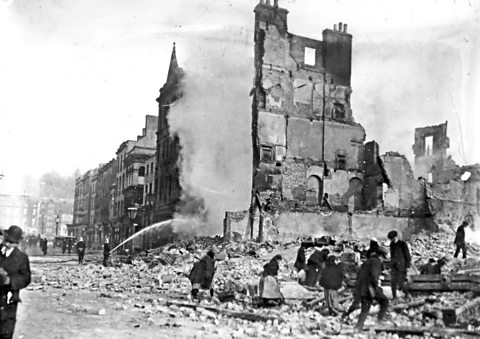 Image source, Independent News and Media / Getty
Despite capturing many important buildings and bridges, the republican forces had failed to capture Dublin's port. This allowed the British to bring in thousands of soldiers from elsewhere in Ireland as reinforcements.
A navy gunboat, the ‘Helga’, was also sailed up Dublin's River Liffey.
On 29th April 1916, after artillery shelling and gunfire, the republican forces surrendered.
Huge areas of Dublin city centre were in ruins and local sympathy was initially with the British rather than the ‘rebels’.
The rebels were openly blamed and criticised for causing so much damage and so many casualties – over 2,000 civilians were caught up in the fighting and injured. Almost 500 people were killed in the uprising, the majority of them, 268, were civilians caught up in the violence.
It was estimated that the rebellion cost over two million pounds worth of damage, taking vital resources away from the war effort and the people of Dublin.
Image source, Independent News and Media / GettyThe aftermath of the Easter Rising, 1916
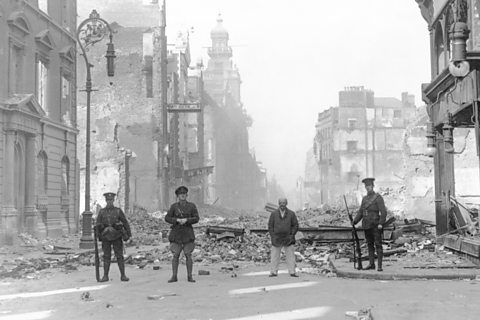 Image source, Ullstein Bild Dtl./ Getty
It was the action of the British after the Easter Rising that began to turn public sympathy in favour of the rebels and their cause.
The pacifist Francis Sheehy-Skeffington was arrested in Dublin on 25th April, taken to Portobello Barracks and shot by firing squad next morning without trial.
On 26th April 1916, martial law was introduced. Major-General Sir John Maxwell was put in charge to restore order and punish those who took part in the rebellion.
Troops from the South Staffordshire regiment broke into houses on North King Street and shot or bayoneted 15 civilian men whom they accused of being rebels.
Executions
190 men and 1 woman, who were thought to have organised the rising were tried in secret by a military court, with no legal representation. In 90 cases the court’s verdict was ‘Death by being shot’.
Maxwell confirmed this judgement on 15 defendants who were executed between 3rd and 12th of May, 1916.
The seven who had signed the proclamation were not professional soldiers, and included a teacher, a poet and an accountant.
The last execution, of the injured James Connolly, struck many as particularly tragic as he was unable to stand due to injuries sustained in the fighting. He was shot sitting down, tied to a chair.
Internment
- British authorities arrested 3,430 men and 79 women.
- Over 1,400 were released within a fortnight.
- On 11 June, over 1,800 prisoners were interned without trial at a prison camp in Wales. They were returned home by Christmas.
To many in Britain, and even Ireland, the Easter Rising appeared a treasonous act, as Britain was forced to divert attention and precious resources away from the war effort. This damaged relations between Britain and Ireland.
The brutal response of British troops, and unfair treatment of the rebel leaders had a dramatic effect on many in Ireland, who saw them as martyrs, bravely sacrificing their lives in an attempt to liberate Ireland from the British oppressor.
Sinn Féin were widely, inaccurately, blamed by the press for the Easter Rising. They benefitted greatly from the association and saw a rise in support following the rising.
Image source, Ullstein Bild Dtl./ GettyTest what you have learned
Quiz
Recap what you have learned
The Easter Rising began on Easter Monday, 24th April, 1916.
- It was planned by leading republic groups such as the Irish Republican Brotherhood, Irish Citizens Army, and the Irish Volunteers.
- It was planned to capitalise on unhappiness at the ongoing conflict of World War One.
- Republican forces captured key buildings such as Dublin's Post Office, the Four Courts legal centre, and key bridges in the city.
- Fighting lasted for six days
- Nearly 500 people were killed, more than half of them civilian, and the city was badly damaged
- The brutal response of British forces, including mass internment and the execution of the leaders of the Easter Rising turned public sympathy against Britain.
More on Britain and Ireland, 1900 - 1985
Find out more by working through a topic
- count5 of 14
- count7 of 14