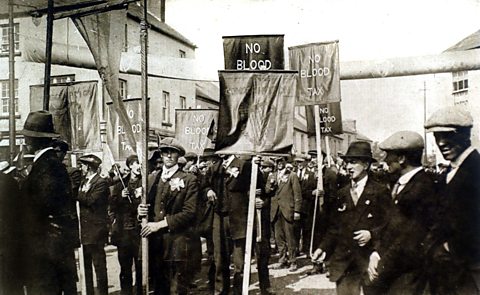
Quick version
Home Rule was a controversial issue in Ireland in the years before WW1:.
- Some wanted Home Rule for domestic affairs only, with the British parliament managing everything else.
- Others wanted full control of all Irish policies with little or no British influence.
- Some Unionists rejected Home Rule as they thought it divided them from the rest of Britain
- Some Republicans rejected Home Rule as it wasn't full independence from Britain
There were two failed attempts at establishing Home Rule for Ireland before the start of the 20th century:
- First Home Rule Bill, 1886
- Second Home Rule Bill, 1893
A Third Home Rule Bill was eventually passed in 1912 with significant help from John Redmond's nationalist Irish Parliamentary Party.
Unionist response:
- Many Unionists in the largely Protestant north of Ireland feared Home Rule would lead to Catholic domination from Dublin.
- Unionist paramilitary groups such as the Ulster Volunteer Force (UVF) were formed.
Republican response:
- While some republicans were prepared to accept the limitations of Home Rule, others rejected it as not being full independence from Britain.
- Republican paramilitary groups such as the Irish Volunteer Force (IVF) were formed.
Video - Rising tensions in Ireland before WW1
On July 26th 1914, a yacht sailed into the bay at Howth, near Dublin.
It was carrying one thousand guns - which were swiftly handed out to a battalion of the Irish Volunteers - a newly formed militia who wanted Irish independence.
The rifles were old and out of date – but the Volunteers were now armed…
They weren’t the only shipment of arms to arrive in Ireland, at a time when tensions over the future of the country were growing, and the North and South felt increasingly divided…
Belfast had overtaken Dublin to become Ireland’s largest city, and its place in the British Empire meant that its manufacturing sector was booming.
By contrast, the South was dependent on farming, and far poorer.
The majority Protestant population of the North were strongly committed to the Union of Britain and Ireland – to protect their cultural identity, their jobs, and their wealth.
In the majority Catholic South, a cultural revival movement had promoted the Irish language, and a strong sense of Irish identity. Politically, most people did not want to be ruled by London.
Some Nationalists believed in full independence for the whole island of Ireland. The Irish Republican Brotherhood, and the Irish Volunteers, were organising, and prepared to use force to bring about change….
But Northern Protestants were determined to never allow an end to British rule. The Ulster Volunteers had ten thousand members, armed and ready to fight.
Moderate Nationalists, though, hoped that change could be brought about without shots being fired…
The Irish Parliamentary Party, led by John Redmond, were moderate nationalists who campaigned for Home Rule.
The idea of Home Rule was for Ireland to stay part of the United Kingdom, with a devolved parliament in Dublin governing over matters such as transport or education.
Redmond’s vision was popular, and the IPP had won huge support in the 1910 general election.
British Prime Minister Herbert Asquith had a majority of just one. He needed the IPP’s support. In exchange, he agreed to Home Rule for Ireland.
It was fiercely contested in Parliament, but in 1912, the Third Home Rule bill passed – with its implementation postponed for two years
Ireland was headed for major change - but while the majority of people were happy with the compromise of Home Rule, those with more extreme views on both sides opposed it…
Conflict seemed inevitable - but Irish tensions were overshadowed.When Britain entered World War I in 1914, Home Rule was suspended – and Ireland’s future hung in the balance.
Learn in more depth
Since the Act of Union (Ireland) came into effect in 1801, Irish political affairs had been run from the UK parliament in Westminster.
Some in Ireland defended this union – becoming known as Unionists. Largely, they were Protestants living in the north of Ireland.
There were many in Ireland, though, who opposed the union and demanded a return to an Irish parliament running Irish affairs. Republican groups, in particular, wanted an Irish state free from British control or influence.
From the middle 1800s multiple Home Rule movements emerged:
- Some wanted to keep the UK parliament but have Irish domestic affairs run from Ireland.
- Others wanted a break all political ties with Britain and have all Irish affairs run from Ireland.
Support and opposition to the idea of Home Rule was complex.
Support:
- Some Unionists reluctantly supported Home Rule as it stopped short of republican demands for an entirely separate Ireland.
- Some moderate republicans supported Home Rule as it was a step towards independence.
Opposition:
- Some Unionists in Ireland opposed Home Rule as they thought it weakened their ties to Britain.
- Less moderate republicans rejected Home Rule as they wanted a separate Ireland free from British control.
Efforts at establishing Irish Home Rule
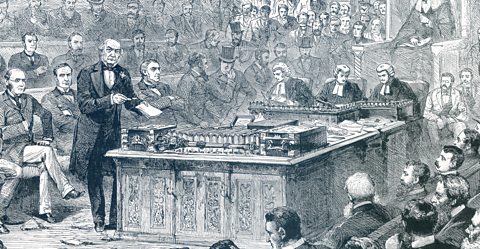 Image source, Ivy Close Images / Getty
Before 1900, there had been two failed efforts to pass laws to establish Home Rule for Ireland.
- First Home Rule Bill, 1886
- Second Home Rule Bill, 1893
Both bills were introduced by the Liberal Party Prime Minister, William Gladstone.
Gladstone personally supported the idea of Home Rule for Ireland. With support of the pro-Home Rule Irish Parliamentary Party, he introduced the bills to parliament.
Both bills were defeated.
The First Home Rule Bill was outvoted in the House of Commons by 341 votes to 311.
The Second Home Rule Bill was narrowly passed in the House of Commons, but was then voted down by the House of Lords.
Image source, Ivy Close Images / GettyHome Rule and the Irish Parliamentary Party
Led by John Redmond, the Irish Parliamentary Party (sometimes referred to as the Irish Nationalist Party) was the largest of the Irish political parties. In the years before the First World War, it was able to influence decision making in the UK parliament in Westminster.
Liberal Government
The Liberal Party came to power in 1906. From 1908, Liberal Prime Minister Herbert Asquith and his government were engaged in a series of sweeping reforms – such as the first free school meals, and old age pensions.
Though popular, these reforms were expensive and led to a challenge from the House of Lords, who refused to pass the budget (with tax rises) in 1909. In response, Asquth called a General Election.
The result of the January 1910 General Election left the Liberals in need of support from other parties
Asquith was a supporter of Home Rule for Ireland, and saw John Redmond and the Irish Parliamentary Party as allies to support his government.
Results of the 1910 General Election
| Party | Number of seats |
|---|---|
| Liberal | 274 |
| Conservatives | 273 |
| Irish Parliamentary Party | 71 |
| Labour | 40 |
The IPP and the Third Home Rule Bill
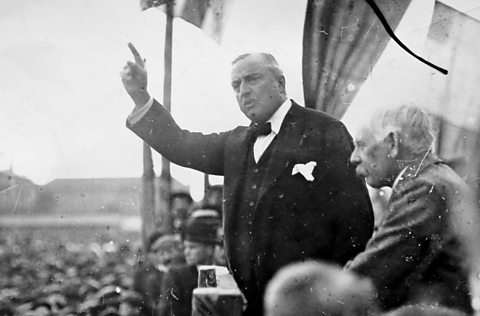 Image source, Independent News and Media / Getty
Irish Nationalist Party MPs only agreed to support the Liberals in return for a new Home Rule Bill.
With the support of John Redmond, a new law was passed to reduce the power of the House of Lords. As a result the Home Rule Bill for Ireland, which was previously blocked by the House of Lords, could now be passed.
Both Asquith’s reliance on the IPP and the reform of the House of Lords made it more likely that the Liberals would introduce another Home Rule Bill, which both raised the expectations of Irish Nationalists and caused fear for Ulster Unionists.
Sure enough, in April 1912 a Third Home Rule Bill was introduced.
Image source, Independent News and Media / GettyUnionist response to the Home Rule Bill
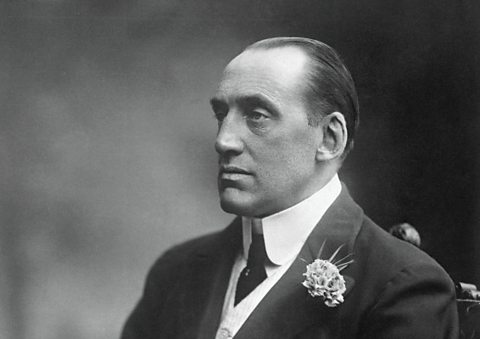 Image source, Bettmann / Getty
Tensions were deliberately heightened by the rhetoric of Unionist leaders such as Edward Carson.
He declared at a rally:
We must be prepared… the morning the Home Rule Bill passes, ourselves to become responsible for the government of the Protestant province of Ulster.
In effect, he was threatening to set up an illegal alternative government for the province of Ulster.
Another leading Unionist MP, William Moore, highlighted the opposition to Home Rule in Ulster in a speech in parliament. He said that there would be ‘blood on government’s hands’ should Home Rule be enacted.
A well-known, often quoted slogan of Carson’s hinted at potential violence:
Ulster will fight, and Ulster will be right.
Emotive language like this became commonplace in Ulster politics.
Image source, Bettmann / GettyUnionist protest to Home Rule
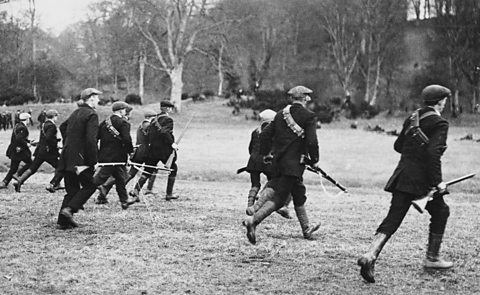 Image source, Archive Photos / Getty
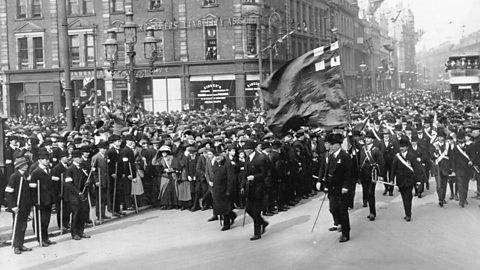
To demonstrate the threat Unionists could pose, and their strength of feeling, on Easter Tuesday, 1912, a rally was held at Balmoral, Belfast, in which 100,000 Unionists marched in military formation.
On 28 September 1912, Sir James Craig presented the 'Ulster Covenant', (known at first as the ‘Solemn League and Covenant’) which people could sign to pledge their determination to oppose the Third Home Rule Bill. It stated that their right to remain citizens of the United Kingdom would be defended by "all means which may be found necessary".
It was a huge propaganda success. 218,000 men signed the covenant, and 228,000 women signed a corresponding document. All told, including Ulstermen signing in England, 471,414 people signed up in support.
Many Unionists felt they would need a back-up military force as 'insurance' to make certain that Ulster was left out of Home Rule.
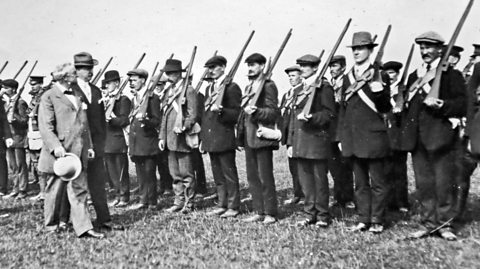
In January 1913, the Ulster Volunteer Force (UVF) was set up. Thousands of Unionists joined, numbering 90,000 by the end of the year. They had a small full-time staff of ex British Army officers to lead them.
On 24th and 25th April 1914, 25,000 rifles and 3,000,000 bullets were illegally brought in on boats by the UVF at Larne, Bangor and Donaghadee, almost all being distributed throughout the province that night.
Image source, Archive Photos / GettyNationalist response to the Home Rule Bill
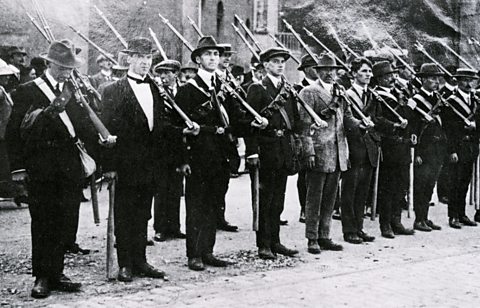 Image source, ALAMY
By the end of 1913 the Nationalists realised that the Liberal government was likely to agree with the Conservatives and leave part of Ulster out of Home Rule provisions.
They were horrified, as they felt an effective and credible Irish nation could only be formed with the whole island included in Home Rule. As with Unionists, they took action.
Nationalists were keen to show that they too were prepared to fight to achieve their aims. The Irish Volunteer Force (IVF) was set up in November 1913. Members from the Gaelic League, the Gaelic Athletic Association, Sinn Féin and the Irish Republican Brotherhood all joined, with Patrick Pearse and Eoin MacNeill as its leading figures.
In response to the arming of the UVF in April 1914, the IVF brought in around 1,500 rifles and 45,000 bullets at Howth, near Dublin, on 26 July.
In this case, the police did intervene. After an aggressive crowd threatened them and started throwing bottles and rocks, the police shot three people dead. It looked as if the police were treating the UVF and IVF very differently.
Image source, ALAMYIrish Home Rule and WW1
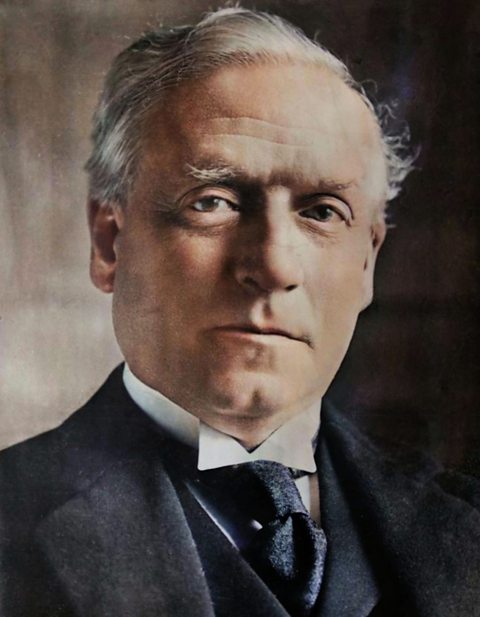 Image source, Heritage Images / Getty
In March 1914 the Liberal government introduced a compromise, which it hoped would prevent a civil war.
The 'County Option Scheme', would allow each county in Ireland to vote on whether or not to join Home Rule. If a county voted ‘No’ then it would be outside Home Rule for six years.
Nationalists were unhappy, as they didn’t want Ireland divided; nor did they want to ‘abandon’ Nationalists living in Belfast and other northern areas where large numbers of Unionists meant they were likely to opt out.
Carson and the Unionists also campaigned vigorously against the scheme. They argued that it was a ‘sentence of death, with a stay of execution for six years’.
With the compromise abandoned, and the Home Rule Bill’s passage through parliament getting closer in 1914, conflict seemed inevitable.
Anticipating an armed conflict, soldiers based at the Curragh barracks in County Kildare were told they would be expected to supress any revolt by the Ulster Volunteer Force.
However many officers were sympathetic to the Unionist cause, and threatened to refuse to obey any order to crush a Unionist revolt.
Asquith’s government was forced to give assurances that they would not use force against the Ulster Unionists. This weakened the government's position and gave them even fewer options when trying to work out how best to deal with the crisis.
The Third Home Rule Act finished its Westminster passage and was on the statue book by September 1914.
However the outbreak of World War One, in August 1914, led to its application being suspended until the war was over. This left the Nationalists and Unionists uncertain about the future, essentially delaying the inevitable conflict for another time.
Image source, Heritage Images / GettyTest your knowledge
Quiz
Recap what you have learned
There were different proposals for how much power Home Rule would hand over to Ireland:
- Some wanted Home Rule for domestic affairs only, with the British parliament managing everything else.
- Some wanted wanted a Home Rule with full control of all Irish policies with little or no British influence.
Not everyone in Ireland wanted Home Rule:
- Some Unionists rejected Home Rule as they thought it divided them from the rest of Britain.
- Some Republicans rejected Home Rule as it wasn't full independence from Britain.
There were three attempts to implement Home Rule for Ireland:
- First Home Rule Bill, 1886 – rejected by the House of Commons
- Second Home Rule Bill, 1893 – rejected by the House of Lords
- Third Home Rule Bill, 1912 – was eventually passed with significant help from the nationalist Irish Parliamentary Party
Unionist response
- Over 100,000 people in Ulster protested against Home Rule
- Unionist paramilitary groups such as the Ulster Volunteer Force (UVF) were formed.
Republican response
- While some republicans were prepared to accept the limitations of Home Rule, others rejected it as not being full independence from Britain
- Republican paramilitary groups such as the Irish Volunteer Force (IVF) were formed
More on Britain and Ireland, 1900 - 1985
Find out more by working through a topic
- count3 of 14
- count4 of 14
- count5 of 14