Quick version
The policies of British and Irish governments played significant roles in the attempts to find a solution to 'the Troubles'. Some policies were more successful than others.
- internment was reintroduced to tackle terrorism. Imprisonment without trial fostered anger in nationalist areas
- direct rule from Westminster was introduced in 1972. It provoked anger from all sides
- the Irish government moved forces closer to the Northern border which inflamed tensions in the North
In a policy known as criminalisation, the British government refused to treat republican paramilitary prisoners as political prisoners which led to new protest including hunger strikes.
Diplomatic efforts to find a solution continued but face obstacles.
- Unionist politicians resented any interference in Northern Ireland by politicians from the Irish Republic
- the Irish Government objected to the involvement of hardline Unionist politicians
In 1973, the Sunningdale Agreement was signed by the British and Irish governments and leading political parties in Northern Ireland.
- It attempted to establish a power sharing assembly to govern Northern Ireland.
- The agreement was opposed by unionist and republican paramilitaries.
- Unionist parties opposed the assembly and organised a general strike.
- In 1974, the agreement failed and direct rule from Westminster was re-introduced.
In 1985, the Anglo-Irish Agreement was signed by the British and Irish governments. It attempted another power sharing assembly. It also failed due to opposition from both unionist and republican parties in Northern Ireland.
Learn in more depth
Decisions made by the British Government had direct influence on events unfolding in Northern Ireland:
- The decision to deploy British Army forces changed the nature of the conflict and made it a military issue.
- Efforts to combat paramilitary forces often inflamed tensions in the region.
On the the most controversial measures was internment – the imprisonment of suspects without trial.
Internment in Northern Ireland
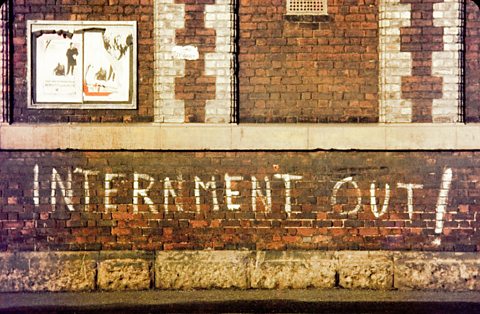 Image source, Alex Bowie / Getty
Due to continuing violence, and under pressure from members of his own party to do something that worked, Northern Ireland's Prime Minister, Brian Faulkner decided to introduce Imprisonment without trial. to deal with those believed to be involved in terrorism. The move was approved by British Home Secretary, Reginald Maudling.
Internment had been used periodically in Northern Ireland during the 1950s in response to incidents on the border with the Republic of Ireland. In the heightened tensions that existed in Northern Ireland in the early 1970s, its reintroduction inflamed the situation.
Authorities were struggling to deal with the guerrilla campaign that the Provisional IRA (PIRA) were waging against the Royal Ulster Constabulary (RUC) and the British Army.
Image source, Alex Bowie / GettyOperation Demetrius
On 9 August 1971, Operation Demetrius started and 452 men were arrested.
However, those arrested were, by and large, the wrong people.
The information used by the authorities was out of date; those Imprisonment without trial. were mainly members of the Official IRA (OIRA), ordinary People who believe their country should be independent from other nations. For example, Irish nationalists, who want Ireland to be fully independent of Britain. or Rights everyone is entitled to regardless of the colour of their skin, their beliefs, sexuality, sex or other personal characteristics. These rights could include - amongst other things - the right to vote, the right to free speech or the right to a good education. supporters - not the Irish republican paramilitary group formed when members split from the Official IRA (OIRA) in 1969..
On top of that, no A person who, in terms of culture, identity and politics, retains a strong loyalty to Britain and firmly opposes a united Ireland. were arrested, even though loyalist A person or organisation that operates like a military force, but is not part of a country's official armed forces. were also involved in killings and bombings.
The first loyalists were not interned until February 1973.
Reaction to internment
- The levels of violence got much worse. In the last 4½ months of 1971, 143 people were killed and many homes and businesses were destroyed. Before internment was introduced, there had been fewer than 30 deaths in 1971.
- Initial A person who believes the union between Britain and Northern Ireland should continue. support began to decline when internment did not reduce violence.
- Politicians from the An Irish nationalist party in Northern Ireland. When it was set up in August 1970, the SDLP was moderately left wing on social and economic issues. At the same time, the party sought political reforms within Northern Ireland and the eventual re-unification of Ireland. , People who believe their country should be independent from other nations. For example, Irish nationalists, who want Ireland to be fully independent of Britain. and A person who wants to establish an all Ireland republic completely independent of Britain. Labour Parties stopped attending council meetings. They urged their supporters to show opposition to internment by refusing to pay either their A payment made by householders to their local council. or the rent due on their homes. 16,000 householders did stop paying.
- Irish republican paramilitary group formed when members split from the Official IRA (OIRA) in 1969. membership increased.
- The Northern Ireland Civil Rights Association (NICRA) held protest marches. However, these soon ran into trouble. When NICRA staged a march close to an internment camp at Magilligan, Co Londonderry, in January 1972, the army responded by firing A substance used to prevent rioting. Also known as ‘tear gas’. and charging the marchers with their batons drawn.
Internment damaged the relationship between the nationalist communities and the British authorities. By the time it ended in December 1975, 1,981 people had been detained, only 107 were from a Unionist background.
Direct rule in Norther Ireland, 1972
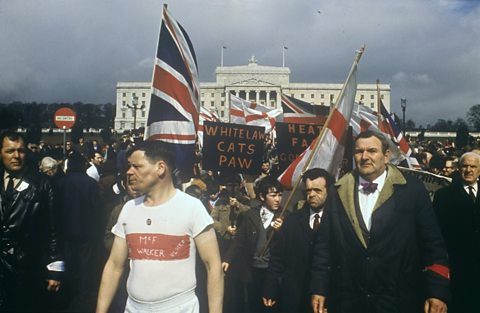 Image source, Bettmann Archive/ Getty
 The situation in Northern Ireland destabilised in 1971 and 1972, partly as a result of internment, but also as a result of the growing violence.
The events of On 30 January 1972, British soldiers from the Parachute Regiment shot 26 unarmed civilians following a protest march in the Bogside area of Derry, Northern Ireland in an event that became known as Bloody Sunday. 14 people were killed (13 died outright, one man died later of his injuries). indicated that Northern Ireland's Prime Minister, Brian Faulkner and his cabinet were unable to deal with the deteriorating security situation.
Faulkner responded to events by asking the British Government for permission to:
- Bring back the Formerly part of the reserve police force in Northern Ireland. Disbanded in 1969.;
- Allow the Police force in Northern Ireland from 1922 to 2001. to carry guns again.
The British Government refused and instead asked the Northern Ireland Government to give up its power over law and order.
Faulkner rejected this request, so in March 1972, the British Government announced that it would:
- Take control of security in Northern Ireland.
- Appoint a member of the British Government to take care of the running of Northern Ireland.
- End Imprisonment without trial. gradually.
- Plan to hold a When a question is decided by putting it to a public vote. on whether or not there should be a border between Northern Ireland and the Republic of Ireland.
- Talk to local politicians to see if a government made up of members from all parties could be set up.
All members of the Stormont Government resigned in protest.
British Prime Minister, Edward Heath then announced that he would close the Northern Ireland Government and Parliament down (at first for one year although this was later extended) and start running Northern Ireland directly from London (known as Direct Rule).
Heath appointed William Whitelaw as Northern Ireland’s first A politician who is in charge of a government department and who is usually a member of the Cabinet.
Reaction to direct rule
There were a number of responses to the closing down of the Northern Ireland Parliament:
- The Irish Government and the An Irish nationalist party in Northern Ireland. When it was set up in August 1970, the SDLP was moderately left wing on social and economic issues. At the same time, the party sought political reforms within Northern Ireland and the eventual re-unification of Ireland. were delighted. They saw the end of Stormont as providing the opportunity of a new start for Northern Ireland.
- The A republican paramilitary group which was determined to create an Irish Republic as proclaimed in the 1916 Easter Rising.welcomed the end of Stormont, but it saw Direct Rule as even greater British involvement in the running of Northern Ireland. It announced its determination to continue its struggle to achieve a united Ireland.
- A person who believes the union between Britain and Northern Ireland should continue. leaders were outraged at the closing of ‘their’ Parliament. Massive protests were organised by Ulster Vanguard. Support for the A conservative and unionist party in Northern Ireland, formed in 1971 by the Rev Ian Paisley. The party has strongly opposed any role for the Republic of Ireland in the governing of Northern Ireland. From 1971-1998, it opposed the 1973-1974 Power Sharing Assembly and Executive, the Anglo-Irish Agreement and the Good Friday Agreement. and other strongly unionist parties also increased.
- There was also an increase in support for A person who, in terms of culture, identity and politics, retains a strong loyalty to Britain and firmly opposes a united Ireland.A person or organisation that operates like a military force, but is not part of a country's official armed forces. and a spate of Belonging to a religious or political group and being intolerant of those with different opinions. If you're a religious sectarian, you are loyal to a particular religious sect or group. killings.
- The Northern Ireland Civil rights Association stated that its campaign for Rights everyone is entitled to regardless of the colour of their skin, their beliefs, sexuality, sex or other personal characteristics. These rights could include - amongst other things - the right to vote, the right to free speech or the right to a good education.would continue.
If the British Government hoped to make things better by closing Stormont down, it was to be disappointed.
There were more violent deaths in 1972 than there were during any other year of ‘the Troubles’.
Nearly 500 people died in 1972.
Although there were attempts to restore the Northern Ireland Government over the coming decades, all failed until after the signing of the Good Friday Agreement in 1998.
Image source, Bettmann Archive/ Getty Power sharing in Northern Ireland, 1973-4
In March 1973 the British Government decided to replace Stormont with a new Another name for a parliament. and Another name for the government or cabinet. The Executive is made up of the core group of politicians who carry out the major roles within the ruling government of a country..
There were a number of elements to this new system:
- Members of the Assembly would be elected using An electoral system in which parties gain seats in proportion to the number of votes cast for them..
- Members of the Executive would come from both A person who believes the union between Britain and Northern Ireland should continue. and People who believe their country should be independent from other nations. For example, Irish nationalists, who want Ireland to be fully independent of Britain. parties.
- There would be an Irish Dimension in the form of a Council of Ireland that would allow politicians from North and South to meet and discuss issues relevant to both parts of the island.
In addition, London would retain control of security and justice.
Response to power sharing
- Former Prime Minister Brian Faulkner supported the plans and some UUP party members agreed with his position.
- Many unionists were angry at the plans. They formed the An anti-power-sharing umbrella grouping composed of members of the Official Unionists, the DUP and the Vanguard Unionist Progressive Party, set up by William Craig to oppose power-sharing.to oppose the plans for power sharing and an Irish Dimension.
- People who believe their country should be independent from other nations. For example, Irish nationalists, who want Ireland to be fully independent of Britain. politicians were generally happy with the plans for a power sharing Assembly and Executive.
The first elections for the new power sharing Assembly were held in June 1973.
- The parties in favour of power sharingwon the most seats.
- But more unionists who were against power sharing were elected that unionists who supported power sharing.
Sunningdale Agreement, 1973
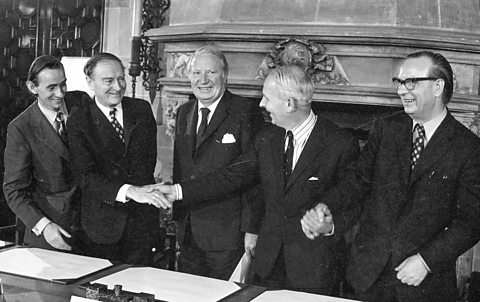 Image source, Independent News and Media / Getty
Northern Ireland’s political leaders joined with leading politicians from Britain and Ireland at Sunningdale in England to work out plans for the Irish Dimension of power sharing.
At first, Ian Paisley and William Craig, the leaders of the anti-power sharing unionists, were not invited to attend although at one point they were invited to join the conference.
Both men refused.
On 9 December 1973, the Sunningdale Agreement was signed.
It set out plans for the creation of a two part Council of Ireland:
- A 14-member Council of Ministers (seven from the power-sharing Executive, seven from the Irish Government). The Council would help develop North-South co-operation and would eventually be given decision-making powers.
- A 60-member Consultative Another name for a parliament. (30 from the power sharing Assembly, 30 from The lower house in the Irish parliament. ). It was to have ‘advisory and review functions’ only.
In addition:
- The British Government agreed not to oppose Irish unification if a majority of the people of Northern Ireland wanted it.
- The Irish Government accepted that Irish unity could only ever be achieved peacefully and with the Approval or agreement, particularly after thoughtful consideration. of the majority of the people of the North.
- At some future date, control over internal security issues would be returned to the Stormont Assembly.
- Approval of the decisions made at Sunningdale was to take place at a future conference.
Response to the Sunningdale Agreement
- Sunningdale was opposed by A person or organisation that operates like a military force, but is not part of a country's official armed forces. from both sides
- On 4 January, the ruling committee of the Ulster Unionist Party voted to reject the Sunningdale Agreement. Brian Faulkner resigned as leader of the Party. 19 of the 21 Ulster Unionist Assembly members resigned with him.
- In the February 1974 UK General Election, all but one of the seats in Northern Ireland was won by UUUC MPs who opposed power sharing.
- Anti-power sharing unionist politicians, trade unionists and paramilitaries set up the Ulster Workers’ Council (UWC) and called a general strike.
- On 17 May 1974 bombs – believed to have been planted by loyalist paramilitaries - exploded in Dublin and Monaghan, killing 33 people.
- On 25 May, Prime Minister Harold Wilson condemned the UWC’s actions and described those involved in the strike as ‘spongers’ in a televised speech. The unionist population saw Wilson’s words as an attack on everyone and support for the strike increased.
- On 28 May 1974, Faulkner and the other unionists in the Executive resigned because the British Government (and the An Irish nationalist party in Northern Ireland. When it was set up in August 1970, the SDLP was moderately left wing on social and economic issues. At the same time, the party sought political reforms within Northern Ireland and the eventual re-unification of Ireland. ) refused to negotiate with the UWC’s leaders. This effectively ended power sharing. The UWC declared its strike was over.
On 30 May 1974, the power-sharing Assembly was suspended and direct rule re-introduced.
Image source, Independent News and Media / GettyCriminalisation of terrorism in Northern Ireland
For the rest of the 1970s and the early 1980s, British governments attempted to solve problems in Northern Ireland . They introduced policies designed to defeat the A person or organisation that operates like a military force, but is not part of a country's official armed forces. campaigns:
- Ulsterisation: Increasing the size of the A regiment of the British Army established in 1970 in Northern Ireland and recruited locally. It was intended as a replacment for the the B specials reserve police force. and Police force in Northern Ireland from 1922 to 2001., while reducing the numbers of British Army troops on the streets of Northern Ireland.
- Criminalisation: Ending The recognition that those convicted of crimes connected with ‘the Troubles’ had acted for political and not criminal reasons. for those convicted of terrorist crimes after March 1976. Anyone convicted after that date would be treated in the same way as other criminals. They would be sent to a new prison - consisting of H-shaped blocks - which had been built at the Maze outside Belfast.
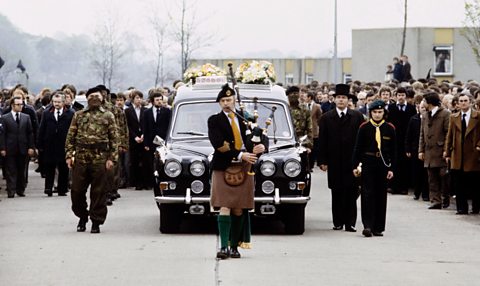 Image source, UPI/Bettmann Archive/Getty Images
Response to criminalisation
The British Government policy of The UK Government policy of removing special category status for those convicted of terrorist crimes, and treating them in the same way as any other criminals, introduced in 1976. led to a series of protests:.
- the ‘blanket protest’ saw members of republican paramilitaries refuse to wear standard prison uniforms as a demand to be recognised as political prisoners
- the ‘dirty protest’ saw PIRA prisoners smearing excrement on the walls of prison cells in protest at having to The emptying by prisoners of their buckets of excrement when their cells are unlocked each morning.
- in 1980, the first hunger strikes began and a group of PIRA prisoners refused all food. The protest ended in confusion without achieving any concessions.
In 1981, Bobby Sands refused food in prison. He was joined by others at staggered times so to maximise publicity and public sympathy.
Whilst on hunger strike, Sands was elected to the UK Parliament as MP for Fermanagh and South Tyrone seat.
After 66 days on hunger strike, Sands died. Over 100,000 lined the route of Sands’ funeral. Nine other hunger strikers died before prisoners' families began to intervene and the strike ended.
The 1981 Hunger Strike had a number of important consequences:
A greater level of People who believe their country should be independent from other nations. For example, Irish nationalists, who want Ireland to be fully independent of Britain. hostility towards the British Government.
An increase in support for the Irish republican paramilitary group formed when members split from the Official IRA (OIRA) in 1969..
An increase in the levels of A person or organisation that operates like a military force, but is not part of a country's official armed forces. violence.
As a result, Thatcher’s government was coming under pressure from:
A person who believes the union between Britain and Northern Ireland should continue., who believed that Thatcher was not doing enough to stop either the growth in PIRA membership or levels of violence.
The Dublin Government, which believed that a new political solution was needed to bring the PIRA’s campaign to an end.
Image source, UPI/Bettmann Archive/Getty ImagesThe role of the Irish Government
Although perhaps more of a peripheral player in 'the Troubles' than the British Government, the Irish Government also proved an obstacle to peace at various points in the conflict.
They did not intervene militarily, and whilst there was some sympathy and support for IRA activity, a British ambassador in the 1970s noted that “indignation [over the violence in the North] is directed more towards the IRA than Protestant extremists”.
Response to 'the Troubles'
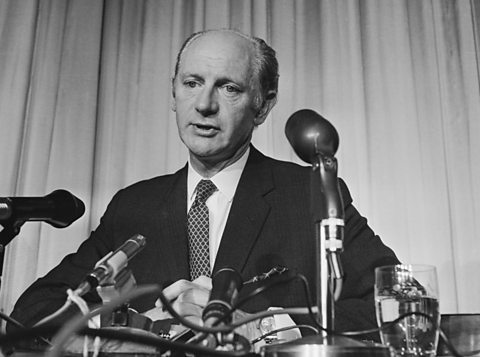 Image source, Evening Standard / Getty
In August 1969, when the ‘Battle of Bogside’ was getting underway, the Irish Taoiseach (Prime Minister), Jack Lynch, mobilised Irish army units and moved them close to the border. He also made a televised speech where he announced that the Irish Government would ‘no longer stand by’ whilst a crisis unfolded in the North.
Although he later admitted he had no intention of crossing the border, people from both communities in Northern Ireland at the time thought it was a possibility.
- In the nationalist and republican communities this raised expectations that the reunification of Ireland might be close to hand.
- Unionist communities were terrified of an invasion and of reunification being imposed on them by force.
Image source, Evening Standard / GettyThe Anglo-Irish Agreement, 1985
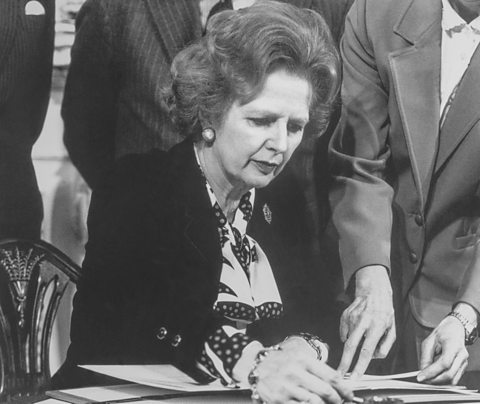 Image source, Bryn Colton / Getty
Another attempt at diplomacy led to the Anglo-Irish Agreement, signed in November 1985 by UK Prime Minister, Margaret Thatcher, and Irish Taoiseach, Garret FitzGerald.
Under the terms of this treaty, the Irish Government would have an advisory role in Northern Ireland’s affairs, and would also agree that there should be no constitutional change to Ireland’s borders.
Response to the Anglo-Irish Agreement
The treaty lost credibility because the main Irish political parties were split on the issue.
Fianna Fáil, then the main republican opposition party, rejected the treaty, arguing that Dublin should not recognise Britain having a say in Northern Irish affairs.
Unionists in Northern Ireland widely rejected the agreement and any involvement of the Republic of Ireland in Northern Ireland's affairs. The major Unionist parties, the DUP and the UUP, all opposed the agreement.
Although limited in its impact at the time, the agreement went some way to breaking the political impasse that had existed in Northern Ireland for decades.
Image source, Bryn Colton / GettyTest your knowledge
Quiz
Recap what you have learned
The policies of British and Irish governments played significant roles in the attempts to find a solution to 'the Troubles'.
- internment was reintroduced to tackle terrorism. Imprisonment without trial fostered anger in nationalist areas
- direct rule from Westminster was introduced in 1972. It provoked anger from all sides
- the Irish government moved forces closer to the Northern border which inflamed tensions in the North
Diplomatic efforts to find a solution continued but face obstacles.
- Unionist politicians resented any interference in Northern Ireland by politicians from the Irish Republic
- the Irish government objected to the involvement of hardline Unionist politicians
More on Britain and Ireland, 1900 - 1985
Find out more by working through a topic
- count14 of 14
- count1 of 14
- count2 of 14
- count3 of 14