Quick version
By the late 1960s, tension and violence between the Protestant and Catholic communities of Northern Ireland was escalating.
- It was feared the the police, the Royal Ulster Constabulary (RUC) were unable to contain the violence and were seen as pro- Unionist.
- In 1969, Northern Ireland's Prime Minister, James Chichester-Clarke, asked for the British Army to be deployed to keep the peace.
- British soldiers were deployed on the streets of Northern Ireland in August 1969.
- They were originally welcomed by Catholic communities as protectors.
In 1970, the Provisional Irish Republican Army (PIRA) began its campaign of violence and the role of the British Army in Northern Ireland came under question.
- In 1970, a curfew and house-to-house search of nationalist homes in Belfast's Falls Road alienated many Catholics to the British Army.
- In 1971, the Military Reaction Force (MRF) saw plain clothed British soldiers carry out intelligence operations. They were implicated in the deaths of 15 people before they were disbanded.
- In 1972, 26 people were shot by British soldiers in what became known as Bloody Sunday. 13 died on the scene and one more died later from wounds.
By the early 1970s, the role of the British Army in Northern Ireland had decisively moved from peace keepers between warring communities to combatants in a war against the PIRA.
Learn in more depth
The British Army were deployed to Northern Ireland in August 1969 with the aim of restoring peace and stability, but in many ways they contributed to the worsening situation.
The Battle of the Bogside, 1969
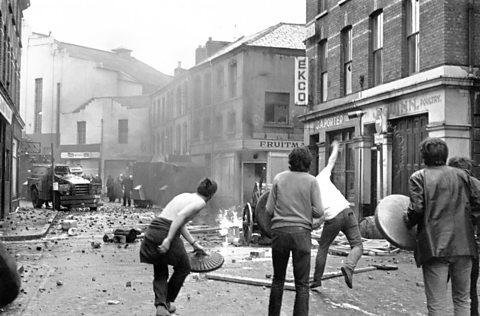 Image source, Peter Ferraz / Getty
The Battle of the Bogside was a three-day riot that occurred in Derry/Londonderry in 1969.
Violence broke out after a Protestant Apprentice Boys parade passed through Catholic Bogside area of the city.
The largely Protestant Royal Ulster Constabulary (RUC) responded with tear gas, and violence with Catholic protestors and residents escalated and soon spread to other areas of Northern Ireland.
Eventually, the Prime Minster of Northern Ireland, James Chichester-Clarke, acknowledged that the violence was out of control and requested that the UK government sent British Army forces to keep the peace.
This is seen as the start of the period of escalating violence that became known as The Troubles.
Image source, Peter Ferraz / GettyThe arrival of British troops in Northern Ireland, 1969
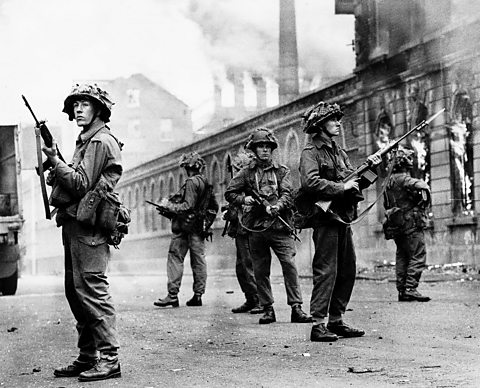 Image source, Mirrorpix / Getty
When the British army was first ordered on to the streets of Northern Ireland it was welcomed by members of the People who believe their country should be independent from other nations. For example, Irish nationalists, who want Ireland to be fully independent of Britain. community.
They viewed them as their protectors from what was seen as the Preference for or against one person or group. of Northern Ireland’s police force, the Police force in Northern Ireland from 1922 to 2001..
Their arrival was also considered to be a rejection by the British government of the security policy followed by the Stormont administration.
The Army, however, soon found itself in a difficult situation.
As the Irish republican paramilitary group formed when members split from the Official IRA (OIRA) in 1969. campaign of violence to achieve its aims took off in the early part of 1970, it became clear that sooner or later the group would target the British army as the symbol of British A system in which one country rules over other countries or territories, often by invasion or exerting power. in Ireland.
The Army decided to act to stop the PIRA growing too strong.
Image source, Mirrorpix / GettyThe Falls Road curfew, 1970
One of its first strategies was the imposition of a military A government/military order that states that people must be off the streets by a certain time. on the People who believe their country should be independent from other nations. For example, Irish nationalists, who want Ireland to be fully independent of Britain. Falls Road area of Belfast.
This curfew – which took place in early July and which lasted for thirty four hours – was designed to allow thorough house-to-house searches for weapons and ammunition.
Locally this became known as ‘The rape of the Falls’.
In many ways, the curfew was a disaster for the Army.
Although some explosives, guns and ammunition were uncovered, the inconvenience of the curfew and the damage caused during the searches meant that:
- The Army’s positive relationship with the nationalist community was fatally damaged.
- Irish republican paramilitary group formed when members split from the Official IRA (OIRA) in 1969. membership increased.
Military Reaction Force (MRF)
In response to growing IRA aggression, the British Army formed the undercover Military Reaction Force (MRF) in 1971, primarily to gather intelligence.
The MRF operated in plain clothes and were armed. The carried out intelligence operations and handled informers. They were also alleged to have been involved in the killings of around 15 IRA members and Catholic civilians.
The MRF was disbanded in 1973, but by then their actions had cemented the mistrust of the British authorities in Catholic communities.
Bloody Sunday, 1972
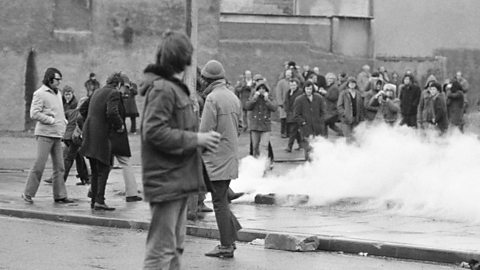 Image source, Henri Bureau / Getty
The most infamous intervention by the British Army during the Troubles became known as ‘Bloody Sunday’.
In January 1972, the Northern Ireland Civil Rights Association (NICRA) had organised a march through Derry/Londonderry to protest against the practice of internment (imprisonment without trial). The British Army force, 1st Battalion of the Parachute Regiment, had been deployed in case of violence.
Violence did break out, and the soldiers discharged their weapons.
- twenty six people were shot by the paratroopers
- 13 died on the day, and one later
- some were teenage boys
- some were shot in the back
The British Army maintained that they were returning fire only after being fired upon themselves, but all other eyewitnesses present insisted that the paratroopers had fired into an unarmed crowd. There were journalists and photographers covering the protest, and it was broadcast and publicised all across the world.
The incident led to retaliation. The Official IRA bombed Aldershot Barracks in England the following month, killing seven.
The most significant effect it had though was on the Catholic community of Northern Ireland. They increasingly saw the British Army as the ‘enemy’, a view reinforced by the curfews and rough house searches the army often performed in republican areas. It acted as a valuable propaganda and recruiting tool for the Republican paramilitaries.
Image source, Henri Bureau / GettyTest your knowledge
Quiz
Recap what you have learned
By the late 1960s, tension and violence between the Protestant and Catholic communities of Northern Ireland was escalating.
- The Royal Ulster Constabulary (RUC) were unable to contain the violence and were seen as pro- Unionist.
- In 1969, Northern Ireland's Prime Minister, James Chichester-Clarke, asked for the British Army to keep the peace.
- British soldiers were deployed in Northern Ireland in August 1969.
- They were originally welcomed by Catholic communities as protectors.
In 1970, the Provisional Irish Republican Army (PIRA) began its campaign of violence and the role of the British Army in Northern Ireland came under question.
- In 1970, a curfew and house-to-house search in Belfast's Falls Road alienated many Catholics.
- In 1971, the Military Reaction Force (MRF) saw plain clothed British soldiers carry out intelligence operations. They were implicated in the deaths of 15 people.
- In 1972, 26 people were shot by British soldiers in what became known as Bloody Sunday. 13 died on the scene and one more died later from wounds.
By the early 1970s, the role of the British Army in Northern Ireland had moved from peace keepers to combatants in a war against the PIRA.
More on Britain and Ireland, 1900 - 1985
Find out more by working through a topic
- count14 of 14
- count1 of 14
- count2 of 14