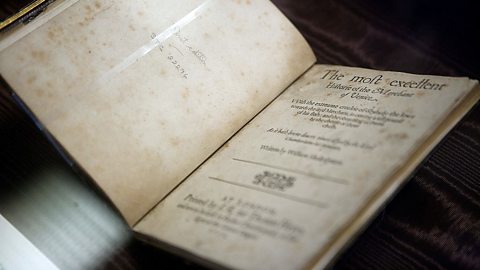
Summary of The Merchant of Venice
- Type of play: Variously known as a tragicomedy, revenge comedy or ‘problem’ play
- Date written: Between 1596 and 1598 (Renaissance literary period)
- Setting: 16th century Verona, Italy
- Themes: Justice and the law, revenge, religion and prejudice, money, generosity and greed, friendship and love, courtship and marriage, mercy
- Useful vocabulary: Lending money to people at high interest rates., A society in which men hold the power and control., conversion, Antisemitism is a type of prejudice or discrimination towards Jews individually or as a group. It is based on unfounded stereotypes that target Jews as a people or their religious practices and beliefs., retribution, Behaving like an animal, especially in a cruel, violent, or savage way., vengeful, Made angry, resentful, or unhappy because of unfair treatment or long‑lasting disappointment., Something valuable that is promised to cover a loan, which can be taken if the money is not repaid., The loss of money, property, or rights as a punishment, usually because a rule or law has been broken.
Additional note: The Merchant of Venice is a play that many critics disagree about. Lots of people have different interpretations of what the different characters and situations mean, so it is really worth reading as many different ideas about the play as you can before you start planning your controlled assessment.
Plot
Act I
Where Antonio agrees to borrow money from Shylock to help Bassanio court Portia, agreeing to a dangerous bond that puts his life at risk.
| Scene | Main events | Main themes and notes |
|---|---|---|
| 1 | • Antonio, a Venetian merchant, speaks of his feeling of great sadness. His friends Solanio and Salerio guess it might be worry over his ships at sea that is causing him such melancholy. When he denies this, they jokingly surmise he must be in love, which Antonio denies. • Bassanio, a kinsman of Antonio’s, arrives with Lorenzo and Gratiano. When the others have left, Bassanio admits he has no money but intends to woo a rich heiress, Portia, with hopes of gaining enough by marriage to pay his debts. He needs to borrow money to visit her. • Antonio notes that all his money is tied up in his merchant ships at sea and that he has no means to lend his friend the money, but he has good credit as a trustworthy merchant and gives Bassanio permission to borrow money in his name, making him liable for the debt. | The opening scene not only introduces the merchant of the title (Antonio), but establishes some aspects of the world of the play: the importance of trade, the camaraderie between the young Christian noblemen, the link between marriage and financial status, and the particular friendship between Antonio and Bassanio. Antonio’s downcast demeanour stands in contrast to his talkative, light-hearted friends, establishing him as a serious man. His loyalty to Bassanio also makes him a fairly sympathetic character. It is worth noting that while Bassanio does seem to truly admire Portia beyond her wealth and beauty, he primarily presents the idea of marrying her as a kind of business transaction that will enable him to access the money he needs to pay off his debts. This highlights the main role of marriage at the time – not love, but an alliance for wealth and social status between families. Themes: Money, generosity and greed, friendship and love, courtship and marriage. |
| 2 | • Portia tells her maid and confidante Nerissa of her boredom and frustration at the number of suitors she has had, none of whom she likes. The terms of her father’s will require that anyone wishing to marry Portia must solve a riddle to choose the correct casket from a group of three, and Portia wishes she could choose her own husband. • Nerissa recalls Bassanio and claims she thought he was a suitable candidate for Portia’s love. Portia seems to agree. • A messenger arrives to tell them that yet another suitor, a Moroccan prince, has arrived to try his luck with the caskets and win Portia’s hand. They go to meet him. | Portia’s maid not only functions as a sounding board for her ideas and emotions but will also have a suitor for marriage – Bassanio’s talkative friend, Gratiano. The audience find Portia both amusing and sharply intelligent here – her intelligence will provide the climax of the play’s action later. Nerissa is also shown to be witty and sympathetic in her role as Portia’s closest companion. Shakespeare’s audience would have found humour in the way in which Portia’s suitors are described – each represents a national stereotype of their homeland which would be recognisable to Elizabethan theatre-goers. Themes: Religion and prejudice, friendship and love, courtship and marriage. |
| 3 | • Bassanio talks with Shylock the moneylender, negotiating a loan of 3,000 ducats in Antonio’s name. Bassanio is eager for an answer, but Shylock seems slow to accept the deal although he acknowledges Antonio’s credit is good. • Antonio enters and Shylock reveals in an aside how much he hates him. He feels it is audacious of Antonio to ask him for a loan when Antonio hates Jews and has spoken ill of Shylock to others. He also hates that Antonio lends money without interest, forcing Shylock to charge less on his loans. Unheard by the others, Shylock declares that he wants to get the better of Antonio just once. • Antonio impatiently asks about the deal, noting he does not usually borrow money with interest. He and Shylock disagree over a Bible story and the validity of Lending money to people at high interest rates.. • Shylock notes that Antonio has verbally and physically abused him in the past for his religion, and now wishes to borrow money. Antonio heatedly retorts that he would still call him names, and that lending money is not a favour – if he fails to meet his end of the bargain, Shylock can punish him. • Shylock agrees to the bargain and says that, to be friendly with them, he will not charge interest on the money but will instead put a pound of Antonio’s flesh, cut from his body, as the Something valuable that is promised to cover a loan, which can be taken if the money is not repaid. on the deal. • Bassanio is wary and urges Antonio not to take such a deal, but Antonio is unworried, saying he will certainly be able to pay. Shylock asks what benefit he would get from a pound of flesh anyway, implying he would not seek its payment even if the deal wasn’t honoured by Antonio. • The deal is agreed, though Bassanio’s doubts remain; they head to the notary to make the contract official. | Shylock’s A speech performed by a character, often depicting that person thinking or talking aloud to his or herself. on seeing Antonio reveals his inner thoughts. The audience learns of his hatred of Antonio and the reasons behind it – not only that he is a Christian, but also that he has openly abused Shylock, and that he damages his usury business by lending money for free. Shylock’s slow ponderance of the terms of the loan in this scene, repeating the amount and time period and pretending he forgets the details, implies he is thinking deeply about how he can use the situation to his advantage, suggesting a scheming nature. This is further seen in how he feigns innocence about what he might want with a pound of flesh anyway – he implies it would be of no use to him since it is not worth much money. The audience knows enough to suspect he is being untruthful to manipulate the others. Bassanio’s multiple questions to Shylock show a kind of youthful eagerness that suggests he is younger and more open than Antonio. However, he is the one who suspects the deal may be dangerous, unlike the older and more seasoned Antonio, who accepts it without suspicion. Note the ways in which Shylock is referred to here, even by people who seek to do business with him. Antonio says the “devil” will quote the Bible just after Shylock tells a Bible story, implying a metaphorical comparison between them; he refers to an “evil soul”, a “villain” and a "rotten apple"; Shylock notes Antonio has called him “cutthroat dog” and other such insults. Non-Jews in the play frequently use demonic imagery, likening Shylock to the devil, or Behaving like an animal, especially in a cruel, violent, or savage way.imagery, comparing him to animals – these are Antisemitism is a type of prejudice or discrimination towards Jews individually or as a group. It is based on unfounded stereotypes that target Jews as a people or their religious practices and beliefs.stereotypes that would have been easily recognised by Shakespeare’s audience, and they emphasise how the other characters frequently treat Shylock as less than human. Themes: Justice and the law, revenge, religion and prejudice, money, generosity and greed, friendship and love. |
Act II
In which Portia’s suitors choose wrongly, Jessica escapes her father Shylock’s house with Lorenzo and tensions rise as Shylock is betrayed.
| Scene | Main events | Main themes and notes |
|---|---|---|
| 1 | • The Prince of Morocco is introduced to Portia. He urges her not to judge him by his skin colour; Portia replies that she views him as well as any other man since she cannot choose her husband for herself. • Portia explains to the prince that the terms of her father’s will mean that if he does not pick the correct casket, he must never marry at all. He accepts the terms and they go to eat before he undertakes the task of choosing. | The prince is proud and self-assured – he is a successful warrior and Portia greets him with due respect. His speech about his complexion is intended to negate prejudice against him, and the reference to how his blood is redder than any fair man’s has an echo of Shylock’s later A speech delivered by a single character in which he or she is thinking out loud. on how Jews have the same physical body as Christians. Themes: Religion and prejudice, courtship and marriage. |
| 2 | • Launcelot Gobbo, a servant in Shylock’s household, debates whether or not he should leave his master for another job. • Gobbo’s father, who is blind, arrives looking for him; Launcelot briefly pretends to that Old Gobbo’s son has died as a prank before revealing it is in fact him. • Bassanio arrives, full of instructions about a dinner he plans to give before he goes to Belmont to woo Portia. Seeing Bassanio is in a good mood, both Launcelot and Old Gobbo implore him to take Launcelot on as a servant and Bassanio agrees. • Gratiano arrives and asks to go with Bassanio to Belmont. Bassanio agrees on the condition that Gratiano reins in his usual talkative and unruly behaviour and acts appropriately in public. Gratiano says he will, but notes he does not intend to censor his behaviour at the gathering they will be holding that night. | Again, a character in the play associates Shylock with the devil – this time, it is Launcelot Gobbo who uses the A metaphor is a word or a phrase used for dramatic effect, to describe something as if it were something else. that Shylock is “the very devil incarnation”. The opposition between Jewishness being associated with evil and Christianity as being associated with good continues when Gobbo notes that Bassanio has “the grace of God”, which seemingly makes him a preferable master. Gobbo is a ‘fool’ or clown figure, common in Shakespeare’s comedies as a way of providing humour for the audience. The fool would often employ slapstick and improvised silliness to entertain the audience and keep them engaged before the next dramatic scene. Themes: Religion and prejudice, friendship and love. |
| 3 | • Jessica, Shylock’s daughter, bids a regretful farewell to Launcelot before he leaves for his new employer, noting he made living in their house a degree more tolerable. • She gives him a letter asking him to pass it to Lorenzo, who will be at Bassanio’s feast that evening. Launcelot says he will and takes his leave. • Jessica reveals that she plans to leave her father’s home to run away with Lorenzo, marry him and convert to Christianity. | A brief but important scene where the audience is introduced to Shylock’s daughter and learns of her plan to elope and renounce the faith that is so important to her father. Yet again, Shylock is associated with demonic imagery, this time with Jessica’s metaphor“Our house is hell”. The idea she is “ashamed to be my father’s child” indicates that she does not agree with how he conducts himself, and that her identity as a Jew is less important to her than her love for Lorenzo. Themes: Religion and prejudice, friendship and love, courtship and marriage. |
| 4 | • Lorenzo plans the evening with his friends Gratiano, Salerio and Solanio – they want to put on a A form of entertainment, which consisted of dancing and acting performed by masked players. Venice was famous for its masqued carnivals. with the guests in disguise but worry they haven’t time to prepare for it well enough. • Gobbo arrives and gives Lorenzo a letter which he recognises as being from Jessica. He sends Gobbo off, instructing him to tell Jessica he “will not fail her”. • Lorenzo tells Gratiano the contents of the letter: Jessica has given him instructions of how to help her escape from her house disguised as a young male servant, with gold and jewels stolen from her father. | Jessica’s love for Lorenzo seems to be reciprocated, setting up another romantic couple in the play. Themes: Friendship and love, courtship and marriage. |
| 5 | • Shylock has received Launcelot Gobbo at his house with a message inviting him to the dinner at Bassanio’s. Shylock is clearly annoyed Gobbo has left, and says he will soon see how much worse Bassanio is as a master. • He is reluctant to attend the dinner but claims he will do so out of spite. He calls Jessica and instructs her to lock the house after he leaves and guard it and his wealth and possessions within. • Gobbo manages to secretly indicate to Jessica that Lorenzo has received her message and will come for her tonight. • Shylock leaves and Jessica hopes her luck holds long enough to escape. | While asking Jessica to stay in and look after the household, Shylock A type of imagery in which non-human objects, animals or ideas are given human characteristics. the house (“stop my house’s ears”), noting he wants it so tightly locked up that even music from the revellers in the streets cannot be heard – perhaps an indicator of repressed and joyless conditions at home that make Jessica feel the house is like “hell”. Shylock’s dream has made him feel uneasy and suspicious that something bad is going to happen, Hint at something that will happen later and have greater significance. the fact that he is about to lose both his daughter and his treasured wealth. This creates When the audience knows something that the characters don’t. for the audience, since they know what is about to happen but he does not. Themes: Religion and prejudice, money, generosity and greed, friendship and love, courtship and marriage. |
| 6 | • Gratiano and Salerio wait for Lorenzo as instructed. They note he is late, and Gratiano talks about how the chase of a new romantic relationship is more exciting than the reality of an established one. • Lorenzo appears and thanks his friends for waiting for him. Jessica calls down from the balcony and they identify each other. • She says she is ashamed she is dressed as a boy, but he encourages her and says she will pretend to be his torchbearer, hiding in plain sight as they go through the street. • He urges her to hurry and she says she will some once she has gathered more of her father’s money to bring along. • Jessica comes down and escapes with Lorenzo and Salerio. • Antonio approaches with news for Gratiano – the masque is cancelled as strong winds mean Bassanio intends to sail immediately to Portia’s estate. They leave so Gratiano can accompany his friend on the boat. | A classic feature of a comedy play at the time was the use of disguise, which Jessica employs here. At this point the audience may feel conflicting emotions, rooting for the young lovers to be together but also anticipating the loss Shylock will feel once he learns he has not only been deserted by his daughter but also robbed of his wealth. Themes: Money, generosity and greed, friendship and love, courtship and marriage. |
| 7 | • At Belmont, the three caskets of Portia’s father’s will are revealed to the Prince of Morocco and he is invited to choose. One is made of gold, one of silver and one of lead. • He considers each casket and its inscription carefully. After much deliberation, he decides that Portia is “what many men desire”, and that only gold is suited to her worth. He chooses the gold casket. • Within it he finds not a picture of Portia as hoped, but a skull and a scroll that tells him he was unwise to choose gold and has lost his chance to be with Portia. • Saddened by his failure, he takes his leave quickly. | The first of the three suitors seen to choose from the caskets is unsuccessful – this sets up a pattern familiar in folk and fairy tales whereby the first two attempts at something do not work and only the third will bring success. The message that gold’s outward beauty does not translate to real value can be seen in the rest of the play, where money is seen to be less important than mercy, friendship and self-sacrifice. Portia’s relief at not having to marry the prince reveals her prejudice against his “complexion” or skin colour. This was perhaps linked to the fact that fair skin was valued as a beauty ideal in Elizabethan England. Themes: Religion and prejudice, generosity and greed, courtship and marriage. |
| 8 | • Salerio and Solanio enter, speaking of recent events. Bassanio has sailed to Belmont with Gratiano. Shylock, upon discovering Jessica was gone with his money, urged the governor to search Bassanio’s ship but they were too late. • Lorenzo and Jessica were reportedly seen together in a gondola, presumably on their way to marry. • Solanio recounts how Shylock openly raged after his missing daughter and the money and jewels she took, and how boys in the street followed and mocked him. • He fears that Antonio will be punished very harshly by Shylock after this if he does not manage to repay the loan. • Salerio shares a rumour he heard of a ship wrecked near France and hopes it was not Antonio’s. • Both note the sadness with which Antonio said goodbye to Bassanio before he sailed, and resolve to go and cheer him up. | Salerio and Solanio here act almost like a kind of chorus (a kind of extra commentator outside the main action of the play, setting things up for the audience) explaining things that have happened offstage to help the audience understand. This saves staging several dramatic scenes, including the one where Shylock laments in the street, a scene which could have easily been too dramatically tragic for a comic play or could have influenced the audience to be more sympathetic to Shylock. Solanio’s prediction foreshadows the bitterness and anger with which Shylock will now approach the loan to Antonio, while the insight into Antonio’s feelings toward Bassanio (“he only loves the world for him”) emphasises the spirit of self-sacrifice that will drive him to accept the forfeit of his ‘pound of flesh’ to benefit Bassanio. Shylock’s lamentation over what he has lost contains several notable features. “Stones” can be seen as a A play on words, relying on similar sounding words or two meanings of one word. since this was a slang term for testicles in Elizabethan times, showing how losing his daughter could be said to have undermined Shylock’s masculinity. The Marked by alliteration - the repetition of a sound at the beginning of consecutive words, such as ‘the big, bold, blue sea' of “daughter” and “ducats” as well as the repetition of these words so close together underscores how a woman’s worth was often conflated with money and women were treated as possessions, not people. Themes: Justice and the law, revenge, religion and prejudice, money, generosity and greed, friendship and love, courtship and marriage. |
| 9 | • The Prince of Arragon is at Belmont and about to choose a casket. He promises to abide by the rules of Portia’s father’s will. • He chooses the silver casket based on its inscription, reasoning that people should get what they deserve and that he deserves good things. Inside the casket he finds a picture of a fool’s head (a clown or jester) and a similar poem to that found by the Prince of Morocco. He leaves quietly. • A messenger arrives to tell Portia that a representative from another suitor has arrived from Venice with pleasant greetings and rich gifts. Portia and Nerissa go to welcome the new suitor, who is arriving shortly. Nerissa hopes that it is Bassanio. | The second suitor seen on stage also fails to choose the correct casket, and as the audience knows Bassanio is approaching, the scene is now set for him to be the third, successful suitor. The audience are now aware of which casket will be correct and can anticipate Bassanio winning Portia’s hand. Themes: Generosity and greed, friendship and love, courtship and marriage. |
Act III
Where Shylock resolves to take his revenge as Antonio’s ships are lost, while Bassanio chooses the correct casket and wins Portia’s love.
| Scene | Main events | Main themes and notes |
|---|---|---|
| 1 | • Salerio and Solanio discuss the rumour that the ship lost near France is actually Antonio’s. Shylock enters and they greet him with false curiosity. • Shylock accuses Salerio and Solanio of having been involved in helping Jessica escape, and laments her ‘rebellion’ against him. • Discussing Antonio, Shylock says he has not seen him but that he must be ready to deliver on the deal they made. Salerio says he doubts Shylock would really take the pound of flesh, but Shylock answers that he would and will, making clear that he intends to get revenge on Antonio – not just for the loan but for all other ‘wrongs’ he has suffered at the hands of Christians. • A messenger from Antonio asks Salerio and Solanio to go to Antonio’s house – they exit. • Tubal, Shylock’s friend and fellow Jew, arrives. He has been travelling to look for Jessica but has not found her, only rumours of her exploits which include the money she has spent and the fact she took and traded a turquoise ring that had personal value to Shylock. • Shylock laments his bad luck; Tubal answers by adding that Antonio’s luck is also bad – the ship wrecked in the English channel was his, and his riches on board are gone. Shylock is overjoyed to hear this. • He asks Tubal to go and arrange for Antonio to be arrested, and then meet him at their synagogue. | Again Shylock is called a “devil”, associated with demonic imagery. The A metaphor is a word or a phrase used for dramatic effect, to describe something as if it were something else. of Jessica as his “flesh and blood” is met by A simile is a word or phrase used to make a comparison for dramatic effect, using 'like' or 'as'. in which Salerio implies that Shylock and Jessica are completely different, creating a contrast between them in which one is willing to go along with Christian values and the other isn’t. Shylock ominously uses a triple, mentioning three times that Antonio must “look to his bond” – it is no longer “merry”, as he introduced it in Act 1, Scene 3, but takes on a deadly seriousness. Salerio’s question about what good taking a pound of flesh would actually do is met by one of the most famous speeches in Shakespeare’s work. In it, Shylock notes with pointed A question asked just for effect with no answer expected. that he as a Jew is physically and mentally the same as any Christian – this seems to be a plea on behalf of humanity, asserting that the prejudice with which Jews are treated is pointless and wrong. However, there is a further ominous note in which he says that Christians take revenge on their enemies, and so Jews should do the same, lending menace to the speech and setting the scene for his seeking vengeance on Antonio as a symbol or representative of all the Christians who have wronged him. Shylock’s obsession with money is apparent in this scene, as he laments every jewel and ducat he has lost and ponders the cost in detail, adding that his efforts to search for Jessica cost even more money. In his conversation with Tubal, Shylock wishes Jessica dead before him with the jewels on her corpse – a chilling image that combines his anger at her and his thirst for revenge with a sense of her being a possession to him. It is as though he wants back the goods he lost, and that Jessica is the same to him dead as she is alive, as long as he is the one in possession of her. This terrible conflation of monetary value with the value of humanity shows how blinded by bitterness Shylock now is – he sees the value in nothing but material wealth, and not even love for his own “flesh and blood” means anything to him any more. Themes: Justice and the law, revenge, religion and prejudice, money, generosity and greed, friendship and love, mercy. |
| 2 | • Recognising that Bassanio is the only suitor so far for whom she has felt any interest or affection, Portia begs him to delay choosing and stay with her for company for a while. She worries that if he chooses incorrectly he must leave immediately, because of the rules of the will, and that then she will never see him again. • He says he is too anxious about the outcome to put it off, and wants to choose from the caskets right away. • Bassanio considers each casket carefully, musing that beautiful outsides can hide ugliness inside. Acting on this idea, he rejects the gold and silver and chooses lead. • Inside he finds a picture of Portia and a scroll confirming he has chosen wisely and won her as his bride. He asks for her consent to marry her and she happily agrees. She gives him a ring as a symbol of commitment and warns him never to give it away or lose it. • Gratiano reveals that he has fallen in love with Nerissa and asks for permission to marry her. Nerissa agrees and a double wedding is suggested. • Into this joyous atmosphere, Lorenzo, Jessica and Salerio arrive with a letter from Antonio, which they give to Bassanio. • Bassanio becomes visibly upset as he reads, and reveals to Portia that he had to borrow the money to woo her; by doing so, his dear friend was put in debt to a vicious enemy and is now in danger. • Salerio notes that Shylock has been begging the Duke for justice, adding to the pressure of the situation. Jessica admits she heard her father say he would rather have Antonio’s flesh than 20 times the money of the debt. • Deeply concerned, Portia offers money to help, and urges Bassanio to marry quickly before going straight to help his friend since the situation is so grave. Reluctantly Bassanio agrees. | This scene is pivotal as it both resolves Bassanio and Portia’s courtship and sets in motion the urgency of Antonio’s situation. The feelings between Bassanio and Portia are seen to be genuine, providing a satisfying match, and further happiness is promised in the shape of a wedding between Gratiano and Nerissa. In the wake of this positivity comes the news of Antonio’s trial and the threat of Shylock’s revenge, which raises the dramatic stakes just as the romantic relationships were happily resolved. The fact Portia is instantly invested in the happiness of Bassanio’s friend shows her faith in him, and also sets up the effort she will go to in saving Antonio where others fail to do so. Bassanio’s rejection of the gold and silver caskets on the grounds that their outward beauty is no guarantee of inner goodness echoes a major theme in the play – that money isn’t everything. He sought to borrow money to pursue love, not to replace it. His choice of casket leads to true love because he rejects an outer appearance of richness; this mirrors how Shylock’s love of gold and hoarding of wealth has warped him into rejecting human virtues like forgiveness and love, even the love for his own daughter. Themes: Justice and the law, revenge, religion and prejudice, money, generosity and greed, friendship and love, courtship and marriage, mercy. |
| 3 | • Antonio, led by a jailer and accompanied by Solanio for moral support, attempts to plead with Shylock. Shylock refuses to let him speak, insisting he will show Antonio no mercy. • Antonio gives up hope, and notes that Shylock has the law on his side. Since Venice is a trade port, the city has to abide by contractual terms or it will lose its international reputation for fair dealing. • He makes a feeble joke about how worry means he has not eaten and therefore may not have a pound of flesh to spare. He hopes to see Bassanio once more before he dies. | Shylock’s repetition of “I’ll have my bond” reinforces his steadfast rejection of any other option and shows his stubborn obsession with nothing but revenge. It is noteworthy that Antonio still primarily considers Shylock’s vengefulness to be rooted only in money, believing Shylock hates him for lending ‘free’ money (without interest) to Shylock’s clients. Even when Shylock reminds him how he has called him a “dog” in the past, Antonio does not register this as a valid source for Shylock’s spite towards him. Themes: Justice and the law, revenge, religion and prejudice, money, generosity and greed, mercy. |
| 4 | • Portia enters with Lorenzo, who tells her how much good she is doing by helping Antonio. • Portia tells Lorenzo that she and Nerissa will be leaving to stay with a holy order while their husbands are away, and asks him to look after her home while they are gone. • When Lorenzo leaves, Portia summons Balthazar and entrusts him with a letter for her cousin, Dr Bellario. She tells him to meet her in Venice as soon as possible. • Portia confides in Nerissa that she has a plan – they will dress and act as men and will travel to Venice to see their husbands. Nerissa is confused and bemused but Portia promises to tell her the full plan as they travel. | This scene does a great deal to help build the audience’s sense of Portia as a character. Her response to Lorenzo’s praise of her goodness shows humility, while her understanding of the need to help her husband’s friend shows the generosity of her nature. She exhibits cleverness and daring in hatching this plan, as well as a sense of humour in her description of all the ways she will behave to appear authentic as a man. The use of disguise hinted at in this scene is characteristic of the comedy genre. Themes: Friendship and love, courtship and marriage, mercy. |
| 5 | • Launcelot Gobbo enters with Jessica, teasing her about being damned because of her Jewish parentage. She reminds him that she is now a Christian because of her husband. • Lorenzo arrives; he attempts to instruct Gobbo to get dinner ready and call everyone but is met with relentless joking, puns and innuendo from the clown. • Once they are alone, Lorenzo asks what Jessica thinks of Portia, and Jessica praises her highly. They lovingly tease each other a little and then go to dinner. | This scene is meant as light relief before the heaviness of the courtroom scene that will follow. Gobbo’s puns and wordplay and the sweet exchanges between Lorenzo and Jessica serve to give the audience some humour and pleasantry before the emotional and dramatic climax of the play. It also reinforces the high opinion the characters hold of Portia. Themes: Justice and the law, revenge, religion and prejudice, money, generosity and greed, friendship and love, courtship and marriage, mercy. |
Act IV
The one where Portia, disguised as a lawyer, saves Antonio in court, defeats Shylock using the law, and forces a harsh judgement upon him.
| Scene | Main events | Main themes and notes |
|---|---|---|
| 1 | • In the court at Venice, the Duke commiserates with Antonio for his unfortunate situation before Shylock arrives at court. Antonio shows quiet acceptance of his fate. • The Duke gives a speech in which he tries to appeal to Shylock’s better nature, but Shylock is resolute – he wants his pound of flesh. He says it is his whim or mood to take it, and admits his deep hatred of Antonio. • From the crowd, Bassanio tries to reason with Shylock, but Antonio claims there is no point, implying it is Shylock’s nature as a Jew to be this way. Bassanio offers more money, but Shylock refuses. • The Duke asks Shylock to show mercy, but Shylock insists he has done nothing wrong and must have what he is owed. • The Duke says he has asked a notable lawyer, Dr Bellario, to come and hear the case. Bassanio has hope that this will save his friend, but Antonio has largely given up, and tells him he is ready to die. • Nerissa enters with a letter from Dr Bellario. While Shylock sharpens his knife, the Duke explains that the letter introduces a young but clever lawyer named Balthazar, who Dr Bellario has sent to hear the case on his behalf. Portia then enters, disguised as the lawyer. • She explains to Shylock that the law is on his side but asks that he show mercy and gives a speech about how positive a quality this is. Shylock refuses, saying he wants what the law has promised instead. • Portia asks if Shylock will accept money instead; he declines. Bassanio asks that the court intervene to save Antonio, but Portia says the law will not allow this and Shylock praises her judgement. Looking at the contract, she advises him to take the money – he again refuses. • Portia states that Shylock may take his pound of flesh and has Antonio bare his chest for the knife. She asks for a surgeon to be brought to save him, but Shylock notes that no surgeon was mentioned in the contract and refuses this. • Antonio is asked to give his last words. His friends Bassanio and Gratiano vow they would give their lives for him; their disguised wives Portia and Nerissa note that these men’s wives would not be pleased to hear such statements. • As Shylock is ready to cut Antonio, Portia reminds him the contract says he may have flesh, but not blood. To spill blood will violate the contract and result is seizure of all his assets. Likewise, if he takes more or less than a pound of flesh, even by a tiny amount, he will violate the contract and give up all he has. • Shocked at this, Shylock quickly backtracks and says he will take the money instead. Portia stops this, saying he insisted on having exactly what was in the contract, and must take his pound of flesh or give up the court case altogether. Shylock says he will give up the case. • Portia then tells of another Venetian law which says that anyone who intended to kill a Venetian citizen would have their property taken and divided between that citizen and the state. According to this law, Shylock must now beg to not be executed. • The Duke immediately says he will show mercy by not executing Shylock. Portia asks what mercy Antonio can show, and Antonio says he will renounce his personal claim to half of Shylock’s wealth on three conditions: the state’s half is given to him to invest on Lorenzo’s behalf, that Shylock make a will leaving everything to Jessica and Lorenzo when he dies, and that Shylock must convert to Christianity. Under threat of execution, Shylock agrees to the terms and asks to leave. • Bassanio and Antonio thank the disguised Portia and offer payment in gratitude. She refuses initially but when they insist, she says she will have Bassanio’s ring. • Bassanio refuses, since he had promised Portia he would keep the ring she gave him forever. Keeping her disguise, Portia is annoyed she cannot have it and leaves. Antonio begs Bassanio to give it over, so Bassanio sends Gratiano to run after the young lawyer and give the ring to them. | The pivotal scene of the play is long and involved, notably showcasing many of the main themes and character traits of the play: the importance of mercy; the idea that the law is not always fair and just; the prevalence of antisemitism and its consequences; Shylock’s blind obsession with vengeance, Portia’s cleverness and eloquence, and the loyalty of Antonio’s friends. There is frequent animal imagery. Much of it extends to Shylock, who the Duke identifies as an “inhuman wretch” – this lack of humanity attributed to him means he is equated with a murderous “wolf” by both Antonio and then, in more detail by Gratiano, called “currish” or doglike, and referred to as an “inexecrable dog”. However, there is also the image of animals and slaves as things purchased, which is used by Shylock to illustrate his ‘ownership’ of Antonio’s life, To take away the features that make a person human, such as free will or dignity. him. Antonio calls himself a “tainted wether of the flock”, meaning he is a Made unable to reproduce, usually by having the parts that allow reproduction removed. Is also infer stripped of power, authority, or manhood. and diseased ram for slaughter – this A metaphor is a word or a phrase used for dramatic effect, to describe something as if it were something else. shows both his sense of hopelessness and an idea that his lack of family or heirs means he is not worth saving in lieu of a young married man like Bassanio. Portia’s language is usually business-like and impartial to suggest her fairness and intellect as a judge in the case. However, her famous “quality of mercy” speech contains elevated, poetic imagery, using A simile is a word or phrase used to make a comparison for dramatic effect, using 'like' or 'as'. (“It droppeth as the gentle rain”), metaphor (“It is enthronèd in the hearts of kings”) and imagery of wealth and power through A quick reference - often to an image, character or place - from a work of literature or music or mythology. to both earthly kings and God. Even this eloquent and moving speech fails to affect Shylock; therefore, Portia’s language becomes logical and legalistic again, resulting in her turning the tables on Shylock by using an interpretation of the contract that is more strictly literal than he could ever have anticipated. The characters of Portia and Nerissa being in disguise as men was a standard device of comedy to the audience, though whether this may distract from the drama of the decidedly uncomical scene might depend on how the scene is performed. Likewise, the asides from Portia and Nerissa in turn to their husbands declaring they would die for Antonio (“Your wife would give you little thanks for that”) seem insignificant to the characters of Bassanio and Gratiano, especially in the heat of the moment. However, they create dramatic irony for the audience, who know who the lawyer and clerk really are, and this too may create a moment of humour that could feel at odds with the seriousness of the scene. The outcome of the play is problematic, for modern audiences at least. Shylock’s forced conversion to Christianity is unpalatable to anyone who believes in freedom of religion; the fact it is suggested by Antonio, who we know is deeply prejudiced against Jews, may make it even harder to see this as a happy ending. Antonio is selfless enough to forego taking Shylock’s money himself; he shows Shylock some mercy, and he does not call him names or curse him as Gratiano does. It is possible to argue that Shylock was given every chance to do the right thing and chose not to, making him the architect of his own righteous destruction. However, it is also important to consider everything he has lost – his religious freedom, his identity, his community, his career, his daughter, half his land and goods, and his faith in the law – in commenting on the success of the trial’s outcome. The fact the play does not end here goes some way towards reinforcing the fact it is meant to show a happy ending, regardless of what Shylock suffers, while the various points throughout the scene where he is invited to choose mercy and fails would suggest the play means for us to feel he gets what he deserves. Nevertheless, it may be hard to feel this ending is fully satisfying. Themes: Justice and the law, revenge, religion and prejudice, money, generosity and greed, friendship and love, courtship and marriage, mercy. |
| 2 | • Immediately after leaving court, and both still in disguise, Portia instructs Nerissa to deliver the contract to Shylock and says they will leave for Belmont tonight so they can get home before their husbands do. • Gratiano arrives with the ring from Bassanio and an invitation to dinner. Portia accepts the ring but not the invitation. • Nerissa, still disguised as a clerk, decides she too will see if she can get Gratiano to give her the ring his “wife” gave him, and takes him outside in the guise of asking where Shylock’s house is. | Immediately after Gratiano offers the ring and the dinner invitation, Portia utters the line “That cannot be”. This can be interpreted both as her firmly declining dinner and her expressing shocked disbelief that Bassanio gave up the ring after all. The double meaning in this line may suggest there could be trouble ahead for the happy couple once reunited. Nerissa’s attempt to ‘join in’ with procuring her own ring from Gratiano may be a way of showing loyalty and solidarity with Portia or could equally be done in the sense of a game about which they can tease their husbands later. Themes: Justice and the law, generosity and greed, friendship and love, courtship and marriage. |
Act V
Where misunderstandings over rings are resolved, marriages are celebrated, Antonio’s fortunes are restored, and the play ends in reconciliation.
| Scene | Main events | Main themes and notes |
|---|---|---|
| 1 | • In the moonlight at Belmont, Lorenzo and Jessica discuss the feats of mythological lovers and compare themselves to them somewhat teasingly. • A messenger arrives to say that Portia is soon to return from the holy retreat with Nerissa and a holy hermit. He asks after Bassanio and Lorenzo says they have not heard from him. • Gobbo arrives shouting for Lorenzo and says there is a letter for him from Bassanio, who will arrive at Belmont before morning. Lorenzo orders the servants to prepare and asks for some music to be played. • Portia and Nerissa draw close to Belmont, and Portia observes how beautiful it is. Lorenzo recognises her voice and welcomes her back. She instructs Nerissa to tell the servants not to give away that they have been absent from the estate and asks Lorenzo and Jessica not to mention it either. • Bassanio, Antonio and Gratiano arrive and are welcomed. Bassanio introduces Antonio to Portia. • Nerissa and Gratiano are heard to quarrel about the ring. Portia asks what is happening, and it is explained that he gave away the ring Nerissa entrusted to him as a symbol of her love. Portia openly disapproves, saying she gave Bassanio a ring and he swore to never give it away. Unable to keep from talking, Gratiano tells how Bassanio also gave his ring away, in gratitude to the judge. • Bassanio admits it is true, and he does not have the ring. Portia pretends shock and fury, vowing she will never sleep with him until she sees the ring, and Nerissa says the same to Gratiano. Both accuse the husbands of giving their rings to other women. • Bassanio pleads for forgiveness, and Antonio backs him up, saying it is his fault the rings were The loss of money, property, or rights as a punishment, usually because a rule or law has been broken. as they were payment for his trial. He swears on his soul that Bassanio will never again betray Portia. Portia accepts this and hands Antonio the ring, pretending it is another ring and asking him to give it to Bassanio. • Bassanio is shocked to see it is the same ring he gave away. Portia says she slept with the lawyer to get it back, and asks forgiveness. Nerissa likewise produces hers and says she slept with the clerk to regain it. • Gratiano starts to speak angrily, but Portia cuts him off, producing the letter that proves she was the lawyer who saved Antonio and exposing the ring trick. She gives Antonio another letter relaying the news that three of his ships have arrived safely, saving his business interests. A third document for Lorenzo shows he and Jessica will benefit from Shylock’s will. The men are all amazed. • Portia notes it is almost morning but invites everyone inside the house for a full explanation of what has occurred. The play ends with a crude sexual joke from Gratiano as they all go inside to hear about Portia’s successful plan. | The final scene sees the main characters leave Venice, the city of trade and law, for Belmont, an idyllic place of romance and comedy which befits the idea of a romantic comic ending. The inclusion of the classical allusions to mythological lovers at the start may be used to To use ridicule, irony, humour or exaggeration to make fun of other people or their ideas. the idea of ideal love. Of all the relationships mentioned, none end happily; the fact Lorenzo and Jessica then descend into teasing each other perhaps suggests that a more realistic, humorous and earthy view of love is what it takes to make a relationship work. This is supported by the end of the play, where the betrayal of the rings that were given away is ultimately taken in good humour and used by Portia and Nerissa to tease their husbands. Real love, Shakespeare seems to suggest, involves forgiveness and good-natured teasing rather than elevated ideals and noble gestures. The rings given by Portia and Nerissa function as symbols, not just of traditional marriage but of female genitalia. Shakespeare links the idea of an object of wealth and status to the idea of female sexuality, highlighting the way in which the sexual relationships in the play are often interlinked with financial concerns, such as Bassanio needing money to woo Portia. The A literary device where an object, person, place, or event represents something beyond its literal meaning. is largely implied for most of the play, but Gratiano’s final joking A play on words, relying on similar sounding words or two meanings of one word. about guarding Nerissa’s ring makes the connection openly and crudely, in a way that Shakespeare’s audience would have found humorous. The fact the play ends on such a bawdy note certainly suggests its comic intentions, yet the dramatic and serious nature of other aspects of the play seems to grate against this. Themes: Justice and the law, revenge, religion and prejudice, money, generosity and greed, friendship and love, courtship and marriage, mercy. |
Test your knowledge of the plot of The Merchant of Venice
The Merchant of Venice performed
Play of the Month. video
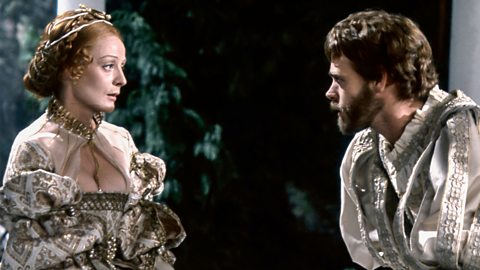
The Merchant of Venice, by William Shakespeare. Starring Maggie Smith and Frank Finlay, with Charles Gray and Christopher Gable.
Shakespeare on 3: The Merchant of Venice. audio
Download an original production of The Merchant of Venice, starring Andrew Scott.
Matthew Gravelle reads from The Merchant of Venice. video
Some of Wales’ most talented actors perform memorable extracts from the great plays as part of the BBC Shakespeare Festival 2016.

Further study
The study of Shakespeare, controlled assessment guidance. activity
Unit 3 of the CCEA GCSE English Literature qualification is a controlled assessment unit based on the study of a play by William Shakespeare.
The Shakespeare Sessions. collection
Your one-stop shop for all things Shakespeare. Catch A-List casts in brand new audio versions of Shakespeare’s greatest plays, plus documentaries from the brightest minds on the bard’s life and work.
Free Thinking - Shakespeare. collection
Leading scholars, insights from actors and directors and new research into the Bard.

More on The Merchant of Venice
Find out more by working through a topic
- count2 of 5
- count3 of 5
- count4 of 5
- count5 of 5