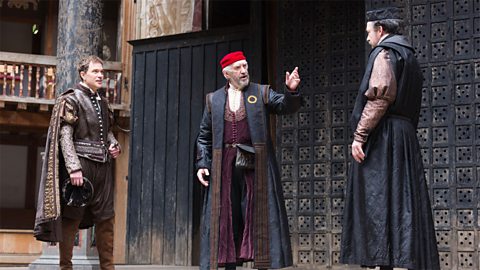
Character overview
- The characters in The Merchant of Venice are divided into Christian and Jewish characters. There is a focus on the Antisemitism is a type of prejudice or discrimination towards Jews individually or as a group. It is based on unfounded stereotypes that target Jews as a people or their religious practices and beliefs. attitudes and behaviours of some of the Christian characters.
- The main characters in The Merchant of Venice are: Shylock, Antonio, Bassanio and Portia.
- The secondary characters are: Nerissa, Gratiano, Jessica, Salerio and Solanio.

When writing about character in the exam, it is important to back your views up with evidence from the text.
The way in which a character speaks and behaves will provide clues.
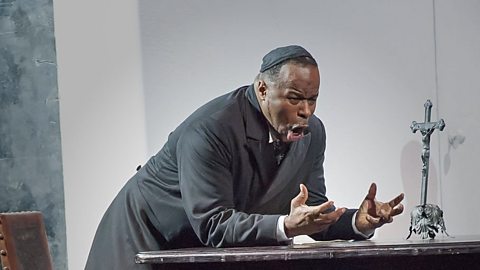
Shylock
Shylock is a Jewish moneylender living in Venice at a time when Jews were restricted by law in what jobs they could do and were often persecuted in wider society. He is wealthy and successful from lending money with interest charged, which was considered immoral by many and thought to be against the rules of Christianity. His wife is dead and he has a daughter, Jessica.
He lends money to Antonio on the condition that he can cut off a piece of Antonio’s flesh if he fails to pay him back on time. Shylock’s hatred of Antonio means he is determined to have the piece of flesh above any monetary reward, and even puts Antonio on trial to get what he is entitled to.
By the end of the play, Shylock is ordered to give away half his fortune and convert to Christianity.
| How is Shylock like this? | Evidence | Analysis |
|---|---|---|
| Bitter and vengeful | ||
| Shylock certainly shows hatred for Antonio and the other Christians, but has been badly treated by them with frequent disrespect and even physical abuse. This context makes it easier to understand his bitterness and desire to get the better of them. | “The villainy you teach me I will execute – and it shall go hard but I will better the instruction” | Shylock makes a clear link between how he has been treated and how he behaves, claiming he has learned to be ‘villainous’ from the Christians’ example. The dash shows a pause midway, which lends a sinister edge to his vow of revenge. |
| Controlling, possessive, obsessed with wealth | ||
| The loss of his daughter is a terrible blow for Shylock. Women were treated as property in society, and she has betrayed him by stealing his wealth, renouncing his faith and leaving his ‘ownership’ without permission. | “I would my daughter were dead at my foot and the jewels in her ear!” | This quote is somewhat shocking – he declares he would rather have his daughter there and dead than alive and away from him. It may be Over-the-top exaggeration for effect., but the fact he also includes the missing jewels indicates that his perspective is now so warped by the loss that he seems to value his wealth above his daughter’s life. |
| Proud | ||
| Shylock is proud of his heritage, religion and his wealth and possessions. He is an outsider in society and feels his success in moneylending is a blow to his enemies, who dislike him but cannot stop him from making money. | “Nay, take my life and all. Pardon not that.” | This quote, at his trial, shows Shylock’s pride – he is suggesting that he would rather lose his life than be forced to live without his wealth. This could show how bitter and corrupted by wealth he has become, but could equally be seen as an attempt to avoid having to live a life that is forced upon him by the Christians he hates, rather than one he chooses himself. |
Question
How could you argue that Shylock deserves our sympathy, despite his cruel and merciless behaviour towards Antonio?
- Shylock has been kicked, spat at and treated as if he was not even a human.
- Many of the characters in the play call him “Jew” rather than use his name.
- His daughter runs away and he is mocked for it.
Whilst it is difficult to excuse his cruelty, an audience may empathise with his pain and feel sympathy for him because of the antisemitic prejudice he encounters.
Antonio
Antonio is the title character of the play – a wealthy and successful merchant who is generally liked and respected in Venice.
He makes an unusual deal with Shylock, allowing Shylock to cut off a pound of Antonio’s flesh if he is unable to repay the money he borrowed. He is put on trial for failure to pay Shylock’s debt but is dramatically saved at the last moment.
He is a complex character whose kindness towards his Christian friends is in sharp contrast to his Antisemitism is a type of prejudice or discrimination towards Jews individually or as a group. It is based on unfounded stereotypes that target Jews as a people or their religious practices and beliefs. hatred of Shylock. It isn’t made clear in the play, but many people interpret his strong devotion to his friend Bassanio as romantic love and suggest he is melancholy at the start of the play because he knows Bassanio may soon marry someone else.
Although Antonio is the title character of the play, he is not an active participant in the events of the story. He is passive – much depends on the outcome of the bargain he makes with Shylock, but the main parts of the plot centre around the romance between Bassanio and Portia and the tragic downfall of Shylock.

| How is Antonio like this? | Evidence | Analysis |
|---|---|---|
| Generous | ||
| Antonio is known in Venice for helping to pay the debts of other Venetians who borrowed from Shylock with interest; he has given or lent Bassanio a good deal of money already but is willing to help with more. | “My purse, my person, my extremest means / Lie all unlocked to your occasions.” | The triple and the superlative “extremest” emphasises how he is willing to give everything to Bassanio. |
| Loyal and devoted | ||
| Antonio has many friends among the Christians but he is particularly loyal to Bassanio – he not only puts his body on the line for him by loaning from Shylock, but in the final scene of the play he vouches for Bassanio again, swearing to Portia ‘on his soul’ that Bassanio wouldn’t let her down again. | “Pray God Bassanio come / To see me pay his debt, and then I care not.” | The earnest reference to God shows how important it is to him to see Bassanio again, while the last statement shows he does not care about his own life in comparison. |
| Antisemitic | ||
| Antonio’s hatred of Shylock may have a personal angle too but there is no doubt he bears a strong prejudice toward him for his Jewish religion and identity, and sees no problem in openly disrespecting and abusing him. | “You call me misbeliever, cutthroat dog, / And spet upon my Jewish The cloak or gown worn by Shylock as an overcoat." – Shylock's description of Antonio’s treatment of him. | Shylock’s account uses direct address to accuse him directly and uses a triple to list the offences, emphasising them by establishing a pattern. |
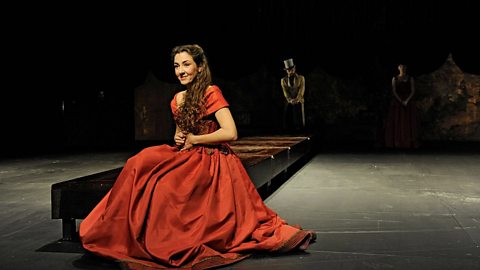
Portia
Portia is an heiress (a lady made rich by inheriting a lot of money) who lives in Belmont. Like all women, she is restricted by the
She loves Bassanio and eventually marries him. It is Portia who saves Antonio at his trial by successfully disguising herself as a male lawyer and arguing his case.
| How is Portia like this? | Evidence | Analysis |
|---|---|---|
| Caring and nurturing | ||
| Portia shows a strong sense of concern for those she cares about. Once she has Bassanio’s love she is determined to protect him from any trouble or worry he might face, which means by extension that she will also help his friends. | “never shall you lie by Portia’s side / With an unquiet soul” | Portia refers to herself in third person, sounding impersonal so her statement seems more factual. The idea she never wants Bassanio to feel worried when he is with her shows how she cares for him, and how she wants to use her wealth, power and qualities to do good and bring peace to others. |
| Modest, honest, humble | ||
| Portia is delighted when Bassanio picks the correct casket and submits to him as a traditional wife. Despite her strong character and virtues, she talks herself down humbly to show her love and say she is now his. | “But the full sum of me / Is sum of something which, to term in gross, / Is an unlessoned girl, unschooled, unpracticèd; / Happy in this – she is not yet so old / But she may learn.” | Portia refers to herself with a triple of adjectives to emphasise how she intends to let Bassanio be the master of her, and promises she is willing to learn from him, showing her modesty and humility. |
| Compassionate, resolute, proactive | ||
| Portia’s plan to help Antonio shows both determination and compassion. She is bold once she decides on her course of action, and her intention to help out in a dire situation makes her certain she will not regret what she does. | “I never did repent for doing good, / Nor shall not now” | The negative language here makes the “good” stand out, The Marked by alliteration - the repetition of a sound at the beginning of consecutive words, such as ‘the big, bold, blue sea' ‘n’ helps reinforce the negative, making her sound steadfast and determined. |
Bassanio
Bassanio is the romantic lead of The Merchant of Venice. He is from a noble family but has wasted most of his own money in his youth; he borrows enough money to allow him to visit Portia in Belmont in the hope he can marry her. He solves the riddle of the caskets successfully, meaning he can marry Portia, and he rushes to help Antonio when he learns that he is on trial.
Bassanio is another complex character in the play. His good qualities of loyalty and intelligence are balanced with his selfishness and lack of responsibility.
However, by the end of the play, Bassanio has expressed deep regret for the trouble he has caused Antonio and appears to be a loving and kind husband to Portia. This shows he is capable of change and has grown as a character.

| How is Bassanio like this? | Evidence | Analysis |
|---|---|---|
| Loyal | ||
| While he does use Antonio’s friendship for money, Bassanio is still a keen and loyal friend to him, and shows loyalty and support to his other friends as well. Male friendship was important to Elizabethans, and Bassanio embodies this spirit. | “To you, Antonio, / I owe the most in money and in love” | The A word that describes the most of something: the biggest, strongest, fastest. “most” shows the extent of what he owes Antonio – more than anyone else. He recognises the financial element but also the “love” of his friend, acknowledging he has given him everything. |
| Irresponsible | ||
| Bassanio is of noble birth but has wasted all his money by living beyond his means. He does not seem to love wealth for its own sake, as Shylock sometimes seems to. Rather he just enjoys living well – whether he can afford to or not. He seems unashamed of this and lives first off money from Antonio and then from Portia. He takes no real responsibility for the money he has lost and isn’t worried about asking Antonio for more. | “’Tis not unknown to you, Antonio, / How much I have disabled mine estate / By something showing a more swelling port / Than my faint means would grant continuance.” | “A more swelling port” indicates the lavish lifestyle Bassanio has been living, though his “faint means” (dwindling funds) cannot support it. He is open and seemingly unashamed of this, claiming it is “not unknown” to Antonio. This phrase is an example of A type of understatement saying what something isn’t, rather than what it is (eg “it’s no joke” for something serious, or “not bad” to mean good). which is used to make the point that Antonio is very aware of Bassanio's money troubles, since he keeps giving him more money. |
| Honest | ||
| While Bassanio could be seen as a kind of cynical gold-digger, his honesty and earnestness makes it hard to think of him as a villainous character. He speaks truthfully, noting his worries about the loan with Shylock before the deal is made and refusing to lie to Portia about the ring. | “When I told you / My state was nothing, I should then have told you / That I was worse than nothing, for indeed / I have engaged myself to a dear friend, / Engaged my friend to his mere enemy / To feed my means.” | This statement shows both Bassanio’s honesty in telling Portia of his financial worries and his concern for Antonio, having just heard he has been arrested. The repetition of “engaged”, the contrast between “dear friend” and “mere enemy” and the A metaphor is a word or a phrase used for dramatic effect, to describe something as if it were something else. “to feed my means” all help to create a tone of regret. This shows Bassanio being open and honest about his part in the situation, as well as a hint of guilt that he has put Antonio in danger. |
Secondary characters
Nerissa
Nerissa is Portia’s waiting woman. Portia confides in Nerissa about her feelings and mocks unacceptable suitors with her. Nerissa disguises herself as the lawyer’s clerk in the courtroom scene to help Portia.
Gratiano
A friend to Antonio and Bassanio. He becomes romantically involved with Nerissa. He is an energetic and witty character with a rude sense of humour and contributes to some of the comedic elements of the play.
Jessica
Jessica is the daughter of Shylock, who disowns him and runs away with Lorenzo, a young Christian man. Jessica’s conversion to Christianity is humiliating to Shylock. Shylock is also worried about the money that Jessica steals from him when she runs away.
Salerio and Solanio
Two of Antonio’s friends who often discuss events that have happened offstage – such as the loss of Antonio’s ships or Shylock’s reaction to the disappearance of Jessica. Shylock delivers his speech about the mistreatment of Jewish people to Salerio and Solanio.
In some versions of the text, Salerio is known as Salarino, though his character remains the same.

Staging during Shakespeare's time – audiences would talk about going to “hear a play” rather than “watch a play”.
Staging and costume were usually quite simple. Salerio and Solanio’s explanations and descriptions of off-stage action would therefore not be unusual.
Minor characters
Lorenzo – a Christian friend of Antonio, with whom Jessica elopes. They seem to end the play happily married, but the mythical and historically famous lovers to whom they compare themselves all had relationships that ended in tragedy – perhaps a hint of bad things to come.
Launcelot Gobbo – a servant who leaves Shylock’s household to work for Bassanio instead. He is a ‘clown’ figure, or fool – a stereotype of a witty working-class character found in many Shakespeare plays.
Tubal – Shylock’s only friend in the play, a fellow Jew whom he trusts greatly and refers to as being from ‘his tribe’.
The Duke of Venice – the ruler of the city, who presides over Antonio’s trial. His city depends on trade and has to maintain its reputation for honest dealing; he tries to persuade Shylock to show mercy but cannot use his power to excuse Antonio of the debt in case this affects the image of Venice as a place that upholds its legal contracts.
Dr Bellario – Portia’s cousin, a respected lawyer in Padua. He never appears on stage but is important in providing her with the letter of introduction to allow her to pretend to be a lawyer herself.
The Prince of Morocco and the Prince of Aragon – two of the many suitors of Portia. Both are rich and important men, but both fail, nevertheless, to pick the correct casket to win her hand. They both condemn themselves to a life without marriage or heirs, since the terms of Portia’s father’s mean anyone who fails is not allowed to seek another marriage.
Test your knowledge of the characters in The Merchant of Venice
The Merchant of Venice performed
Play of the Month. video
The Merchant of Venice, by William Shakespeare. Starring Maggie Smith and Frank Finlay, with Charles Gray and Christopher Gable.

Shakespeare on 3: The Merchant of Venice. audio
Download an original production of The Merchant of Venice, starring Andrew Scott.
Matthew Gravelle reads from The Merchant of Venice. video
Some of Wales’ most talented actors perform memorable extracts from the great plays as part of the BBC Shakespeare Festival 2016.

Further study
The study of Shakespeare, controlled assessment guidance. activity
Unit 3 of the CCEA GCSE English Literature qualification is a controlled assessment unit based on the study of a play by William Shakespeare.
The Shakespeare Sessions. collection
Your one-stop shop for all things Shakespeare. Catch A-List casts in brand new audio versions of Shakespeare’s greatest plays, plus documentaries from the brightest minds on the bard’s life and work.

Free Thinking - Shakespeare. collection
Leading scholars, insights from actors and directors and new research into the Bard.

More on The Merchant of Venice
Find out more by working through a topic
- count3 of 5

- count4 of 5

- count5 of 5

- count1 of 5