Relevant context for The Merchant of Venice

Context is important, but don’t use too much!
A few small and relevant references used to support your points about the play are far better than huge chunks of unrelated information – even if the information is interesting.
Antisemitism
The Merchant of Venice is considered controversial because of its portrayal of Antisemitism is a type of prejudice or discrimination towards Jews individually or as a group. It is based on unfounded stereotypes that target Jews as a people or their religious practices and beliefs. – a type of prejudice or discrimination towards Jews individually or as a group. It is based on unfounded stereotypes that target Jews as a people, or their religious practices and beliefs; it was common across Europe for hundreds of years, even before Shakespeare wrote The Merchant of Venice.
- In Venice itself, Jewish people had been forced to live in a separate area of the city since 1516 – these separate areas were common in European cities and came to be known as ghettos.
- Jewish people were banned from living in England altogether in 1290 and, while some had returned by the 16th century, they would still have been a small minority in the country. They may have been forced to either practise their religion secretly or to live in closed communities with other Jews for support, being viewed with intense suspicion by outsiders.
- Elizabethan audiences would have been likely to hold at least partly antisemitic views because of this.
The impact of antisemitism has resulted in Jewish people facing discrimination, being banished or even murdered for centuries. The long history of antisemitism in Europe was exploited by Hitler in building towards the Holocaust during World War Two, in which millions of Jews and other minorities were murdered.
Today there are various interpretations of antisemitism in The Merchant of Venice.
- Modern audiences may find it shocking that Antonio, an otherwise likeable character, is openly prejudiced against Shylock and admits to being verbally and even physically violent towards him, based solely on him being Jewish.
- The ending of the play, with Shylock’s forced conversion to Christianity, is also hard to justify. Many The 'Golden Age' of the reign of Queen Elizabeth 1st in Britain from 1558-1603. theatre-goers would have been pleased by this, as they would feel assured that Shylock’s soul could now be saved by the Christian God they believed in, but modern audiences may be disgusted that Shylock is forced to give up his religious freedom.
- People cannot fully agree on whether the play is antisemitic or seeks to criticise antisemitic behaviour, and this is one of the reasons it is sometimes described as a “problem play”.
Money and wealth
English society was firmly divided along lines of social class, from upper class nobles and aristocracy to peasants who were poor and had few possessions. Money was largely inherited in families, and strict social rules usually kept people in the class they were born into. However, in Shakespeare’s time, cities were growing, new business opportunities were becoming available and an emerging class of traders and merchants were appearing in society.
- Venice itself had little industry – meaning it did not farm, make or manufacture enough to boost its local economy – but it was known worldwide as a trading port, where business owners and shipping merchants could strike deals to send goods all over the world.
- The fact it was a hub of commerce meant that those with businesses who earned them money became more powerful and important than those who simply inherited wealth or had noble titles, and so money was a key factor in who was secure, powerful and accepted in Venetian society.
- Bassanio is a good example of this – he is of noble birth and considered a gentleman by society, yet he has no money of his own and has to borrow (from Antonio) or marry into (with Portia) the wealth he feels he needs to live a life that meets his status.
The significance of money in this society was a partial factor in Shylock’s obsession with wealth. As an outsider who is not accepted socially in the city, he feels it is important that he amasses enough money to secure his family and ensure he cannot be overlooked, even if he is despised.
- Lending money to people at high interest rates., the principle of lending money with interest charged on it, was considered to be against Christian teaching in these times.
- Conversely, there was a long tradition of Jewish communities functioning as money-lenders in European cities because it was one of the few trades in which they were allowed to participate. People looked down on moneylenders but also needed them, particularly in a city like Venice where businesses may have needed money upfront before ships came in or stock could be sold.
- Shylock charges interest on his money to make a living; others judge him for it yet still use his services, and the law dictates that, as a Jew, there aren’t many other professions he is allowed to engage in. Viewed in this way, his bitterness may be easier to understand.
Patriarchy and gender roles
A period in European history from 1300-1600 which saw new scientific discoveries and the creation of great art. England was a A social system in which men rule and hold power over women. society, in which men held the positions of power and women were considered little more than their father’s or husband’s property.
- Marriage was important to forge a connection between two families of equal wealth and status – a ‘good’ marriage meant family fortunes and titles were preserved and consolidated. It could even provide business opportunities or a rise in social status, and these were considered the important factors in a marriage – not love between individuals.
- In Elizabethan England, and in the world of the play, women were expected to be wives, mothers and homemakers and had very little power or influence.
- Women were not allowed to act on stage, so in Shakespeare’s plays the company of actors would use young men whose voices had not broken for younger parts, such as Jessica in The Merchant of Venice, and older men for mature female roles.

Portia: In the play, Portia has to abide by the rules of her father’s will, marrying whoever solves the riddle even if she does not feel love for them.
She is a clever and confident woman with strong views about others and on her own situation, but she never speaks these views publicly. She can only speak in private to her waiting woman Nerissa.
Arguably the only time that Portia has any real power in the play is when she disguises herself as a man.

Jessica: Jessica would have been expected to submit to the wishes of her father absolutely and to allow him to arrange her marriage to a suitor he chose.
The fact she rebels against him to run away with a Christian man she chooses herself isn’t just personally hurtful to him or damaging to his religious beliefs as an orthodox Jew – it is also an insult to his patriarchal authority over her and a huge blow to his pride.
It is worth noting that three women are involved in the bringing down of Shylock, but all three must dress as men to do so.
Because of the secondary role of women in society, it was common for men to have close friendships with other men of similar status.
- This is more generally seen in the camaraderie and support offered by Antonio’s friend group, such as when Lorenzo thanks his friends for waiting at Jessica’s house and promises to wait for them if they ever need to secretly arrange an elopement themselves.
- More specifically, the devotion of Antonio to Bassanio would not have been seen as especially unusual but as a form of A relationship that is loving but not sexual (friend-like) love between the men.
- Some critics believe Antonio feels romantic love towards Bassanio but there is not enough evidence in the text to directly support or deny this, and their close friendship as it is would not have been strange to audiences of the time.
The Merchant of Venice performed
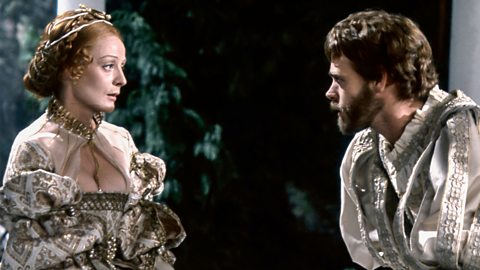
Play of the Month. video
The Merchant of Venice, by William Shakespeare. Starring Maggie Smith and Frank Finlay, with Charles Gray and Christopher Gable.
Shakespeare on 3: The Merchant of Venice. audio
Download an original production of The Merchant of Venice, starring Andrew Scott.
Matthew Gravelle reads from The Merchant of Venice. video
Some of Wales’ most talented actors perform memorable extracts from the great plays as part of the BBC Shakespeare Festival 2016.

Further study
The study of Shakespeare, controlled assessment guidance. activity
Unit 3 of the CCEA GCSE English Literature qualification is a controlled assessment unit based on the study of a play by William Shakespeare.
The Shakespeare Sessions. collection
Your one-stop shop for all things Shakespeare. Catch A-List casts in brand new audio versions of Shakespeare’s greatest plays, plus documentaries from the brightest minds on the bard’s life and work.

Free Thinking - Shakespeare. collection
Leading scholars, insights from actors and directors and new research into the Bard.

More on The Merchant of Venice
Find out more by working through a topic
- count5 of 5
- count1 of 5
- count2 of 5
- count3 of 5
