The controlled assessment
The controlled assessment theme for Unit 3: The Study of Shakespeare changes every year. Current themes can be found on the CCEA website. Recent examples of themes for study have included forgiveness, ambition, and power – the topic will be general enough to apply to a wide range of Shakespeare plays.
The choice of play and the specific wording of the question you will answer is up to your class teacher.
Questions can be left fairly open regarding the theme, such as:
Examine the way Shakespeare presents the theme of justice in The Merchant of Venice.
Alternatively, the theme may be explored through a more specific focus, for example:
Who is more to blame for Shylock’s downfall: Shylock himself or Venetian society?
The following essay questions are examples that not only touch on relevant topics and potential controlled assessment themes, but also try to frame the focus in a way that makes for an interesting argument in your essay. Consider how you might answer the following theme-based questions about The Merchant of Venice:
- Is wealth always a destructive force in The Merchant of Venice?
- How does Shakespeare use the ideas of mercy and revenge to comment on events in The Merchant of Venice?
- Examine how Shakespeare presents relationships between men and women in The Merchant of Venice.
- What parts do loyalty and disloyalty play in The Merchant of Venice?
- To what extent can Shylock be considered a victim of a cruel and hostile Christian society?
- Analyse how Shakespeare presents female characters in The Merchant of Venice with reference to the characters of Portia, Nerissa and Jessica.
Example essay
Here are the opening paragraphs of an example essay written in answer to the following question:
Is wealth always a negative influence in The Merchant of Venice?
Read carefully and note how the writer of the piece:
- Demonstrates their knowledge of the overall play
- Incorporates small amounts of relevant context
- Proposes an initial answer to the question – that it isn’t always destructive but can cause harm by leading people to act in destructive ways – which they then consistently support throughout the essay with relevant points and evidence
Be aware that there is no ‘correct’ answer to the question – the writer’s argument here is based on the evidence they have analysed, and would be judged on how well they seem to have argued their point and weighed up their conclusions.
Q: Is wealth always a negative influence in The Merchant of Venice?
A: Shakespeare’s The Merchant of Venice was initially classed as a comedy, and contains many comic elements including romance and marriage, use of disguise and a ‘fool’ or standard clown figure. However, there are undoubtedly some serious and tragic elements to the play which mean it is usually now classed not as fully comic or tragic but as a ‘problem’ play. The main reason for this lies in the antisemitic treatment of the character Shylock, whose Jewish identity is used in the play to make him both a victim and a villain. Stereotypes about Jews included their controlling and hoarding of wealth, and this is certainly seen in the characterisation of Shylock, who shows an obsession with money and goods. Wealth itself can also be seen to be a problematic aspect of the wider play. It could be argued that it is shown to be a negative influence some of the time, but in many instances the negative influence of wealth serves only to hide or worsen deeper issues such as prejudice, recklessness or vengeance.
There are two main storylines within the plot of The Merchant of Venice – the trial of Antonio and the courtship of Bassanio and Portia. These interlink, and both revolve around wealth. Antonio is brought to trial and faces death because of his failure to pay back a loan owed to Shylock; the loan itself was taken so that Bassanio could woo Portia, a courtship partly driven by his need to pursue a rich wife after spending all his own money. In both of these storylines, wealth can be seen at first as being a negative influence. It leads to situations where money is leveraged against a human life and what is supposed to be a loving, committed relationship. However, while money is the factor that leads to Shylock having the power of life or death over Antonio, it isn’t what drives him at that point. This can be seen at the trial, when Shylock refuses Bassanio’s offer to repay double or triple the amount of money owed and instead insists “I would have my bond” – the repetition of this phrase in the play shows he is set on causing Antonio mortal harm, not on making a good return on his investment. Shylock’s fixation on vengeance is more of a negative influence here than his love of wealth. Likewise, Bassanio could be seen as a cynical gold-digger who only courts Portia for her money, but it is made clear even when he first mentions her that he considers her “fair” and “of wondrous virtues”. Portia clearly feels love for him too, and despite the issue of him giving up her ring after the trial, they seem to have the basis of a sound married relationship by the end of the play. Therefore, it could be said that wealth has not had an overly negative influence on the courtship of Portia and Bassanio.
This essay could then go on to:
- Analyse Shylock’s preoccupation with money, goods and possessions, which becomes so warped and obsessive that he even wishes his daughter were dead before him so he could have his stolen property back, showing money as a negative influence.
- Contrast the importance of trade and commerce in Venetian society with the hypocritical hatred shown to Shylock for practicing usury in his money-lending. This could suggest wealth is a negative influence, but could also be seen more as an example of human prejudice.
- Examine how wealth traps Portia, a clever and largely virtuous character, who is held hostage by the terms of her father’s will and forced to entertain suitors not of her choosing who are enticed by her wealth and status; a need for wealth also leads Jessica to steal from her own father (Shylock), suggesting a negative influence. It is worth looking at whether the loss of his daughter is worse than the loss of his money, or if it is her conversion to Christianity and betrayal of her Jewish heritage that bothers Shylock more. Which, to him, would be the more negative influence between wealth and Christianity?
- Look at possible counterargument. To show full understanding of the question, you might also examine instances in the play where wealth may not be a negative influence, to demonstrate awareness that it is not necessarily "always" so. For example, you could suggest it is positive that Portia's wealth allows her to help Antonio. You could even argue that the promise of inheriting in Shylock’s will means hope for the future for Jessica and Lorenzo. However, you could also explain why these examples are not as positive as they first appear. Portia's wealth does not actually solve the conflict with Shylock since he does not take her money anyway. Jessica and Lorenzo stole from Shylock in the first place and renounced his religion – is it actually positive that they would profit from his death? Showing knowledge of both sides of the argument helps you reach a stronger conclusion when responding to the question statement.
The Merchant of Venice performed
Play of the Month. video
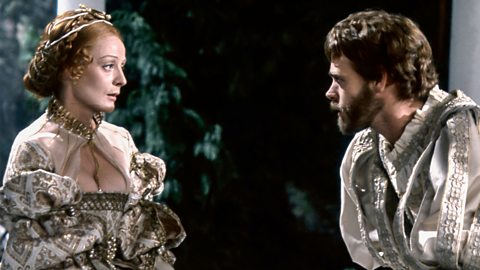
The Merchant of Venice, by William Shakespeare. Starring Maggie Smith and Frank Finlay, with Charles Gray and Christopher Gable.
Shakespeare on 3: The Merchant of Venice. audio
Download an original production of The Merchant of Venice, starring Andrew Scott.
Matthew Gravelle reads from The Merchant of Venice. video
Some of Wales’ most talented actors perform memorable extracts from the great plays as part of the BBC Shakespeare Festival 2016.

Further study
The study of Shakespeare, controlled assessment guidance. activity
Unit 3 of the CCEA GCSE English Literature qualification is a controlled assessment unit based on the study of a play by William Shakespeare.
Shakespeare: Love Across the Racial Divide. audio
Yasmin Alibhai-Brown explores the complex role of Shylock in Shakespeare’s The Merchant of Venice. From 2016.

Free Thinking - Shakespeare. collection
Leading scholars, insights from actors and directors and new research into the Bard.

More on The Merchant of Venice
Find out more by working through a topic
- count1 of 5
- count2 of 5

- count3 of 5

- count4 of 5