The form of William Shakespeare's The Merchant of Venice
Comedy in Shakespeare’s time was something more like a modern audience’s understanding of a rom-com, or romantic comedy – it mostly revolved around love and marriage, with the main characters getting married or at least engaged by the end. Comedies often began with a problem (such as Portia’s casket riddle and Bassanio’s money worries) and ended with a happy resolution. Disguise and confusion would also be involved, and these elements can be seen in The Merchant of Venice.
Shakespeare’s A type of drama in which characters undergo suffering or calamity and which usually ends with a death. A sad or catastrophic event causing suffering or death. often centred around the ruin or destruction of a single character who had a In tragedy this refers to a defect in someone's character that leads them to a bad end., or character trait that ruined them. The character usually began in a strong position, but their fatal flaw combined with the events of the play would lead to his or her downfall.
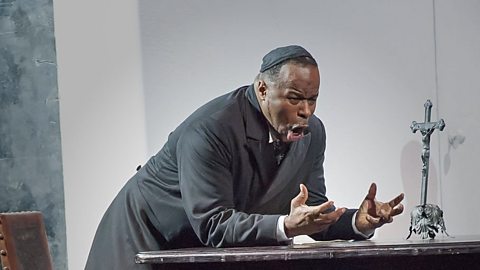
The Merchant of Venice was first classified as a comedy, but it has tragic elements too – most obviously the downfall of Shylock, who is seen both as a victim of terrible prejudice and as a villain or A character who creates conflict with the main character.. Shakespeare makes Shylock a complex character who is neither all good nor all bad, and the audience may feel sorry for him but also recognise his wrongdoing at the same time. The combination of comic and tragic traits in this play leads many to class it as a A play or novel that blends elements of both comedy and tragedy, making it both sad and funny..
The play raises many questions about prejudice, justice, mercy and revenge, and it does not offer the audience any easy answers or tell them exactly how to feel about these questions. Because of this, The Merchant of Venice is sometimes referred to as a ‘problem play', where the playwright has highlighted issues to make us think but not included solutions to the problems.
Can you tell comedy from tragedy? Test your knowledge with this quiz…
The structure of William Shakespeare's The Merchant of Venice
The play is divided into five In drama, an act is a section of the performance, usually made up of a number of scenes., although it is probable that Shakespeare himself didn’t organise it in this way for performance and that editors imposed this structure on the play when first publishing it.
This five-act structure is fairly standard for a Shakespearean comedy, starting with The part of a narrative that sets the scene for the audience, for example giving the backstory of the characters or information about the setting. introducing the main characters and situation; The main events in a story, building up to the point of greatest interest. taking in Portia’s suitors, Jessica’s elopement and the loss of Antonio’s ships at sea; the dramatic An exciting end of a text. in which Antonio is arrested and brought to court; the The part of a story that happens immediately after the biggest turning point or the most intense moment. in which Portia saves Antonio by disguising herself as a lawyer and defeating Shylock; and the dénouement or resolution, which restores everything back to order and brings forth a happy ending for most of the characters.
The five-act structure in detail
1. Introduction
Act 1 - An introduction to all characters and their situations: Antonio is sad for no reason, whilst Bassanio needs his help.
Portia is in Belmont – will a suitable suitor choose the right casket?
Antonio and Bassanio strike a deal with Shylock regarding the loan and the pound of flesh.
2. Rising action
Act 2 and Act 3 – Portia is introduced in Belmont. Her unsuccessful suitors choose the wrong caskets and fail to solve the riddle to become her husband.
Shylock’s daughter Jessica plots with young Christian Lorenzo to escape from her father.
Bassanio solves the riddle of the caskets allowing him to marry Portia, but disaster strikes for Antonio when his ships are lost at sea.
Shylock learns of Antonio’s misfortune but also discovers his daughter has run away with Lorenzo.
3. Climax
The climax is the important turning point in the story that everything has been building up to.
Act 3 and Act 4 - Antonio is arrested and Portia forms a plan to secretly represent Antonio in court. Shylock and Antonio face each other in court.
4. Falling action
Act 4 – Portia appears disguised as a young lawyer and outwits Shylock. Shylock loses his wealth and his religion. Antonio is now a free man.
5. Resolution
Act 5 - A comical resolution involving Bassanio’s wedding ring, which he has given away to the lawyer. Portia’s identity as the lawyer is revealed. There is a happy ending for many of the characters.
Language and dramatic methods in Shakespeare's The Merchant of Venice
You will need to comment on language and dramatic methods in your controlled assessment, and analyse how and why they are used. Consider your topic carefully and analyse the most relevant scenes to that topic – below are some more general ideas to help you write meaningfully about the use of language in the play.
Rhythm and rhyme
The structure of the language simply means the different types of speech used for different characters. The lines of most significant Shakespearean characters are mainly composed in Lines in a poem that don't rhyme, usually in iambic pentameter - five two-syllable feet per line. – unrhymed One ‘iamb’ is a two-beat combination: an unstressed syllable followed by a stressed (emphasised) syllable, making a ‘da-DUM’ pattern, like a heartbeat. Pentameter means five of these two-beat units per line, making ten syllables altogether. You may be familiar with iambic pentameter from poetry as it is a commonly used The rhythm of a line of poetry based on how many syllables it has and where they are stressed or emphasised – likes beats in music. (arrangement of rhythmic beats). One ‘iamb’ is a two-beat combination: an unstressed Each individual part of a word which is pronounced when the word is said aloud. followed by a stressed (emphasised) syllable, making a ‘da-DUM’ pattern, like a heartbeat. A line of poetry that has five metric feet or beats in it. means five of these two-beat units per line, making 10 syllables altogether. Antonio’s first line in the play is an example of this:
|In sooth | I know | not why | I am | so sad |
|da-DUM | da-DUM | da-DUM | da-DUM | da-DUM |
Blank verse was used to show a character of importance and worth and to give weight to significant moments – much of the courtroom speech between Shylock, the Duke, Antonio and Portia uses blank verse to elevate it.
Portia and Nerissa’s The words said by a character in a story or play. in Act 1, Scene 2 is in Ordinary language both spoken or written; different from poetry (which does not reflect everyday speech patterns). (unarranged or disorganised rhythms, akin to normal speech), allowing them to show their closeness with informal, familiar chat that allows them both to make witty observations about Portia’s situation.
In this example, prose allows them casual freedom and shows their closeness. Prose is also used for less important characters like Launcelot Gobbo, the former servant of Shylock who goes to work for Antonio.
Can you tell verse from prose in The Merchant of Venice? Test your knowledge with this quiz…
Soliloquy and monologue
A A speech performed by a character, often depicting that person thinking or talking aloud to his or herself. is a speech given by a character which reveals their inner thoughts. It is usually done when the character is alone, or at least speaking in an ‘aside’ that is not overheard by other characters, meaning it is a way of the writer showing the truth of a situation from that character’s perspective. Soliloquys can be important in enabling the audience to see what really motivates the characters. This often helps to create When the audience knows something that the characters don’t. in the play, allowing the audience to see things that the other characters do not – Shylock’s deep dislike of Antonio, for example, which he initially hides when speaking to Antonio directly. Shylock's aside in Act 1, Scene 3 (when Antonio enters and he details his hatred of him) is an important soliloquy in The Merchant of Venice because it helps the audience understand the sinister motive behind his “merry bond” – to get revenge on Antonio. Jessica also gives a pair of short soliloquys during Act 2 to help the audience understand her love for Lorenzo.
Remember a soliloquy is only heard by the audience. There are other examples of important speeches in the play which are A speech delivered by a single character in which he or she is thinking out loud. – spoken by a single character but heard by one or more of the other characters. Famous monologues in The Merchant of Venice include:
- Shylock’s address to Antonio in Act 1, Scene 3, recounting Antonio’s antisocial and antagonistic behaviour towards Shylock;
You call me misbeliever, cut-throat dog, And spit upon my Jewish gaberdine
- Shylock’s speech in Act 3, Scene 1, comparing the body and needs of a Jew to those of every other human being;
Hath not a Jew eyes? Hath not a Jew hands, organs, dimensions,
senses, affections, passions?
…
If you prick us, do we not bleed? If you tickle us, do we not laugh?
If you poison us, do we not die?
- Portia’s courtroom speech on “The quality of mercy” in Act 4, Scene 1.
Don’t confuse soliloquys and monologues!
Symbolism
The main A literary device where an object, person, place, or event represents something beyond its literal meaning. used in the play are the caskets of Portia’s father’s riddle and the rings given by Portia and Nerissa to their husbands Bassanio and Gratiano. The purpose of the caskets seems to be a symbol of the difference between inner reality and outer appearance; only those who understand the value in a casket of humble lead could understand the value of inner beauty, it suggests. The rings represent the traditional elevated and ideal side of marriage – eternal commitment and faith – but are also linked to female genitalia. This is hinted at earlier in the play when the eloped Jessica is said to have traded a ring she stole from Shylock for a pet monkey and is shown again in the final scene when Portia and Nerissa pretend to have slept with the lawyer and clerk to regain their rings and when Gratiano makes his final A metaphor is a word or a phrase used for dramatic effect, to describe something as if it were something else. joke of the play. This can be seen as a comment on the relationship between human relationships and financial transactions which links into the wider themes of materialism, greed and generosity in the play.
There is a further dimension to the A literary device where an object, person, place, or event represents something beyond its literal meaning. of rings – the fact Shylock is so upset by the loss of the particular ring Jessica stole, given to him by someone named Leah (presumably his dead wife), adds a human dimension to him – the ring clearly had sentimental value as well as a monetary one, and with the loss of it as well as his daughter, Shylock seems to become ever more isolated, warped by hatred and set on vengeance.
Repetition
Repetition features heavily in the speeches of Shylock. In earlier scenes, such as when Bassanio keenly discusses the terms of a loan with him, his Where a word, phrase or idea is repeated for emphasis. of Bassanio’s phrases suggests he is thinking carefully over the terms – perhaps even scheming.
Later, he repeats “I will have my bond”, showing his fixation with revenge on Antonio. At the trial, his praise of Portia in disguise as a lawyer – referring to her intelligence and nobility and A quick reference - often to an image, character or place - from a work of literature or music or mythology. to the Jewish prophet Daniel, known for his wisdom – uses repetition to show his approval of her judgement when he believes she will get him what he wants. Gratiano also uses repetition when he mockingly repeats Shylock’s own praise of the lawyer when her judgement starts to favour Antonio.
Imagery
Imagery of demons and evil: The Christians dislike and distrust Shylock as a Jew; he is frequently verbally abused, and when they discuss him, they frequently associate him with the Christian devil and the concept of evil.
- The idea of him as a “misbeliever” and a “faithless Jew” indicates the characters (and indeed most of Shakespeare’s audience) would have believed that any religion aside from Christianity was blasphemous and wrong.
- Shylock is referred to as a “devil”, a “fiend” and an “evil soul” at various points. His disagreement with Antonio over a Bible story leads Antonio to exclaim how “The devil can cite Scripture for his purpose!”, suggesting Shylock is not only evil but also misleading and deceptive in using Christian scripture against Christians.
- Later, when Portia’s courtroom speech claims that mercy is like “gentle rain from heaven” and “an attribute to God himself”, it is clear that the ‘merciful’ Christians are associated here with the side of goodness and God; the ‘vengeful’ Jew is suggested to be the opposite.
Imagery of animals: Shylock is frequently dehumanised and metaphorically compared to an animal, most often a dog: “cut-throat dog”, “dog Jew”, “inexecrable dog”.
- Shylock notes that he has been spat on and kicked by Antonio in public as if he were a “stranger cur” or stray dog.
- Later, when he has the power to deny Antonio mercy, he turns Antonio’s slur back on him, saying: “Thou call’dst me dog before thou hadst a cause, / But since I am a dog, beware my fangs.”
As he loses hope during the trial, Antonio calls himself a “tainted wether of the flock”, meaning a castrated and diseased ram ripe for slaughter – this A metaphor is a word or a phrase used for dramatic effect, to describe something as if it were something else. shows both his sense of hopelessness and an idea that his lack of family or heirs means he is not worth saving in lieu of a young married man like Bassanio.
During the trial, Shylock uses the image of animals and slaves as things Venetians purchase in order to illustrate his ‘ownership’ of Antonio’s life, dehumanising him. He makes a speech in which he explains to the Duke that he intends to pursue his bond against Antonio simply because it is his “humour” or mood; in it he uses the imagery of a “a gaping pig” and “a harmless necessary cat” as creatures a man might hate for no real reason; he is using these examples to associate them with Antonio and further dehumanise and debase him.
Test your knowledge of William Shakespeare's The Merchant of Venice
The Merchant of Venice performed
Play of the Month. video
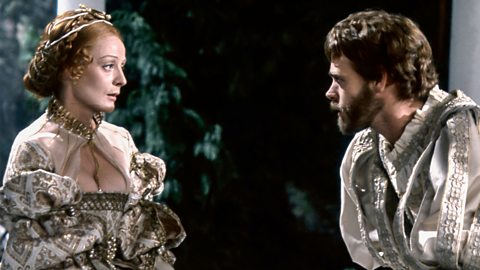
The Merchant of Venice, by William Shakespeare. Starring Maggie Smith and Frank Finlay, with Charles Gray and Christopher Gable.
Shakespeare on 3: The Merchant of Venice. audio
Download an original production of The Merchant of Venice, starring Andrew Scott.
Matthew Gravelle reads from The Merchant of Venice. video
Some of Wales’ most talented actors perform memorable extracts from the great plays as part of the BBC Shakespeare Festival 2016.

Further study
The study of Shakespeare, controlled assessment guidance. activity
Unit 3 of the CCEA GCSE English Literature qualification is a controlled assessment unit based on the study of a play by William Shakespeare.
The Shakespeare Sessions. collection
Your one-stop shop for all things Shakespeare. Catch A-List casts in brand new audio versions of Shakespeare’s greatest plays, plus documentaries from the brightest minds on the bard’s life and work.
Free Thinking - Shakespeare. collection
Leading scholars, insights from actors and directors and new research into the Bard.

More on The Merchant of Venice
Find out more by working through a topic
- count4 of 5
- count5 of 5
- count1 of 5
- count2 of 5