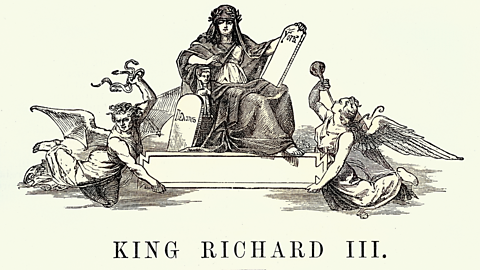
Context relevant to Richard III
In your controlled assessment it is important you consider the context of Richard III. References to context should be relevant both to the play and to the argument/theme of your essay. Context should be explored throughout your essay and not simply ‘stuck on’ at the beginning or the end.
Below are several aspects of context which you may wish to consider in the preparation of your essay.
Biographical context
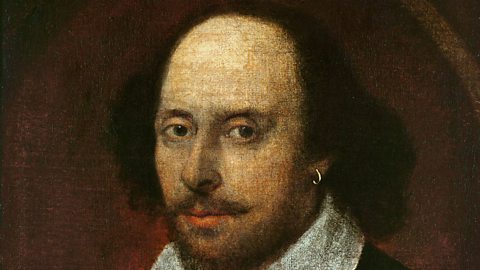
Shakespeare lived from 1564 to 1616.
He wrote Richard III around 1592, which was early in his career as a playwright.
Shakespeare wrote plays for commercial theatre – being a playwright was his job. His aim was to entertain his audiences, so his plays were not always historically accurate. He crafted his play to reflect the politics of the time and he had to be careful not to offend the monarch on the throne – at this time, it was Queen Elizabeth I.
Shakespeare would have used sources like A late‑16th‑century compilation of the histories of England, Scotland and Ireland that became a major source for Shakespeare and other writers., but he changed details to create drama and engage the interest of his audiences.
Social context
The 'Golden Age' of the reign of Queen Elizabeth 1st in Britain from 1558-1603. society in England was concerned with order, stability and the dangers of civil war; they would have been very aware of the A conflict between the houses of Lancaster and York, which lasted from 1455 to 1487. The two sides were rival claimants to the English throne. . They knew what could happen when a monarchy was weak, disputed or a position was falsely obtained.
The The royal dynasty that ruled England and Wales between 1485 and 1603, starting with Henry VII and ending with Elizabeth I, through the English Reformation and England becoming a world power. myth painted Richard III as a A way of governing or ruling that is oppressive and cruel to the people. – so it would seem the Tudors’ victory was divinely ordained.
Gender and marriage
This play was probably written around 1592. At this time there were strict gender roles and men held most of the power. Marriage was seen as a social contract and often based on social status rather than love. Richard III appears to view marriage as a political tool – he first marries Lady Anne Neville to strengthen his claim to the throne and later plans to marry Elizabeth of York to consolidate his power.
Class
Society adhered to a hierarchy at the time, where the class system is clearly defined. Shakespeare’s play focuses mainly on the nobility. In Act 2 the citizens discuss the political situation with fear and uncertainty. Their inclusion in the play allows Shakespeare to illustrate how the actions of the nobility can affect the vulnerable lower classes.
Religion
Shakespeare was writing for a Christian society, and religion was a key part of people’s lives. Christian concepts such as sin, virtue, repentance and divine justice influenced and shaped everyday thinking. Richard III’s rise and fall would have been viewed as a Concerned with the principles of right and wrong behaviour. warning – evil may take over, but God will ultimately prevail and restore order.
Shakespeare uses biblical references, prayers and oaths throughout the play. When Richard appears between two religious figures holding a prayer book in each hand, he is using religion to influence the people and make them believe he is morally good and humble. His fake piety showed how he used religion as a political prop – this would have been viewed as sinful to the Elizabethan audience and would have shaped their view of Richard.
The church is discussed as sanctuary by the Duchess of York and Queen Elizabeth in the play. Richard’s disregard for this sanctuary would have indicated to the audience that Richard was not only a political threat but also a spiritual one.
The eve of the final battle is set on All Souls’ Day, which could symbolise that Richard’s time was coming to an end.
The Divine Right of Kings
This was a belief in the Elizabethan era that kings were chosen by God and therefore anyone who interfered with this process was going against the will of God. In the play, Richard intervenes time and time again to ensure he is crowned king. His ultimate death would have been seen as God restoring order.
Historical context
Queen Elizabeth I
Under the reign of Queen Elizabeth I there was political stability. However, there was some anxiety and concern about succession and social order. Queen Elizabeth I did not marry and did not have any children. At the time the monarch could name the heir to their throne, but Queen Elizabeth refused to do this. Given these circumstances and the historical events (the Wars of the Roses), it is understandable that Shakespeare’s audience would have had an interest in the restoration of social order and the monarchy at the end of Richard III.
The Wars of the Roses
The Wars of the Roses was a series of civil wars in England which took place between 1455 and 1487. The wars were between the House of Lancaster (whose emblem was a red rose) and the House of York (whose emblem was a white rose). Richard III was the last king of the House of York. He was defeated by Henry Tudor (Henry VII), who founded the Tudor dynasty. His marriage to Elizabeth of York ended the civil unrest between the two houses and restored peace. Interestingly, they combined the two roses to make a Tudor rose which was red and white.
Shakespeare’s audiences would have been very familiar with this history, and the Tudors were still in power when he wrote the play. This would have influenced how he presented the story. To justify their ruling position, the Tudors often portrayed Richard III as a villain – this was something Shakespeare also did (perhaps a mixture of truth, tradition and keeping the monarchy on side).
The Great Chain of Being
This was a belief held by Elizabethan society. They believed that everything in the universe had a specific place in a hierarchy. This fixation with social order is reflected in the play where, after the chaos of the play and historical events, the Tudor era begins restoring order to society.
Literary/theatrical context
Genre
Richard III is a history play, but it also has aspects of a A type of drama in which characters undergo suffering or calamity and which usually ends with a death. A sad or catastrophic event causing suffering or death. and A medieval drama in which characters personify virtues and vices to teach a clear moral lesson to the audience.. Shakespeare’s history plays often explore power, legitimacy and kingship; these are themes that would have been of interest to Elizabethan audiences.
Machiavellian character
Richard is presented as a Someone who is cunning and sneaky, using tricks or lies to get what they want without caring if it is right or wrong. Often believing that "the ends justify the means" villain – someone who is cunning, ruthless and power-hungry. This type of character was popular in literature of the time and originates from the Italian political thinker Niccolò Machiavelli (1469–1527). Machiavelli argued that a successful ruler might lie, manipulate, break promises, use fear and act immorally to protect the state.
Shakespearean theatre
Theatre was a popular form of entertainment during Shakespeare’s time. All classes of society attended plays. Theatre was not just entertainment, but could deliver morals and messages.
At the time, theatres were open-aired and contained a mixture of seating and standing areas. Scenery and props were minimal, so the language had to communicate a strong sense of setting. This is evident in Richard III, where Shakespeare uses strong visual imagery. He uses a A metaphor is a word or a phrase used for dramatic effect, to describe something as if it were something else. to suggest a cold, oppressive atmosphere: “Now is the winter of our discontent”. This opening line sets the mood for the rest of the play.
Actors
It is interesting to note that females were not allowed to act on stage during the Elizabethan era. Female roles were played by young males whose voices had not yet broken.
Further study
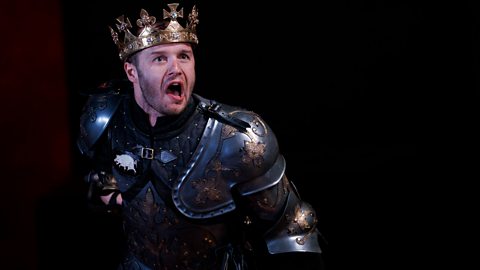
Why Shakespeare's Richard III became a controversial villain. interactive
The notorious monarch is one of the Bard's most iconic characters. But the truth about him is increasingly contested, as is the depiction of his disability.
The study of Shakespeare, controlled assessment guidance. activity
Unit 3 of the CCEA GCSE English Literature qualification is a controlled assessment unit based on the study of a play by William Shakespeare.
Is Shakespeare History? The Plantagenets. podcast
Melvyn Bragg and guests discuss Shakespeare's treatment of English Plantagenet history from Richard II to Richard III and all the Henrys in between, written under Elizabeth I.
More on Richard III
Find out more by working through a topic
- count1 of 5

- count2 of 5
- count3 of 5
- count4 of 5