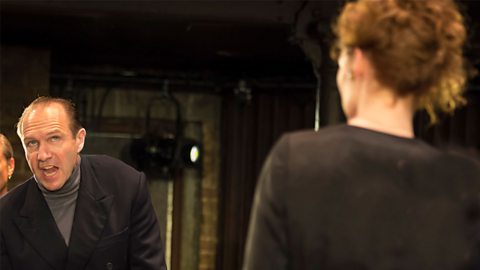
Use of form in Richard III
The form of Richard III is that of a history play. However, Shakespeare blends elements of A type of drama in which characters undergo suffering or calamity and which usually ends with a death. A sad or catastrophic event causing suffering or death. and A medieval drama in which characters personify virtues and vices to teach a clear moral lesson to the audience. to create a powerful exploration of ambition, villainy and the collapse of political order. While history plays retell real events, Shakespeare uses real life events but adapts them for dramatic purposes. This is to give the play maximum entertainment value for his audience – but also ensures he does not offend his patron, Queen Elizabeth. As a result, aspects of the play could be considered more a tragedy than historically accurate.
Like classical tragedy, Richard III is based on a The chief character in a novel, film or play. of noble birth – Richard, Duke of Gloucester. Although he is a member of the royal family, Shakespeare presents him as having a In tragedy this refers to a defect in someone's character that leads them to a bad end. (this flaw is also known as A character’s fatal flaw or error in judgement that leads to their downfall in a tragedy.) – his ruthless ambition and manipulation without conscience. Richard is not a good man who goes wrong; he chooses to be a villain. Through the dramatic technique of soliloquy (where the audience learns a character’s true feelings), Richard states "I am determined to prove a villain", so Shakespeare allows the audience to see this from the outset. His flaw drives the action forward as he lies, murders and schemes his way to the crown.
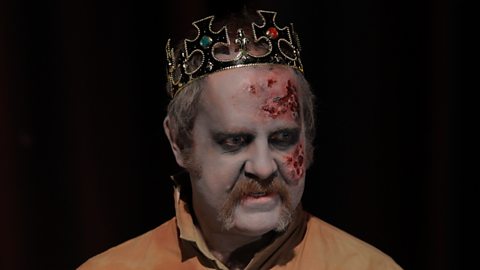
The play also follows the tragedy pattern of a rise followed by a catastrophic fall. Richard initially succeeds through cunning and charisma, but his crimes accumulate until he becomes isolated, paranoid and spiritually tormented. Just before the final battle at Bosworth, Richard is tormented by the ghosts of his victims. This is the start of the turning point where the audience see the consequences of his Check your connection, refresh the page and try again. catching up with him.
Shakespeare also draws on the tradition of A medieval drama in which characters personify virtues and vices to teach a clear moral lesson to the audience., where a central figure is tempted by evil and ultimately punished. Richard is theatrical, witty and directly addresses the audience, drawing them into his schemes.
Although Richard III ends with Richmond bringing about the restoration of order, the play’s form ensures that Richard’s downfall feels both inevitable and morally necessary – an outcome which would have been satisfactory to the The 'Golden Age' of the reign of Queen Elizabeth 1st in Britain from 1558-1603. audience.
Use of structure in Richard III
Richard III organises events to show Richard’s rise and fall. The structure (like many of Shakespeare’s plays) is Chronological means following the time order in which events happened. Stories told chronologically start with the earliest event and end with the last.. The audience is taken through Richard’s schemes step-by-step, witnessing the consequences of his actions and finally his defeat and death.
While many events happen onstage, some others happen offstage, including the murder of the princes. This was customary in the theatrical world at the time. In Richard III it creates a sense of secrecy and political darkness.
Although the play is now divided into five acts, interestingly this division was added later by editors. It is important to consider how Shakespeare creates and shapes the narrative. The first half of the play focuses on Richard’s rise to power, each scene revealing another betrayal, manipulation or act of villainy. Richard’s control is reflected in the tight and fast-moving structure. However, the structure shifts once Richard becomes king. Scenes are shorter and more fragmented, showing (Presenting an idea in a way that is interesting or strange because of being very different from what you would expect.) a loss of control and his growing paranoid state of mind.
The night before the Battle of Bosworth is a structural turning point. The play moves from A literary movement and style that aims to present life as it really is, focusing on ordinary people, everyday settings and plausible events. to a scene where ghosts torment Richard. This contrasts with the order and control of the first part of the play, signalling that Richard’s downfall is inevitable. At the very end of the play, Richmond’s calm order is distinct from the chaos created by Richard. Structurally, this shows the play’s movement from A way of governing or ruling that is oppressive and cruel to the people. to a restoration of order, which would have been pleasing to the audience.
Use of language and dramatic techniques in Richard III
When studying a play and in preparation for your controlled assessment you must consider both language features and dramatic techniques. It is important that you consider the effect of these – don’t just identify or name them. Below are some language (or linguistic) features and dramatic techniques that you will come across in Richard III.
Language features
Imagery
Imagery is language that creates pictures in the audience’s mind. It appeals to the senses (sight, sound, touch, taste, smell). Shakespeare uses several types of imagery in Richard III, some of which are considered below along with their effects.
Animal imagery
Richard is often referred to in animal terms. He calls himself a “bottled spider” and Queen Margaret refers to him as a “poisonous bunch‑back’d toad”. Richard’s emblem is the boar, which is a symbol of aggression and predatory violence.
The effect of the animal imagery is to dehumanise Richard, suggesting he is a creature of instinct, danger, and corruption. It contributes to the theme of unnatural disorder, as it seems England is overrun by predators.
Imagery of disease and decay
The play contains imagery of sickness, rot, and infection. Margaret’s curse conjures images of festering wounds and rotting bodies. The kingdom is described as infected by Richard’s rise to power.
The effect of this imagery is to show a society at dis‑ease or out of balance. It suggests Richard is infecting the state and his corruption spreads invisibly (like an illness).
Imagery of violence and blood
Although most of the violence happens off‑stage, Shakespeare conveys a sense of violence through his language. For example, Clarence’s dream of “ghastly corpses”, Margaret’s description of her son’s death “stabbed with bloody daggers” and Tyrrell’s description of the murder of the young princes speaks of their “innocent blood”.
The effects of these are to make the violence seem more disturbing as the audience has to imagine it and to reinforce Richard’s A way of governing or ruling that is oppressive and cruel to the people..
Religious language
In Richard III, characters frequently use religious vocabulary such as prayers, curses and oaths to highlight the moral significance of the events. Richard (ab)uses religious language to manipulate and pretend to be morally good and humble, “God forgive them that have done this deed.”
The effect of this is to highlight his hypocrisy. Shakespeare was writing for a Christian society, and they would be familiar with the language. It creates When the audience knows something that the characters don’t. as the audience were aware of Richard’s true motivations and character.
Rhetorical language
Richard is a character who is skilled in manipulation. This is best demonstrated in his use of language and rhetoric. He uses A question asked in order to create a dramatic effect or to make a point, rather than to get an answer. to unsettle others (such as “Would you enforce me to a world of cares?” (Act 3, Scene 7) and flattery to win trust, such as when he is wooing Lady Anne “divine perfection of a woman” (Act 1, Scene 2).
The effect of this is to show how he gains power through words rather than brutal force (he gets others to do the latter for him!)
Word play and puns
Richard uses words to manipulate. In the play when Rivers tries to defend Elizabeth, Richard twists his words to belittle his argument.
Richard: What, marry, may she? Marry with a king.
The double meaning is on the word ‘marry’ which in Shakespeare’s day was also used to mean 'indeed’. Richard is twisting Rivers’ meaning – indeed – to play on the fact that by marrying the King, Queen Elizabeth gains favours for her friends and family.
The effect of this is to show how intelligent Richard is, and in doing so, he shows how much slower Rivers is. Here Richard uses a A play on words, relying on similar sounding words or two meanings of one word..
Prose and verse
Shakespeare wrote his plays in both Ordinary language both spoken or written; different from poetry (which does not reflect everyday speech patterns). and verse, using each form for a particular reason. Most of Shakespeare’s plays are written in verse and prose is used strategically.
Use of verse
One ‘iamb’ is a two-beat combination: an unstressed syllable followed by a stressed (emphasised) syllable, making a ‘da-DUM’ pattern, like a heartbeat. Pentameter means five of these two-beat units per line, making ten syllables altogether is unrhymed Lines in a poem that don't rhyme, usually in iambic pentameter - five two-syllable feet per line.. There are ten syllables (or beats) in each line following a pattern of unstressed and stressed syllables (da‑DUM) repeated five times. Iambic pentameter was used as it reflects natural speech but it also gave a sense of authority and elevation to the words.
The effect of iambic pentameter in Richard III gives the play a formal, political tone appropriate to represent a royal court. It also allows Richard to sound controlled and intelligent “Now is the winter of our discontent”.
Rhyming couplets
In poetry, a pair of lines that rhyme and have the same length and metric pattern. are two lines of rhyming iambic pentameter. They are often used by Shakespeare to indicate the end of a speech or scene giving it a sense of completion. For example, the Duchess’ final words to her son Richard:
Bloody thou art, bloody will be thy end;
Shame serves thy life and doth thy death attend.
Use of prose
Shakespeare used prose to indicate a lower class character, to demonstrate emotional unstability and for letters. In Richard III, Shakespeare also uses prose for manipulation – Richard strategically switches to prose when he wants to appear friendly for example in Act 1, Scene 1 when he is sympathising with his brother Clarence who is being taken to the Tower.
The effect of this is to show how Richard can use language to manipulate the situation and others into trusting him. The effect of prose at other points in the play is to show lower‑class characters in contrast to the court.
Dramatic techniques
Remember that plays are written to be performed; therefore you should use the term ‘audience’ and not ‘reader’.
Soliloquy
A A speech performed by a character, often depicting that person thinking or talking aloud to his or herself. is a speech delivered by a character alone on stage. It reveals their true thoughts, motives, and feelings directly to the audience. As no other character can hear these words, this creates When the audience knows something that the characters don’t. – the audience are privy to information which the other characters are not.
Richard frequently speaks in soliloquy, such as at the beginning when he declares “I am determined to prove a villain” and discusses “plots have I laid”. These reveal his intentions to the audience and set the tone for his action and the rest of the play.
The effect of soliloquies is to engage the audience by providing them with insight, create suspense and show Richard’s true motivations.
Asides
An aside is a short remark spoken by a character directly to the audience. They are shorter than a soliloquy and may be said when other characters are onstage – however, the other characters cannot hear (we must employ suspension of disbelief for this). An example of using an aside is when Richard is wooing Lady Anne and tells the audience how easily she is persuaded, “Was ever woman in this humour wooed?”.
The effect of the asides is to reveal Richard’s duplicitous nature and consolidate his Someone who is cunning and sneaky, using tricks or lies to get what they want without caring if it is right or wrong. Often believing that "the ends justify the means" character.
Dramatic irony
When the audience knows something that the characters don’t. is a technique where the audience knows something important that the characters on stage do not. This creates tension, humour, or a sense of inevitability, because the audience can see the truth while the characters remain unaware.
For example, when Richard pretends to be pious or loyal, the audience knows he is being duplicitous and not genuine.
The effect of dramatic irony is to build tension as the audience is aware of additional information. It also emphasises the gap between appearance and reality.
Breaking the fourth wall
This dramatic technique describes when a character directly addresses the audience. Richard frequently speaks directly to the audience, such as in Act 1, Scene 1 when he says:
To set my brother Clarence and the King
In deadly hate, the one against the other;
And if King Edward be as true and just
As I am subtle, false, and treacherous
The effect of breaking the The space that separates performers and audience. If it is ‘broken’, a character acknowledges the audience and may speak to them. and directly addressing the audience is to make the audience complicit, to arm them with knowledge and to create a sense of unease.
Violence happening off-stage
In The 'Golden Age' of the reign of Queen Elizabeth 1st in Britain from 1558-1603. theatre most of the violence happened off-stage. This was both for practical purposes but also to create a sense of tension and for dramatic effect. An example of this is the murder of Clarence in Act 1, Scene 4.
The effect of this happening off-stage was to show the secrecy and political corruption, as well as creating a sense of dread and heightening the emotional intensity of the play.
Test your knowledge of the structure and language in Richard III
Further study
The study of Shakespeare, controlled assessment guidance. activity
Unit 3 of the CCEA GCSE English Literature qualification is a controlled assessment unit based on the study of a play by William Shakespeare.
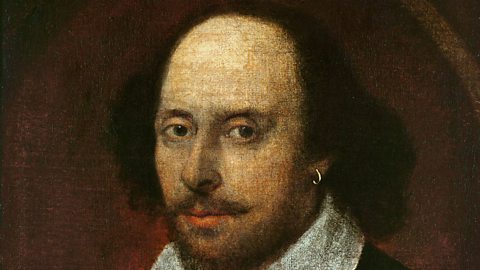
Why Shakespeare's Richard III became a controversial villain. interactive
The notorious monarch is one of the Bard's most iconic characters. But the truth about him is increasingly contested, as is the depiction of his disability.
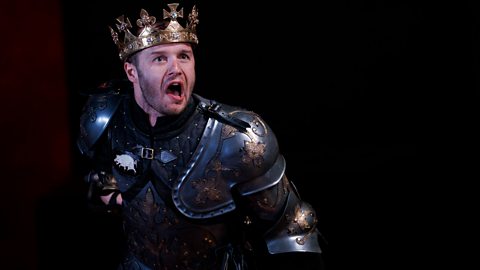
Is Shakespeare History? The Plantagenets. podcast
Melvyn Bragg and guests discuss Shakespeare's treatment of English Plantagenet history from Richard II to Richard III and all the Henrys in between, written under Elizabeth I.
More on Richard III
Find out more by working through a topic
- count5 of 5
- count1 of 5

- count2 of 5
- count3 of 5