Issues affecting inequality
Quick version
Homelessness creates barriers to employment, from lack of a permanent address to difficulties with hygiene and interview preparation, trapping individuals in extreme poverty.
Social mobility remains low in the UK, where those born into poverty, often remain in it due to limited educational and career opportunities.
Gig economy jobs offer flexibility but often come with irregular hours and low income, challenging financial stability, despite some work-life balance benefits.
Cost of care is a barrier for working families. The Scottish Government has increased childcare support to help parents enter or remain in the workforce.
Gender pay gap exists, with women often earning less due to part-time work in lower-paid 5 C’s roles (caring, clerical, cashiering, catering, cleaning).
The glass ceiling restricts female leadership in many sectors.
Racial Inequality persists, with ethnic minorities facing income and employment disparities despite strong educational attainment.
Learn in more depth
Keep going to learn:
- Barriers to employment that cause inequality
- Impact of the gender pay gap
- How society views different employment types
- How racial inequality affects income
Then test how much you have learned.
Barriers to employment
Homelessness
 Image source, Findlay / Alamy
 The Housing (Scotland) Act 1987 states that a person should be treated as homeless, even if they have accommodation, if it would not be reasonable for them to continue to stay in it.
Homelessness includes rough sleeping, living in temporary accommodation and hidden homelessness (such as 'sofa-surfing', sleeping in a car).
Well-paid employment is one way out of poverty, yet it is difficult to find a job you do not have a permanent address.
Online application forms and applying for a bank account required address information.
Without an address, homeless people can often miss important letters, such as those from the Jobcentre, courts, and healthcare services. Missing these can lead to missed appointments, interviews, benefit sanctions, legal action, or lost housing opportunities.
It is not easy to prepare for an interview without space, facilities to wash and privacy. It is hard even to know if there are jobs available when day-to-day survival is the priority.
Homeless people, it could be said, don’t just experience relative poverty but in fact are far worse off living in absolute poverty.
(Source: Citizens Advice)
Image source, Findlay / Alamy Lack of social mobility
Social mobility is a term used to describe the way people can improve their position in society.
In theory, a good education or having any one of a range of skills, can see people improve their position and income. However, there is evidence from the Sutton Trust the UK has low levels of social mobility - people born in poverty are most likely to remain in poverty throughout their lives.
Gig economy
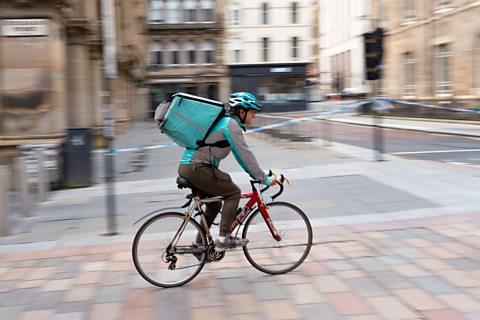 Image source, Iain Masterton / Alamy
 In recent years there has been an increase in employment (just under half a million people) in what has been called the ‘gig economy’.
The gig economy is the phrase used to describe employment which is characterised as temporary with irregular hours.
For some people working in the gig economy, in jobs such as drivers, delivery people, events staff or home cleaning, an irregular income can result in too small an income to make ends meet.
However, this type of employment can offer individuals flexibility around working hours and days. This could benefit people who have obligations such as taking care of a family member, or full time education.
(Source: Chartered Institute of Personnel and Development)
Image source, Iain Masterton / Alamy Cost of care
One major challenge individuals face in trying to take up paid employment is the cost of child care or the lack of support when looking after another person who requires care.
To help families with children aged 2-4 years to take up paid employment, the Scottish Government increased the number of hours of government supported child care in 2021 to 1,140 hours (or 30 hours a week if taken during school term-time).
Gender pay gap
The 2025 UK Labour Force survey by the Office for National Statistics, found the gender pay gap figures in median hourly pay between men and women are:
- for full-time employees, 6.9% less for women.
- for part-time employees, 2.8% more for women.
- for all employees, 12.8% less for women.
The survey also found:
- men in full-time work earned more than women across all major occupation groups.
- the gender pay gap is wider for employees aged 40 and over compared to those under 40.
- the gender pay gap is largest among higher earners, with women’s representation in high-paying roles decreasing with age.
(Source: Gov.uk)
What causes the gender pay gap?
One reason to explain gender pay inequality (or the gender “pay gap”) is employment type.
Women hold 77% of roles in health and social work and 71% or roles in education.
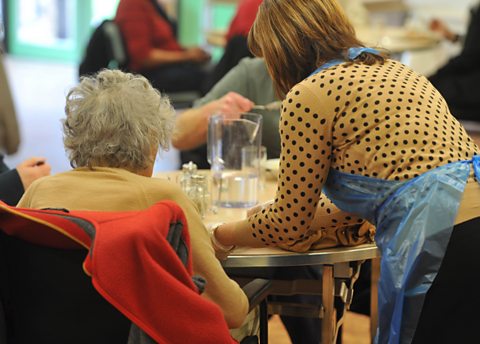
Women are also more likely to be the primary carers in families and are more often found in caring employment than men.
In 2025, 37% of women in the UK were working part-time, compared to just 14% of men. This, overall, leads to women earning less.
Women who are working part-time tend to work in lower skilled, lower paid roles. These are known as the ‘5 C’s’: caring, clerical, cashiering, catering, and cleaning. Only 12% of women who work part-time in the private sector are in high-skilled jobs.
(Source: House of Commons Library)
Men are often reluctant to apply for employment which involves looking after children, older people or others who require support.
For example, in 2026, there were many more female than male primary teachers in Scotland with 89% compared to 11%.
In the secondary school sector, the gender employment differences are not as wide but remain statistically significant at 65% female teachers and only 35% male teachers.
(Source: Scottish Government)
How society views different employment types
 Image source, SolStock / Getty Images
Society in general puts a lower economic value on the contribution of carers than it does for employment such as finance or engineering where men are most likely to be found. Employment such as carers and those in cleaning, catering, cashiering and clerical, are often referred to as '5C' jobs.
Overwhelmingly female, many caring jobs are part-time and lack job security and other attractive features such as paid holidays and company pension plans.
6.22 million women in the UK work part-time, which equates to 37% of all women who work. Women are also far more likely to work as unpaid carers, looking after relatives.
(Source: House of Commons Library)
Image source, SolStock / Getty ImagesHow does maternity affect employment?
In 2025, a survey by pregnancy and maternity discrimination charity Pregnant Then Screwed, found that up to 74,000 women lose their jobs each year due to pregnancy or maternity leave which is an increase of 37% since 2016.
What is the glass ceiling?
The glass ceiling refers to a situation where women can see the path to the jobs at the top of an organisation, but there are invisible barriers preventing them from obtaining these posts. These barriers could include inflexible or extended hours of work which reduce opportunities for women caring for young children.
A 2023 independent review of women in entrepreneurship in Scotland found that only one in five businesses are led by women.
Additionally, start-ups founded by women receive just 2% of total investment capital.
(Source: Scottish Government)
How racial inequality affects income
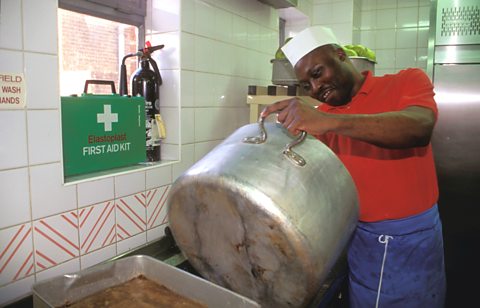 Image source, Photofusion Picture Library/Alamy
 The main ethnic minorities in the UK have family backgrounds in Commonwealth countries such the Indian sub-continent, the West Indies and parts of Africa. Most non-white Britons were born in the UK.
Despite many years of legislation, non-white citizens still encounter discrimination and even hostility. On average they have lower incomes, higher unemployment and are more likely to live in overcrowded accommodation than the white majority population.
Although the law bans racial discrimination, people from ethnic minorities are more likely to live in poverty. Despite this, in Scotland people from ethnic minorities do well in education with people of African, Caribbean, Indian, Pakistani and Chinese backgrounds outperforming white pupils at National 4, 5 and Higher level.
In the UK, more young people from almost all ethnic minority backgrounds are more likely to go to university by age 19 than White British pupils.
However, after graduating from university, many people from minorities are less likely to be employed, and likely to be earning less money if they are employed, than their white peers.
UK Government figures show between 2021 and 2024 an average of 75% of Bangladeshi households were in the lowest 40% of incomes (after housing costs were deducted) - this was the highest percentage out of all ethnic groups.
Cultural factors, such as religion and language can make it harder for some groups to gain employment or participate in some aspects of UK society.
There are many differences between ethnic minority groups. Some Asian groups, such as people with Indian and Chinese backgrounds, tend to be better off than people of Afro-Caribbean descent as they are more likely to own businesses and have professional qualifications.
For example, the Scotland Census survey found in 2021 that the African ethnic group was more qualified than others - 55.1% of people aged 16 and over in the African group had a university or professional qualification, compared with 29.0% of the White Scottish group.
Image source, Photofusion Picture Library/Alamy Relations with police
Relations between the police and some minority communities have been difficult.
The police have problems recruiting from these communities despite programmes, like Police Scotland’s Equality, Diversity and Inclusion Strategy 2022-26. This aims to improve the very low percentage of Asian and black officers by eliminating discrimination and encouraging equality and inclusion to build a more inclusive police service.
(Source: Police Scotland)
Equality and Human Rights Commission (EHRC)
In 2007 the Equality and Human Rights Commission (EHRC) combined the work of the Equal Opportunities Commission, the Commission for Racial Equality and the Disability Rights Commission.
The EHRC works to eliminate discrimination, reduce inequality and protect human rights so everyone has a fair chance to participate in society. It also has the responsibility for other aspects of equality: age, sexual orientation and religion or belief, as well as human rights.
The Government policy to tackle discrimination. was passed in October 2010. It was introduced to strengthen discrimination legislation in all its forms and thus make Britain a fairer place. It replaced nine major pieces of legislation dating back to the Equal Pay Act (1970) and Discrimination Act (2005).
Quiz
Recap what you have learned
Being homeless can cause multiple barriers to employment, from lacking an address for job applications to difficulties with hygiene and interview preparation.
The UK has low levels of social mobility, meaning many born into poverty remain there throughout life.
Gig economy jobs, although flexible, can make financial security difficult.
The Scottish Government aims to help families struggling with child care cost by offering more free child care hours for families.
Women in the UK face a median hourly pay gap of 12.8% compared to men. This is known as the gender pay gap.
Lower paid care-giving roles, termed the 5 C's (caring, clerical, cashiering, catering, and cleaning) are more often occupied by women.
In some situations, pregnancy and maternity leave can put women in a vulnerable position regarding employment.
The term glass ceiling refers to the invisible barriers such as inflexible working hours which preventing women from progressing in their careers.
Racial inequality affects non-white Britons, who on average have lower incomes, higher unemployment and are more likely to live in overcrowded accommodation than the white majority population.
The Equality and Human Rights Commission (EHRC) created in 2007 seeks to address various inequalities, including race, gender, age, and disability, under the Equality Act of 2010.
More on Inequality
Find out more by working through a topic
- count6 of 9
- count7 of 9
- count8 of 9