Gender inequality
Quick version
The shift from manufacturing jobs to service sector roles has opened up more equal opportunities for women.
The Equal Pay Act (1970) and Sex Discrimination Act (1975) are laws that have contributed to making society more equal for women.
The Equality Act of 2010 addresses discrimination in the UK and is based on nine characteristics (e.g. sex, age, disability).
The rise in flexible working arrangements has helped more women balance work and family duties.
At the 2024 UK general election, a record 263 women were elected as MPs, marking the highest proportion of female MPs to date.
Since May 2025, there are 58 female MSPs in the Scottish Parliament.
The positive action clause of the Equality Act allows employers to balance gender representation without discrimination.
Since 2017 companies employing more than 250 people are legally required to publish or disclose annually earnings of employees including by gender.
Learn in more depth
Keep going to learn:
- The factors leading to gender inequality changes
- Women in politics
- Actions governments have taken to ensure gender equality
- What the Equality Act is
- Why some company's have to disclose pay
- How the Public Sector Equality Duty (PSED) operates
Then test how much you have learned.
How has gender inequality changed?
 Image source, SolStock / Getty Images
Societal and economic changes
Gender inequality has reduced with changes in society. Changes in the economy have made a difference too.
Women make up the majority of professional workers in many countries. Sexist behaviour at work is illegal.
The UK has passed important Acts of Parliament, including the Equal Pay Act (1970) and the Sex Discrimination Act (1975), that have contributed to making society more equal for men and women.
All acts addressing discrimination in the UK have been brought together and strengthened in the Equality Act of 2010.
The old manufacturing industries which provided jobs in Scotland such as coal, steel and shipbuilding have been replaced by ‘service sector’ jobs in tourism, education, banking, IT and law. Women compete for these jobs on more equal terms.
Image source, SolStock / Getty ImagesFlexible working
An increasing number of companies are seeing the benefits of flexible working. Staff are employed on annual rather than weekly hours and many come into work later or go home earlier, enabling them to look after children. Some businesses allow their staff to work nine days per fortnight and more people now work from home.
As people live and work longer, companies are rethinking the structure of their career opportunities. Many offer unpaid leave and/or career breaks.
Women in politics
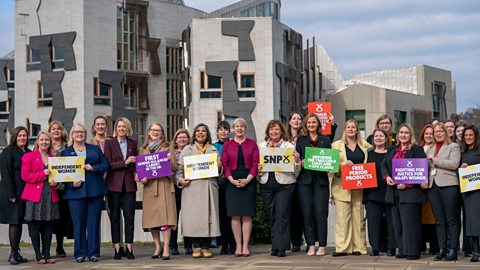
In politics there is often an under-representation of women.
As of March 2026, only 41% of MPs in the House of Commons are women (265 from 650 MPs). This is an increase from 31% in 2023 but is low considering the UK population is 51% female.
There is no evidence that women are less interested in politics than men. However, getting involved in politics is time consuming: political life means elected representatives must attend evening meetings and are expected to be ‘always available, anytime’ by phone, email or social media.
Women tend to have greater family commitments, such as looking after children and elderly relatives, and this is seen as one reason why they are less likely to get involved in politics.
The Scottish Parliament has led the way in having more family-friendly working hours and holidays and this has helped increase women’s representation. In 2026, there are 56 female MSPs in the Scottish Parliament out of 129 which was 43% of all MSPs.
However, this does balance does not reflect the population of Scotland, where there are more women than men.
(Source: House of Commons Library)
What action has the government taken on gender inequalities?
Government action has reduced gender inequalities over time.
The Equality Act (2010)
In 2010, the UK Parliament passed the Equality Act which strengthened and replaced all existing equal opportunities laws, including those covering sex, race and disability. Now, instead of lots of different Acts of Parliament we just have one Equality Act which tries to ensure that people in the UK are treated equally.
Under the Equality Act (2010) it is unlawful to discriminate (treat less favourably) anyone directly or indirectly because of a ‘protected characteristic’ of which there are nine:
- age
- disability
- gender reassignment
- marriage and civil partnership
- pregnancy and maternity
- race, colour, nationality and ethnic or national origins
- religion or belief (including lack of belief)
- sex
- sexual orientation
Equality and Human Rights Commission (EHRC)
The EHRC has the job of protecting and promoting human rights and equality and tries to make sure that the Equality Act is understood by employers and the public at large.
It is unlawful to pay someone less for doing the same job, or to treat someone less favourably at work or in society because they are a man or a woman (or any other protected characteristic).
'Positive action' clause of the Equality Act
One controversial aspect of the Equality Act (2010) is the clause that allows organisations to take ‘positive action’ where there is an imbalance of employees i.e. a workforce that does not reflect the balance of people in wider society.
The Public Sector Equality Duty (PSED) was introduced in law in 2007 and extended in 2011. The PSED requires all public sector organisations to review the balance of men and women in their staff to ensure women are not just represented equally across an organisation in terms of employment but also that they are employed in equal numbers in the highest paid jobs.
PSED applies to groups with protected characteristics too.
How the Public Sector Equality Duty (PSED) operates
 Image source, Compassionate Eye Foundation/Gary Burchell / Getty Images
If an organisation has an imbalance of either men or women, it is allowed to take action to create a more balanced workforce.
Positive action can be through re-branding to make the organisation look more male/female-friendly on its website, advertising or other marketing. They might also carry out visits to schools and career talks where it is emphasised that the organisation is open to all.
In terms of employment, if during recruitment for a job a man and a woman are found to be equally suitable for the role, the organisation can choose to employ the man or the women based on their sex to help balance the ratio of staff.
Positive action does not mean that an employer can offer the job to a woman (or someone with another protected characteristic) purely to improve the company's balance of staff. They must be able to do the job and have the appropriate skills and qualifications.
Image source, Compassionate Eye Foundation/Gary Burchell / Getty ImagesPay disclosure
Since 2017, companies employing more than 250 people must, by law, publish or disclose annually earnings of employees including by gender.
For example, in 2017, pay disclosure highlighted that the BBC had a gender pay gap of around 9.3% in favour of men. As a result, the BBC undertook a pay review with the aim of eliminating this difference.
In 2023, the BBC reported that all but two pay levels were within +/-2% for all its employees.
Quiz
Recap what you have learned
Inequality between men and women has significantly reduced in recent decades:
- economic shifts towards more service sector jobs like tourism, education and IT have opened up more equal opportunities for women.
- legislative measures including the Equality Act (2010) offer legal protection to prevent discrimination based on nine protected characteristics, including sex, race and disability.
Flexible working arrangements have become more common and allow a better work-life balance which benefits women with family commitments.
In politics, female representation remains low, with the UK Parliament only having 263 women MPs out of 650 (40%) in 2024. Only 35% of MSPs are female.
The Equality Act (2010) covers nine protected characteristics including:
- age
- disability
- gender reassignment
- marriage and civil partnership
- pregnancy and maternity
- race
- religion or belief (including lack of belief)
- sex
- sexual orientation
The Positive Action Clause allows employers to take positive steps to address gender imbalances in the workforce, but only when candidates are equally qualified.
Pay disclosure laws: companies employing more than 250 people must, by law, publish or disclose annually earnings of employees including by gender.
More on Inequality
Find out more by working through a topic
- count9 of 9
- count1 of 9

- count3 of 9