Responses to social and economic inequality
Quick version
The UK's welfare state was established during World War II, with the goal to provide a safety net funded by taxes and National Insurance to support people in need.
Over time, rising life expectancy, an aging population, and advances in healthcare have significantly increased welfare costs.
In 2025-26, the UK spent £322.6 billion on the social security system.
In UK-wide national surveys, around three-quarters of people were in favour of increased NHS funding with only around one in five people supporting more spending on welfare.
The Conservative party leans more towards a individualist view, which advocates for self-reliance, lower taxes and encourages those able to work to seek employment.
The Labour Party and the Scottish National Party (SNP) support a more collectivist view, which is more government-funded welfare support and has used it's devolved powers to expand welfare.
Learn in more depth
Keep going to learn:
- The history of the welfare state
- How the welfare state has changed through the years
- How welfare services are funded
- Different views and approaches to poverty
Then test how much you have learned.
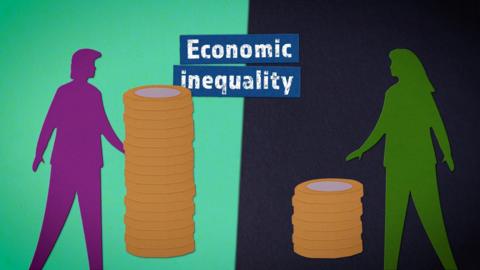
Video - Economic inequality
Watch this video to learn about the various provisions the government has in place for specific groups.
Targeted help for specific groups
Economic inequality is when financial resources are not shared equally amongstmembers of society.
Inequality is a major cause of persistent poverty, as people's income can beaffected by education level, access to jobs or social groups.
In the UK, the poverty line is officially defined at around 60% of the medianyearly income.
There are many government policies and organisations that aim to reducepoverty. The welfare state has many social provisions to reduce poverty.It is paid for out of tax and national insurance.
So those with higher incomes pay more to support those who have less.
Some provision is general, like the NHS providing free health care for everyone.Some is targeted to help specific groups.
For example, state pensions give older people an income.
Cold weather payments help pensioners and people with disabilities or youngchildren with their fuel costs.
People who are out of work can receive practical support to help them findemployment, as well as financial support like Jobseeker's Allowance.
In return, Jobseeker's must demonstrate that they are actively looking for a job.Benefits are also used to top up the income of people on low pay.
This is intended to minimise the number of people stuck in a welfare trap wherefinding a job might result in a lower income because of loss of benefits.
The national minimum wage also aims to help people in low paid jobs.
It is the minimum amount per hour that employers must legally pay theirworkers.
Everyone over the age of 23 is legally entitled to the National Living Wage, whichis a higher amount.
Both are in place to reflect the cost of living.
There are many reasons people are unable to access work that can move themout of poverty, including education levels, care responsibilities and the costs ofchildcare and travel.
Since 2016, the Scottish Parliament has been responsible for a number of welfarebenefits in Scotland, including Disability Payments and Carer's Allowance.
Best Start Grants for young children and the Bereavement Support Payment.
In Scotland there has been free bus travel for over 60s since 2006 and for under22s from 2022 and the Scottish Government introduced access to free periodproducts in 2021.
Charities and non-profit organisations also provide services to reduce inequalityin society.
There are charities that provide food and hygiene banks and help with housingand emergency accommodation.
Health charities can support people with advice and resources.
Some help people with disabilities or health conditions meet the costs of mobilityaids and adaptations. or training and assistance to help them find work.
By introducing policies to reduce inequality and support people in need,governments, charities and other organisations hope to create a fairer society foreveryone.
Government responses to social and economic inequality
What is the welfare state?
What is the history of the UK's welfare state?
The UK's A state (or country) where the government provides welfare benefits, such as education, health care and unemployment payments, to its population free at the point of use, although they are paid for by general taxation. has its roots in the proposals put forward by the politician and economist Lord Beveridge during World War Two.
Following the destruction caused by the war, Britain needed to rebuild.
After the collective national sacrifice to win the war, it was felt that there should be a collective national ‘safety net’, paid for by taxation and Deductions from gross pay which are paid to HMRC towards some benefits, including the state pension., to support people in need, including children, the unemployed, the elderly, and those who were sick.
How has the welfare state changed?
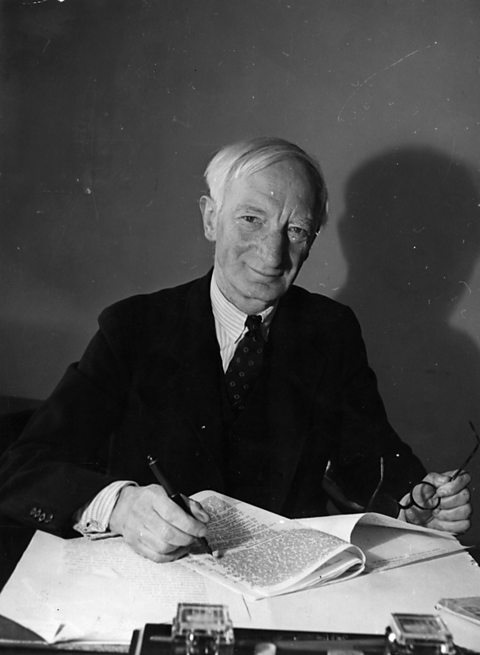
Successive governments have aimed to ensure that everyone has the basic needs in life met, including; sufficient income, housing, education and health care, with support lasting from “the cradle to the grave”.
However, when the welfare state was introduced, no-one could foresee how different UK society would be today.
- Life expectancy for men and women has risen dramatically. This has implications for the cost of pensions, health care and social care.
- In 2025/26, according to Department of Work and Pensions figures, the UK is set to spend £177.7 billion on pensioner benefits alone.
- A growing and ageing population plus developments in healthcare services including drugs and transplant surgery, means the demand and cost for healthcare has increased hugely.
- In 2025 health spending in the UK was estimated at £345 billion.
- There has been a large growth in the number of working-age adults who for a variety of reasons are unable to take up paid employment.
(Source: Gov.uk)
(Source: Census 2021)
How are welfare services funded?
All developed countries across the world have experienced challenges in finding enough revenue (money) to fund welfare services.
Scotland and the UK are no different.
As well having to find more revenue for an ageing population, healthcare and support for working-age adults and their families who are not able to work, there are also challenges in dealing with increasing levels of substance abuse, greater obesity rates and the increased expectations of society.
While most people in the UK support the idea of a welfare state, in some cases there is tension between those who work and pay taxes and those who do not work and receive support from the welfare state for example state benefits.
In UK-wide national surveys, around three-quarters of the people responding consistently support the idea of government spending more on the NHS to improve services.
However, when it comes to the government spending more money on welfare benefits, only around one in five people consistently support.
48% of Britons think benefit rules are too lenient, but not many think people on welfare get too much support.
(Source: YouGov)
Current UK statistics:
- 4.9% of people (1.76 million) in the UK are unemployed (February to April 2026)
- 13.2 million people receiving the State Pension (2025/26)
- Life expectancy for babies born in Scotland 2021-2023 was 76.8 for men and 80.8 for women
- As of April 2026, over four million adults in England and Wales claimed Personal Independence Payment (PIP)
- In Scotland, over five hundred thousand people received Adult Disability Payment (April 2026)
- In 2025, one million people in the UK received Employment Support Allowance (ESA)
(Source: House of Commons Library)
(Source: Citizens Advice Scotland)
Different views of poverty and welfare services
Individualist views of poverty and welfare services

Individualists tend to think that taxes should remain low and that people should be encouraged to provide for themselves instead of relying on the welfare state.
Their view is that individuals should, as far as possible, make their own welfare provision. Anyone of working-age should, as far as possible, look to undertake work and this explains why many benefits are linked to those without work actively looking for work.
Collectivist view of poverty and welfare services
Collectivists tend to think that taxation should fund public services and a strong welfare state.
They believe society has a collective responsibility to support those in need. The state plays a key role in welfare provision by supporting those unable to work and helping others into employment through education, training, and fair opportunities.
Political parties
Different political parties tend to have different views on welfare and health services.
Generally, the Conservative Party and Reform UK take a more individualist approach.The Liberal Democrats support a mix of individualist and collectivist responsibility.Traditionally, the Labour Party are more collectivist, as are the SNP and Greens.
In Scotland, the Scottish National Party (SNP) have been in power in Holyrood in Edinburgh since 2007.
In 2016, the Scottish Parliament gained legislative (law-making) powers in the area of social security. Subsequently, the SNP used these powers to increase welfare support for people, for example the Scottish Child Payment.
Quiz
Recap what you have learned
The UK's welfare state was created from proposals put forward by economist and politician Lord Beveridge during Word War II.
- The goal was to provide a safety net for all citizens, funded through taxes and National Insurance.
- It aims to offer support from cradle to grave for children, the unemployed, the elderly, and the sick.
Over the years welfare costs have risen due to:
- Increased life expectancy and an aging population
- Advances in healthcare.
In 2025-26, UK welfare spending included:
£177.7 billion on pensions
£345 billion on healthcare
In UK wide national surveys, around three-quarters of the people that responded supported government spending more on the NHS to improve services, but only around one in five people supported spending more on welfare benefits.
An individualist view of poverty and welfare services is that individuals should, as far as possible, make their own welfare provision.
The Conservative Party leans towards a more individualist view which aligns with right-wing ideologies. There is an emphasis on low taxation and encouraging individuals to provide for themselves rather than depend on government welfare.
A collectivist view of poverty and welfare services is that the government should provide greater support to people through the welfare state.
Usually more left-wing parties like the Labour Party and the Scottish National Party (SNP) are generally more in favour of collectivist approaches where a government should provide greater support to people through the welfare state.
More on Inequality
Find out more by working through a topic
- count7 of 9
- count8 of 9

- count9 of 9
- count1 of 9