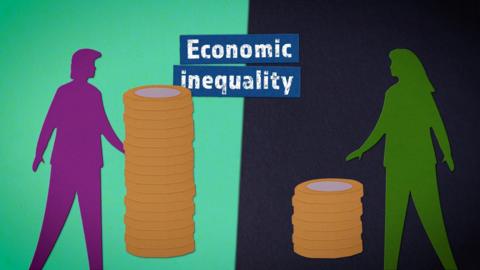
Consequences of social and economic inequality
Quick version
Health consequences of poverty
- People living in deprived areaslive shorter lives and face more health issues.
- In Glasgow, men live on average 74.3 years, compared to 81.5 years for those living in more affluent areas. Life expectancy for women is on average 78.7 years, rising to 84.9 in affluent areas.
- Those in poverty spend around a third of their lives in poor health, while those better off only about 15%.
Education consequences of poverty
- Poverty can negatively impact school success, with lower literacy and numeracy rates in deprived areas.
Crime and inequality
- Crime rates are higher in deprived areas
- Unemployment and financial issues drive crime, with 31% of new prisoners in Scotland coming from the most deprived areas.
Learn in more depth
Keep going to learn:
- How poverty affects health and life expectancy
- How inequality affects educational success
- How crime is influenced by poverty
- Other facts linking to poverty
Then test how much you have learned.
What are the consequences of social and economic inequality?
Living in poverty can have serious negative consequences for a person’s life and health.
How are the consequences of poverty measured?
Life expectancy
 Image source, Purple Collar Pet Photography / Getty Images
 One measure of the consequences of poverty is the impact poverty has on life expectancy – the age to which people are expected to live.
The National Records of Scotland reported that in Glasgow City, one of Scotland’s most deprived council areas, average life expectancy for males was 74.3 years and for females 78.7 years in years 2022-24.
This compared with East Renfrewshire council area, one of Scotland’s most affluent council areas, where average life expectancy was 81.5 years for males and 84.9 years for females in years 2022-24.
Image source, Purple Collar Pet Photography / Getty Images Illness
In terms of illness, a 2026 report by National Records of Scotland, found that in 2022-24:
- In the 10% most deprived areas:
- Healthy Life Expectancy (HLE) for females was 44.2 (±3.2) years
- HLE was 44.8 (±2.8) years for males.
- In the 10% least deprived areas:
- HLE for females was 70.9 (±2.1) years
- HLE was 70.4 (±1.8) years for males.
The difference in HLE between the most and least deprived areas was 26.7 years for females, and 25.6 years for males.
People in the most deprived areas have poorer health and shorter lives.
Low birth weight
Low birth weight is another indicator of poverty in society. Children with a low birth weight are more likely to develop health-related problems later in life. Studies from the Glasgow Centre for Population Health note that a higher proportion of babies born to mothers from more deprived areas have a lower birth weight, compared to those born in more well-off parts.
Lifestyle choices
Having a long life expectancy and good health are not only affected by poverty, as people’s lifestyle choices also affect their health.
There are links between lifestyle choices and economic inequality.
Smoking and alcohol
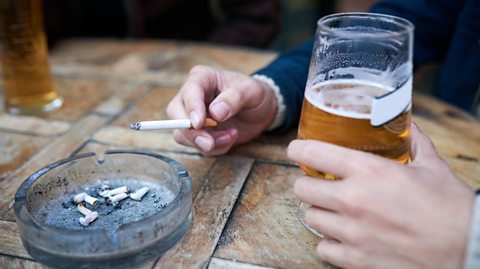 Image source, Moyo Studio / Getty Images
 In 2024, the Scottish Government reported that 14% of adults in Scotland were smokers. Out of that number, 16% were male and 12% were female.
Among adults in the most deprived areas of Scotland, 23% smoked, compared to 7% in the least deprived areas.
For alcohol, National Records of Scotland reported in 2024 that alcohol-related deaths were 4.5 times more common in the most deprived areas of Scotland compared to the least deprived areas.
(Source: Scottish Government)
Image source, Moyo Studio / Getty Images How does inequality affect education?
There are many negative consequences that arise from inequality in society. There are clear links between poverty and a lack of success in education.
Living in poverty affects a child’s chances of achieving in school. For example, as growing up in poverty affects good health, children from the most deprived areas are more likely to miss school which harms their progress in education.
Literacy and numeracy
 Image source, Allan Milligan / Alamy
In 2024-25 the attainment gap for literacy for pupils in Scottish schools at S3 level has narrowed to 10.8% for S3 pupils. This is down from 12.7% in 2023-24.
For numeracy, the figures for pupils from the most and least deprived areas achieving S3 has also shrunk from 12% in 2023-24 to 11.6% in 2024-25. The lowest ever recorded level.
(Source: Scottish Government)
Image source, Allan Milligan / AlamyHow does inequality affect crime?
Although people from all sections of society commit crime, there is a clear link between poverty and crime.
There is a wealth of evidence to show poverty is one of the main causes of crime, as those with a low income may turn to crime to get what they need.
In 2021/22, Scottish Government statistics showed that 31% of the people arriving into prison were from the 10% most deprived areas in Scotland.
Deprived areas tend to have higher crime rates, and this suggests that poverty can lead to crime. For example, crime rates are higher in Dundee City, Glasgow City and Aberdeen City than East Dunbartonshire, East Renfrewshire, and the Orkney Islands.
| Local authority | Recorded crimes per 10,000 population (2024-2025) |
|---|---|
| Glasgow City | 829 |
| Dundee City | 783 |
| Aberdeen City | 629 |
| Scottish average | 545 |
| East Renfrewshire | 264 |
| East Dunbartonshire | 242 |
| Orkney Islands | 234 |
Most prisoners in Scotland are from poor socio-economic backgrounds with underlying causes of offending related to substance misuse, mental health and abuse. The Scottish Prison's Commission has found that around one in nine young men from the most deprived communities will spend time in prison before they are 23 years old.
According to the Scottish Prison Service 17th Prisoner Survey (carried out in 2019), prisoners identified many factors that they felt contributed to their committing an offence, some of which relate directly to poverty and deprivation:
- Unemployment - 16%
- Financial difficulties - 15%
What other factors are linked to poverty?
Other factors that are often linked to poverty and deprivation also featured, such as accommodation type, alcohol and drug misuse, neighbourhood and a lack of support in the community.
Quiz
Recap what you have learned
The health consequences of poverty can include:
Life expectancy: In Scotland, people from deprived areas have shorter life expectancies compared to affluent areas.
Chronic illness: Those in the most deprived areas spend roughly one-third of their lives in poor health, whereas those in wealthier areas experience only about 15% of their lives in poor health.
Low birth weight: Babies from deprived areas are more likely to have a low birth weight, increasing their risk of health problems later in life.
Lifestyle choices: Economic inequality feeds into higher smoking and alcohol abuse rates with 23% people in deprived areas who smoke compared to 7% in wealthier areas. Alcohol-related deaths are also over four times higher in deprived areas.
Poverty affects children’s educational outcomes, and overall academic success because:
they are more likely to have health-related absences which can disrupt learning
they are more likely to have literacy and numeracy gaps, although in recent years these gaps are narrowing
Economic inequality is closely linked to higher crime rates with areas with higher poverty, like Dundee City and Glasgow City, having more recorded crimes per capita compared to wealthier areas like East Renfrewshire and Orkney Islands.
More on Inequality
Find out more by working through a topic
- count6 of 9
- count7 of 9
- count8 of 9

- count9 of 9