Themes in Of Mice and Men
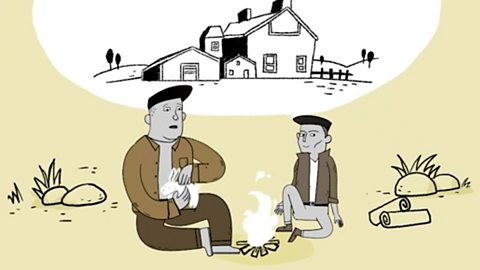
There are different themes running through Of Mice and Men, all linked primarily to George and Lennie as the central characters of the novel. Their plan to own their own farm highlights the theme of dreams, which also involves Candy and Crooks, as well as Curley’s wife. George and Lennie’s unusual friendship introduces the idea of companionship, while also contrasting with the loneliness experienced by characters such as Curley’s wife, Crooks and Candy.
The three main themes in Of Mice and Men are:
- dreams
- loneliness
- companionship
Dreams
The theme of dreams is introduced at the start of the book through George’s description to Lennie of the farm that they hope one day to own together. They continue to discuss this throughout the text, with Candy also becoming involved and making it finally seem possible. This dream is very important to the men because it represents freedom and having control over their own lives, which they do not have while moving around looking for work.
Dreams in Of Mice and Men are linked to the ‘American Dream’. This is the idea that in America, it is possible for anyone to achieve success and improve their lives through hard work. This is linked to the United States Declaration of Independence which states that ‘all men are created equal’. For the men on the ranch in Of Mice and Men, having dreams gives them some hope that their hard work will be rewarded. Curley’s wife also has a dream – to be a film star – and although she no longer has any real hope that this could come true, it gives her a distraction from the unhappiness of her life, which is also true of dreams for the other characters.
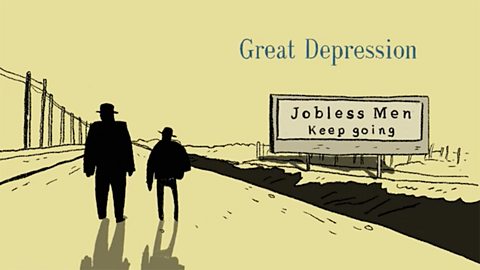
Although dreams are initially a source of hope in the book, Lennie’s death makes his and George’s dream impossible so, as the novel ends, we see that even simple, modest dreams are unattainable in the harsh environment of America during the A period from 1929 when, starting in America, countries around the world suffered huge unemployment and economic damage..
How is the theme of dreams shown in the novel?
In Of Mice and Men, Steinbeck explores dreams through:
- George and Lennie’s dream
- Candy and Crooks turning to George and Lennie’s dream as a way of escaping the hardships in their lives
- Curley’s wife’s failed dream
- the end of George and Lennie’s dream (which is also the end of Candy’s dream)
| How does Steinbeck show this? | Evidence | Analysis |
|---|---|---|
| George and Lennie’s dream | ||
| George recites the dream to Lennie like a story, which suggests that they don’t really believe in it, even though the things they are dreaming of are quite modest. | “‘Sure,’ said George. ‘All kin’s a vegetables in the garden, and if we want a little whisky we can sell a few eggs or something, or some milk. We’d jus’ live there. We’d belong there. There wouldn’t be no more runnin’ round the country and gettin’ fed by a Jap cook. No, sir, we’d have our own place where we belonged and not sleep in no A building for workers to sleep in, usually very basic. This is where the white workers on the ranch sleep and keep their belongings..’” | All George and Lennie are really hoping for is described here: a place where they feel they belong and do not have to leave. These are the things that are missing from their lives, showing that the reason they need the dream is to have some hope that their lives may improve. However, despite the simplicity of their dream, the way that George recounts this like a bed-time story or folk tale suggests that it will never really come true and they need to talk about it as a comfort rather than as a real plan. |
| Candy and Crooks’ wish to be involved in the dream | ||
| Both Candy and Crooks ask to be involved in George and Lennie’s dream as a way of trying to escape from the isolation of their difficult lives on the ranch. | “[Candy] said miserably, ‘You seen what they done to my dog tonight? They says he wasn’t no good to himself nor nobody else. When they can me here I wisht somebody’d shoot me. But they won’t do nothing like that. I won’t have no place to go, an’ I can’t get no more jobs.’” “[Crooks] hesitated. ‘…If you… guys would want a hand to work for nothing—just his keep, why I’d come an’ lend a hand. I ain’t so crippled I can’t work like a son-of-a-bitch if I want to.’” | Candy asks George and Lennie if he can be a part of their plan to buy their own farm because he feels like he does not have a value on the ranch as he is ageing and will be unable to continue working. Like George and Lennie, he aspires to have somewhere he belongs and a permanent home. Crooks also wants to escape his miserable life on the ranch and sees George and Lennie’s dream as his only opportunity for this. On the ranch, Crooks is isolated and continually experiences racism. Both Crooks and Candy see the dream as a way out of their otherwise inescapable unhappiness. However, Crooks immediately realises how futile this hope is and Candy understands at the end of the book that it was never really possible. |
| Curley’s wife’s dream | ||
| It is not only the men on the ranch who have dreams; Curley’s wife also has hopes for a better future. She tells Lennie that she married Curley after her plans of becoming a movie star fell through. | “‘I tell you I ain’t used to livin’ like this. I coulda made somethin’ of myself.’ She said darkly, ‘Maybe I will yet.’ And then her words tumbled out in a passion of communication, as though she hurried before her listener could be taken away. ‘I lived right in Salinas,’ she said. ‘Come there when I was a kid. Well, a show come through, an’ I met one of the actors. He says I could go with that show. But my ol’ lady wouldn’ let me. She says because I was on’y fifteen. But the guy says I coulda. If I’d went, I wouldn’t be livin’ like this, you bet.’” | Curley’s wife is focused on how her life could have been if she had been an actress, showing how her dream is a type of escapism for her. Curley’s wife’s dream is different to George and Lennie’s because hers is grander; however, the dreams are similar in that the characters rely on them as a way of coping with the difficulties in their lives. |
| The end of the dream | ||
| George and Lennie’s dream is impossible once Lennie has killed Curley’s wife. Without Lennie, George cannot envision himself carrying on, and he realises that the dream was never really possible. This represents the hopelessness of men like them. | “George said softly, ‘—I think I knowed from the very first. I think I knowed we’d never do her. He usta like to hear about it so much I got to thinking maybe we would.’” “Crooks was scornful. ‘I seen hunderds of men come by on the road an’ on the ranches, with their bindles on their back an’ that same damn thing in their heads. Hunderds of them. They come, an’ they quit an’ go on; an’ every damn one of ’em’s got a little piece of land in his head. An’ never a God damn one of ’em ever gets it.’” | Crooks’ comments remind the reader of how George and Lennie’s dream is not unusual for men like them: many others are also dreaming of a better life. This is linked to the idea of the American Dream as they believe that by working hard and saving up, they will be able to achieve the success they hope for. However, George realises at the end of the novel that his plans with Lennie really were just a dream; they would never have come true. This suggests that the dreams that men like them held during this period in America were hopeless. |
Loneliness
The name of the town close to the ranch where the novel is set is Soledad, which translates from Spanish to ‘solitude’, so loneliness is immediately established as an important theme in Of Mice and Men.
Most of the characters on the ranch are lonely. George and Lennie stand out because their friendship means that they are not isolated and this is very unusual, making some others (like the Boss) suspicious of them. Steinbeck shows how the lifestyle that the men lead is very damaging to their relationships, making them lack compassion for others.
The loneliest characters in the book are Candy, Crooks and Curley’s wife. All of these characters are different to the others on the ranch: Candy is older than the others; Crooks is the only black man; and Curley’s wife is the only woman. These factors make the characters isolated and the men on the ranch show no empathy towards them, instead making them more isolated by treating them badly.
How is the theme of loneliness shown in the novel?
In Of Mice and Men, Steinbeck explores loneliness through:
- the contrast between George and Lennie’s friendship with the lonely existence of the other men on the ranch
- the isolation of Candy, Crooks and Curley’s wife
| How does Steinbeck show this? | Evidence | Analysis |
|---|---|---|
| George and Lennie stand out because of their friendship | ||
| George and Lennie are the only characters in the novel who have a meaningful relationship in their lives. This makes them unique and draws attention to the loneliness of the rest of the characters in the book. | “‘Guys like us, that work on ranches, are the loneliest guys in the world. They got no family. They don’t belong no place… With us it ain’t like that. We got a future. We got somebody to talk to that gives a damn about us.’” | By comparing their situation with others’, George demonstrates that they are very unusual. George uses the pronouns ‘they’ and ‘we’ to emphasise how different he and Lennie are from other men who work on ranches. |
| Characters like Crooks, Candy and Curley’s wife are particularly isolated because they are different | ||
| Crooks, Candy and Curley’s wife are the loneliest characters in Of Mice and Men because they are isolated due to their differences. They are separate from the rest of the characters on the ranch. | “‘… I ain’t wanted in the bunk house, and you ain’t wanted in my room.’” (Crooks) “Candy looked for help from face to face.” “‘I never get to talk to nobody. I get awful lonely.’” (Curley’s wife) | Crooks is physically separated from the other workers on the ranch because of his race. This literal isolation makes him angry and bitter towards people when they do approach him, demonstrating the damaging effects of loneliness. Candy is isolated because of his age and disability, making him less useful on the ranch and therefore insignificant. The lack of reaction to Candy’s pleading look when Carlson wants to kill his dog represents the lack of empathy that the other men feel for those in pain. Candy’s need for a companion is not acknowledged because they are not able to form relationships themselves. Curley’s wife is the only woman on the ranch and is treated with suspicion by the men because of her flirtatious behaviour. However, she acts this way in order to get attention because of her poor relationship with her husband. Again, the men on the ranch do not feel sympathy for her – despite knowing that Curley is unpleasant – and instead treat her with contempt and don’t speak to her, so she becomes even more desperate for acknowledgement. |
Companionship
Companionship in Of Mice and Men is primarily demonstrated through the friendship of George and Lennie, as there are no other meaningful relationships between people in the book. The unusualness of their bond is emphasised throughout the novel, particularly through the contrast with the other characters who are isolated and lonely. Apart from Slim, the men on the ranch find it difficult to understand why George and Lennie stick together.
Many of the other characters are searching for companionship but are unable to find it. By the end of the book, all of the characters are lonely in some way, even George, who has now lost his friendship with Lennie because Lennie is dead. George and Lennie’s friendship was the only friendship evident in the text.
How is the theme of companionship shown in the novel?
In Of Mice and Men, Steinbeck explores companionship through:
- George and Lennie’s commitment to each other
- the other men’s lack of understanding of George and Lennie’s friendship
- the way that lonely characters crave friendship
| How does Steinbeck show this? | Evidence | Analysis |
|---|---|---|
| George and Lennie’s friendship sets them apart | ||
| George and Lennie recognise that they are different because they have each other and understand that this is very important for them. | “‘But not us! An’ why? Because… because I got you to look after me, and you got me to look after you, and that’s why.’” | The way that Lennie repeats this sentence to George demonstrates that he has learnt it through saying it many times, as he cuts George off to complete this A statement that is frequently repeated.. Even though George sometimes gets annoyed with Lennie, their friendship is the most important thing in both of their lives and it means that they protect each other. George takes this to an extreme length by killing Lennie at the end of the book in order to shield him from Curley. |
| The other men cannot understand the relationship between George and Lennie | ||
| The other men on the ranch are suspicious of George and Lennie’s relationship and do not seem able to understand that it is a straightforward friendship. | “‘I said what stake you got in this guy? You takin’ his pay away from him?’ ‘No, ’course I ain’t. Why ya think I’m sellin’ him out?’ ‘Well, I never seen one guy take so much trouble for another guy. I just like to know what your interest is.’” (Boss speaking to George about Lennie) | The Boss is immediately suspicious that George answers for Lennie and cannot understand why they are travelling together. This demonstrates the way in which the men on the ranch are unable to fully appreciate the benefits of companionship as they have been isolated for so long. Men like Curley and Carlson do not recognise the value of forming relationships and cannot empathise with who that do. |
| Many of the characters are lonely and searching for companionship | ||
| The loneliest characters on the ranch are Candy, Crooks and Curley’s wife. All of them seek out companionship but are unable to find it. | “‘George can tell you screwy things, and it don’t matter. It’s just the talking. It’s just bein’ with another guy. That’s all.’” (Crooks to Lennie) | Due to him being so isolated on the ranch, Crooks understands the need for human relationships. He explains the need to have contact with others, no matter how meaningless it may be. This emphasises the damage that loneliness causes and how important friendships can be in such a harsh environment. |
Test yourself
Further study
In Context: Of Mice and Men (pt 1/4) video
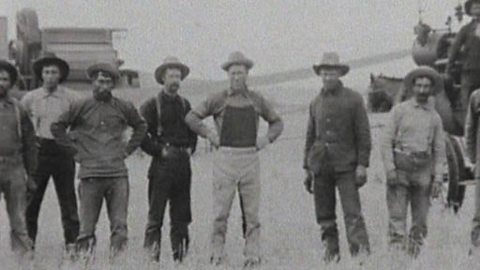
Narrator Andy Kershaw explores what life was like for 1920s migrant workers and the autobiographical nature of John Steinbeck's novel.
In Context: Of Mice and Men (pt 2/4) video
An analysis of how political, economic and agricultural developments shaped John Steinbeck's novel, Of Mice and Men.

In Context: Of Mice and Men (pt 3/4) video
An analysis of how the political climate of 1920s America affected the work of John Steinbeck. He was the son of a 1920s migrant worker, and we see the effects the Great Depression had on his family.

In Context: Of Mice and Men (pt 4/4) video
An analysis of why Of Mice and Men, by John Steinbeck, struck a chord in 1920s American society and its continuing resonance.

More on Of Mice and Men
Find out more by working through a topic
- count5 of 5
- count1 of 5
- count2 of 5