Form
Of Mice and Men is written in the form of a A novella is a short novel., which is fictional and shorter than a novel but longer than a short story. Steinbeck said that he decided to write the story in a similar way to a play, with a focus on using The words said by a character in a story or play., and less description than is usual for Ordinary language both spoken or written; different from poetry (which does not reflect everyday speech patterns). fiction.
The play style is also evident in the structure as the book has three sections, like acts – each a pair of chapters, like scenes. Each chapter starts with an overview of the setting of that ‘scene’, similar to stage directions in a play.
The book has a Where the story is written from the point of view of someone not involved in the action, but there is less narration than in traditional prose fiction and the action often moves on through the characters’ dialogue. Although the narrator is Able to observe everything; a narrator who knows the thoughts and actions of all the characters., they do not give a lot of insight into the characters’ thoughts and feelings, as some omniscient third person narrators do. Instead, this is suggested to the reader through the characters’ actions and what they say.This makes the style of writing quite direct and unemotional, which reflects the way that the characters live and relate to each other.
Structure
The structure of Of Mice and Men is A cyclical process is one in which a series of events occurs in a repeating pattern, for example the change of seasons each year. – there is a sense of things happening in a certain order and being repeated. This is reflected in the way that the book starts and ends in the same place – the brush by the Salinas River. This gives the reader the impression that the ending is inevitable and nothing can be done to stop it. The sense of repetition created through this element of the structure also creates a sense of hopelessness for the reader, reflecting the lack of choices that itinerant workers like George would have had at the time. The men’s lives are also repetitive and it is only the American dream that gives them any hope of changing this cycle. However, Steinbeck shows at the end that even this dream is pointless.
Death is present throughout the novella, from the very beginning where Lennie is carrying a mouse that he has accidentally killed to the very end when he kills Curley’s wife. Lennie’s lack of awareness of his ability to cause harm is presented as being a problem straight away and this escalates: first he kills a mouse, then a puppy, then finally Curley’s wife. His inability to control himself when panicked is also revealed at different stages (George describes when Lennie grabbed a girl’s dress in Weed and then Lennie crushes Curley’s hand when attacked), adding to the sense that he will inevitably cause destruction.
The increasing violence in Of Mice and MenHint at something that will happen later and have greater significance. the tragic events at the end. Life is not valued in the book; Lennie accidentally kills the creatures he pets and Candy’s dog is shot by Carlson when he is no longer useful. The title itself foreshadows the characters’ unhappiness at the end of the book, as it provides a warning that things will not work out for the characters as they hope.
How to analyse structure
- Foreshadowing is used throughout the novel to suggest the tragic ending. From the title, to the death of Candy’s dog and Lennie killing animals, there are frequent suggestions that George and Lennie’s plan to buy their own farm and be happy will go wrong.
- The novel’s structure is cyclical, suggesting that the characters’ fates are inevitable. This makes the story seem A belief or idea that events are inevitable and cannot be altered..
- Lennie’s dangerous behaviour escalates throughout the novel. George cannot seem to control him and Lennie cannot control himself, warning the reader that this will cause more serious harm.
Literary devices and narrative techniques
Language refers to the choices of style and vocabulary made by the author. When analysing the language that John Steinbeck uses you should think about:
- What? The author's choice of specific words and literary devices (language techniques).
- Where/how? The way in which the writer uses them.
- Why? The effect on the reader.
Steinbeck includes a lot of dialogue in the book, and this is all written in Everyday language.. This reflects the way that people would really have spoken, which shows Steinbeck’s focus on trying to show the hardship of life for itinerant workers during the Great Depression.
There is a lot of animalThe use of language to create images and pictures in the reader's mind. used throughout the novella. Lennie in particular is linked to animals through A simile is a word or phrase used to make a comparison for dramatic effect, using 'like' or 'as'. and A metaphor is a word or a phrase used for dramatic effect, to describe something as if it were something else.. This demonstrates his inability to understand the behaviour of others and the consequences of his own actions. The way that animals are treated, such as Candy’s dog, also reveals a lot about how society treats people.
Steinbeck writes in a direct and straightforward way, particularly when referring to things that happen on the ranch. This reflects the way in which the men on the ranch speak: they are honest and forthright. However, in the parts of the book (mainly at the beginning and end) which are set in unspoiled nature, Steinbeck is more descriptive, perhaps suggesting that beauty exists in this world primarily where man has not interfered.
Imagery
| Device and how it is used | Why is it used? | What is its effect? |
|---|---|---|
| Colloquial language | ||
| The men on the ranch speak colloquially, for example when Carlson talks to Slim about Candy’s dog: “‘Ever’ time he comes into the bunk house I can smell him for two, three days. Why’n’t you get Candy to shoot his old dog and give him one of the pups to raise up?’” | This style of speaking represents the way that men like this would really have spoken, so Steinbeck is presenting the characters in a realistic way. | Carlson is very direct and unsentimental in the way that he speaks. The language he uses is colloquial and informal, reflecting the relaxed way in which the men talk to each other. This quotation in particular also demonstrates the lack of emotion Carlson feels for the dog, even though Candy has strong feelings for his pet. Steinbeck demonstrates the reality of life for itinerant workers during the Great Depression. |
| Animal imagery | ||
| Lennie in particular is described using similes and metaphors linked to animals, for example during the fight with Curley: “Lennie covered his face with his huge paws and bleated with terror.” | Lennie’s developmental disability makes him unable to understand situations, the way that others behave and what they say. His size and lack of intelligence are often emphasised through the comparisons made between him and animals. | Lennie is made more sympathetic at times when linked to animals, as these descriptions suggest his lack of understanding and inability to see the consequences of his behaviour. So when he does bad things, it is difficult to blame him for these. Steinbeck also focuses on Lennie’s size, through comparing him to animals such as bears. His relationship with George is at times presented as master and pet, showing how much Lennie needs George for guidance and to survive. |
| Direct style | ||
| When narrating most of the events of the book, Steinbeck uses a forthright style and is sparse with description, focusing on using dialogue to progress the plot: “Slim looked through George and beyond him. ‘Ain't many guys travel around together,’ he mused. ‘I don't know why. Maybe ever'body in the whole damn world is scared of each other.’” | Steinbeck reflects the way that the men speak through his straightforward narration of events, suggesting the way in which they have little time for emotion and for making meaningful connections with each other. | In this quotation, Steinbeck uses very few words to suggest a lot about Slim’s character and about the way the men on the ranch live. Slim is shown to be thoughtful and reflective just through the brief description of how he looks at George. The lack of relationships in itinerant workers’ lives is demonstrated through Slim’s short statements, without the need for any additional narration from Steinbeck. |
| Descriptive style for the natural world | ||
| When focused on the natural setting of the river at the beginning and end of the book, Steinbeck is more descriptive in style: “Already the sun had left the valley to go climbing up the slopes of the Gabilan Mountains, and the hilltops were rosy in the sun. But by the pool among the mottled sycamores, a pleasant shade had fallen.” | Unlike his narration during most of the book, when describing the natural world Steinbeck is more expressive, showing the beauty of the untouched setting. George and Lennie are much more at peace in this environment. | Through his descriptions of nature, Steinbeck gives the impression that this environment provides a sanctuary for George and Lennie away from the harsh world of people. It is important that this is where they return at the end of the book, when George does what he can to protect Lennie from the violence of the other men. There is also an interpretation of Steinbeck’s descriptions of nature that he is evoking the Garden of Eden, because the peaceful setting by the river seems perfect and unaffected by humans. George and Lennie’s feeling of tranquillity at the start of the book cannot continue, just as Adam and Eve could not continue in the Garden of Eden. |
Test yourself
Further study
In Context: Of Mice and Men (pt 1/4) video
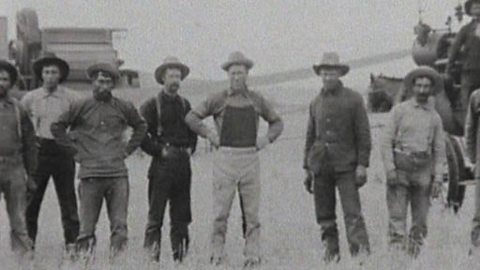
Narrator Andy Kershaw explores what life was like for 1920s migrant workers and the autobiographical nature of John Steinbeck's novel.
In Context: Of Mice and Men (pt 2/4) video
An analysis of how political, economic and agricultural developments shaped John Steinbeck's novel, Of Mice and Men.

In Context: Of Mice and Men (pt 3/4) video
An analysis of how the political climate of 1920s America affected the work of John Steinbeck. He was the son of a 1920s migrant worker, and we see the effects the Great Depression had on his family.

In Context: Of Mice and Men (pt 4/4) video
An analysis of why Of Mice and Men, by John Steinbeck, struck a chord in 1920s American society and its continuing resonance.

More on Of Mice and Men
Find out more by working through a topic
- count5 of 5
- count1 of 5
- count2 of 5
- count3 of 5