Example questions
Use these questions to hone your knowledge of Of Mice and Men, and to practise using your notes and analysis in organised paragraphs that focus on how particular characters, themes or ideas are shown in the novel. There is an example answer in the following section to demonstrate how you can do this.
- How does Steinbeck explore the theme of powerlessness in Of Mice and Men?
- To what extent is Curley presented as a bully in Of Mice and Men?
- In what ways does companionship matter in Of Mice and Men?
- In what ways is ranch life isolating for the characters in Of Mice and Men?
- Examine how far Lennie is presented as a positive character in Of Mice and Men.
- How does Steinbeck present dreams and ambitions in Of Mice and Men?
- To what extent is Lennie responsible for what happens to him in Of Mice and Men?
Example answer
Below is a demonstration of how to use your revision material to answer an example essay question. The answer below is not a full essay, but only an extract of a longer answer showing some of the points that could be made.
Q: How does Steinbeck explore the theme of powerlessness in Of Mice and Men?
A: Steinbeck came from a comfortable background in California but became concerned with writing about the plight of poor and working class people, especially during the Great Depression of the 1930s. Of Mice and Men documented the difficult lives of itinerant farm workers during the economic hardships of the Depression and the aftermath of the ‘dustbowl’, the result of years of overfarming and drought in the Midwest which ruined the land and meant farmers and farmhands were forced to migrate towards California in hope of finding land to work. George and Lennie, like many others, have no homes, no money, no secure jobs, no stability and no community. As such, they are socially and financially powerless, forced to leave everywhere they’ve ever known to try and find work. Yet as the novella progresses it becomes clear they are not the only powerless characters in the book, and that others experience even greater powerlessness than they do. Steinbeck uses third person narrative perspective to allow access to different characters in the novella, showing different kinds of powerlessness. This means he can explore how hopeless life was for poor people in this era, and illustrate the hollowness of the ‘American Dream’ that suggested anyone’s hard work would always lead to their prosperity and freedom.
George Milton is as powerless as any other migrant worker, travelling to find work and always under threat of being fired by a boss, but Lennie has an additional powerlessness because of his learning disability. He lacks personal responsibility, he cannot remember much and he cannot look after himself – Slim uses the simile of him being “‘jes’ like a kid’”. Lennie is at the mercy of others because he is so easily manipulated. Crooks finds it easy to ‘torture’ him just by saying upsetting things to him. Curley’s instant dislike of Lennie means he is immediately in danger on the ranch, something George picks up at once but Lennie completely fails to notice or understand. Lennie has some power because of his physical strength, which allows him to work with great success and also means he can physically defend himself; however, he doesn’t do this until George gives him ‘permission’, and his strength is ultimately his downfall because it is the means he uses when he accidentally kills Curley’s Wife – he can’t control himself. In these ways, Lennie is probably more powerless than most of the other workers in his situation, because he cannot use his power well. Steinbeck shows how Lennie’s physical strength isn’t a useful form of power, and his lack of mental capacity makes him more powerless than most.
This essay could go on to make the following points, backed up by evidence from the novel and analysis/interpretation of that evidence:
- Candy is powerless because he is old and disabled by his injury, meaning he worries about his future. He is also powerless because he has no one to speak up for him, meaning no one defends him when Carlson wants to shoot his dog, his sole companion.
- Curley’s wife is powerless because she is a woman. We never know her name; she is identified merely as a possession of Curley. She is trapped and isolated, with a mean-natured husband and no other friends or family; none of the men will speak to her as they are intimidated by Curley. The only form of power she has is a horrible one – she can threaten Crooks with racist violence because he is below her in importance. Even this partly shows her powerlessness, as the only power she has over someone else relies on her husband and other men taking action; it isn’t something she can do herself, and it isn’t something that would benefit her in any way. As such, she is more powerless than the men on the ranch merely because she is a woman.
- Crooks is shown to be the most powerless character on the ranch. He is the sole black employee, segregated from the others and looked down on because of their racism. He is also disabled and in pain, all of which contributes to how isolated, lonely and bitter he is. He is defensive to protect himself; when he lets his guard down, he ends up being verbally abused and threatened by Curley’s wife and he can do nothing about it but withdraw from the situation. Steinbeck shows how racial hatred makes Crooks the most powerless character, utterly at the mercy of even someone as otherwise powerless as Curley’s wife.
Further study
In Context: Of Mice and Men (pt 1/4) video
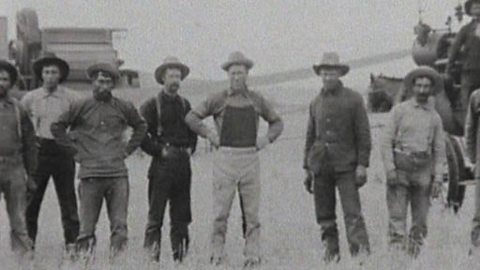
Narrator Andy Kershaw explores what life was like for 1920s migrant workers and the autobiographical nature of John Steinbeck's novel.
In Context: Of Mice and Men (pt 2/4) video
An analysis of how political, economic and agricultural developments shaped John Steinbeck's novel, Of Mice and Men.

In Context: Of Mice and Men (pt 3/4) video
An analysis of how the political climate of 1920s America affected the work of John Steinbeck. He was the son of a 1920s migrant worker, and we see the effects the Great Depression had on his family.

In Context: Of Mice and Men (pt 4/4) video
An analysis of why Of Mice and Men, by John Steinbeck, struck a chord in 1920s American society and its continuing resonance.

More on Of Mice and Men
Find out more by working through a topic
- count1 of 5
- count2 of 5
- count3 of 5