Summary
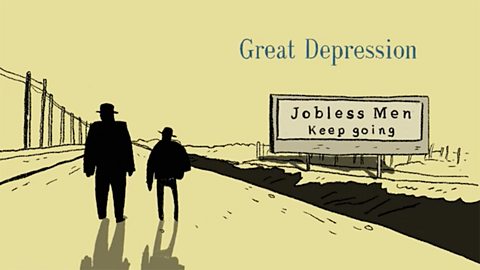
Summary: Of Mice and Men is a A style of writing from the early 20th century that breaks away from traditional forms to explore new ways of representing thoughts, feelings, and reality.A novella is a short novel. published in 1937 by John Steinbeck, and follows two itinerant farm workers in the wake of the A period from 1929 when, starting in America, countries around the world suffered huge unemployment and economic damage. in America. Their dream of owning their own land and having a real home is made tragically impossible by a combination of their difficult circumstances and the people around them. The novella shows how trapped ordinary people were at this time, in a land where anything was supposed to be possible for those who worked hard enough.
Title: Of Mice and Men is an A quick reference - often to an image, character or place - from a work of literature or music or mythology. taken from a line of poetry by Robert Burns, a famous Scottish poet: “The best laid schemes o’ Mice an’ Men/ Gang aft agley”. The poem To a Mouse was written in 1785 as a sympathetic apology to a mouse whose nest Burns accidentally ruined while ploughing, and the line Steinbeck references in the title explains that even the best plans, whether made by a mouse or a man, often go wrong. This links to the precarious situation of the men in the novella despite their plans and dreams; it also fits with Lennie’s obsession with keeping a “soft” mouse to pet.
Narrative perspective: Of Mice and Men is told from a A third person narrator is not a character in the story. They see the events from the outside and tell the story using third person pronouns, like 'him', 'her' and 'they'.Able to observe everything; a narrator who knows the thoughts and actions of all the characters.Narrative is another word for story. perspective, where the story is related by a voice from outside the characters who can access everyone’s thoughts and feelings, and who describes the action without taking part.
Setting: Salinas and Soledad, rural/farming areas of California, during the Great Depression of the early 1930s.
Themes: Loneliness and friendship, dreams and ambitions, weakness and strength, power, protection, nature, masculinity and Hatred of women., the American Dream.
Characters in Of Mice and Men
The main characters in Of Mice and Men are George and Lennie, as the novel revolves around their friendship.
Several of the secondary characters they come into contact with on the ranch are also important, particularly Curley’s wife, Candy and Crooks. These three characters demonstrate the harshness of life in the working class environment during the Great Depression for those who are perceived to be weak. Curley draws attention to the violence of the life lived by the men on the ranch, while Slim is a more understanding and admirable character, able to empathise with George in particular.
The other men on the ranch are The Boss, Carlson and Whit. Carlson and Whit are both workers on the ranch, Carlson being the character who kills Candy’s dog. Lennie’s Aunt Clara does not feature directly in the text but is referred to by George and Lennie and then seen by Lennie in his hallucinations after he kills Curley’s wife.
George Milton
George is a protective man, who has been caring for his friend Lennie for a long time. The two men are not related but have been friends since they were children so, as well as enjoying his company, George also feels responsible for his welfare. George often talks to Lennie about their dream.
Due to Lennie’s mental disability, George has to take responsibility for him and finds this stressful and frustrating at times, due to Lennie getting into trouble. This results in outbursts of anger towards Lennie at certain points in the novel, although George regrets these quickly.
George recognises that his friendship with Lennie is special because men like George would not have had friendships due to moving around so much for work; it would have been very unusual for two men to travel around together due to work being scarce.
George is a small, quick-witted man; his intelligence contrasts with Lennie’s throughout the book; as does his size. George often has to think quickly in order to cover up for Lennie’s mistakes. Finally, he feels forced to shoot his best friend in order to protect him from Curley and the other men, who George believes would have tortured Lennie if they found him first.
| How is George Like this? | Evidence | Analysis |
|---|---|---|
| Lennie’s opposite | ||
| George is described as a small, quick, intelligent man. | “The first man was small and quick, dark of face, with restless eyes and sharp, strong features.” | The language used here such as “quick”, “restless” and “sharp” are a physical reflection of George’s intelligence and quick thinking. This provides a strong contrast with Lennie, who is large and slow. |
| Frustrated with Lennie | ||
| George’s reactions to Lennie when he makes mistakes can be short-tempered and angry. | “‘So you forgot that awready, did you? I gotta tell you again, do I?’” | George’s rhetorical questions (which he knows that Lennie cannot really answer) shows his frustration with his companion. |
| Grateful for his friendship with Lennie | ||
| George recognises that he and Lennie are different to other men because they have each other, which means they are not lonely. | “‘With us it ain’t like that. We got a future. We got somebody to talk to that gives a damn about us.’” | Plural pronouns “we” and “us” are repeated to show that George and Lennie are a unit and stay together, unlike many men like them. He builds up the impression of their closeness through giving three short, definite statements about their relationship. |
| Caring | ||
| George is protective of Lennie and tries to look after him. When he kills Lennie, he is trying to protect him from the almost inevitable cruelty of Curley and the other men. | “Lennie said, ‘I thought you was mad at me, George.’ ‘No,’ said George. ‘No, Lennie, I ain’t mad. I never been mad, an’ I ain’t now. That’s a thing I want ya to know.’” | George is reassuring to Lennie, even after he has done a terrible thing, by killing Curley’s wife. George is just about to kill Lennie here and he is kind to him first, making sure that he knows that George cares about him and forgives him, so that Lennie can die in peace, knowing that George isn’t angry with him. |
Lennie Small
Lennie is George’s friend and the two travel together. Lennie has a learning disability, making him dependent upon George to manage day to day life in the difficult environment in which they live and work.
Lennie is physically very big and strong, so his name is Happening in the opposite way to what is expected and maybe causing amusement because of it.. However, he cannot control himself, leading to escalating acts of accidental violence through the book. He is obsessed with stroking soft things, such as animal fur. This starts with mice, which he kills, then leads to his puppy, which he also kills, before the tragic death of Curley’s wife when he strokes her hair. He does not mean to cause harm but is not aware of his own physical power.
Lennie is very Innocent or lacking experience. and sweet-natured; he always means well and is focused on simple pleasures, which his dream with George reminds the reader of. He lacks awareness of social conventions and so does not feel the same racism and prejudice against women that many of the other male characters feel. Lennie is happy to talk to Crooks and Curley’s wife, despite them being rejected by the other characters on the ranch.
Lennie only gets angry or aggressive when he feels that his friendship with George is threatened. For example, when Crooks suggests that George might abandon Lennie, Lennie reacts angrily, worried that Crooks is threatening violence against his friend.
| How is Lennie Like this? | Evidence | Analysis |
|---|---|---|
| George’s opposite | ||
| Lennie is described as a very large, slow man. | “Behind him walked his opposite, a huge man, shapeless of face, with large, pale eyes, with wide sloping shoulders.” | Lennie’s physical vastness is emphasised here, which is linked to the problems that this causes later in the book. Whereas George’s quickness is concentrated upon when he is introduced (reflecting his intelligence) Lennie’s size is the focus of his introduction. |
| Lacking control | ||
| Lennie has no awareness of his own strength and cannot stop himself from hurting the animals he pets, which leads to him accidentally killing Curley’s wife. | “‘He was so little,’ said Lennie. ‘I was jus’ playin’ with him … an’ he made like he’s gonna bite me … an’ I made like I was gonna smack him … an’ … an’ I done it. An’ then he was dead.’” | The use of The omission of a word or words usually indicated by three dots. here shows how upset Lennie is as he is not able to speak fluently, demonstrating that he did not mean to cause any harm to his puppy. The way he repeats “an’’ (meaning ‘and’) is childlike, which reflects the way that Lennie thinks and cannot control his own behaviour. The way that he describes the puppy’s death does not show the link between his actions and the outcome as he uses the passive phrase “then he was dead’. |
| Innocent | ||
| Lennie is kind and innocent and so does not understand other characters’ cruelty and anger properly. | “Lennie covered his face with huge paws and bleated with terror. He cried, ‘Make ’um stop, George.’” | Lennie is described using animal The use of language to create images and pictures in the reader's mind. (“paws” and “bleated”), showing his lack of understanding as Curley attacks him. Rather than defend himself, which he could do easily because of his size, he looks to George for help and protection. |
| Sweet-natured | ||
| Lennie is cheerful and kind most of the time, quickly forgetting things that make him unhappy. | “‘Tha’s good,’ he said. ‘You drink some, George. You take a good big drink.’ He smiled happily.” | Even though George has just told Lennie off, Lennie quickly moves on and is focused on his immediate, positive experience. The way that he “smiled happily” suggests that he is focused on simple pleasures and can be satisfied with small things in life; he is not demanding. |
Secondary characters
Curley’s wife
Curley’s wife is the only significant female character in Of Mice and Men, and she is never given a name. This reflects how she is defined by her relationship to Curley rather than as an individual.
Curley’s wife is presented as a flirtatious and provocative character, often wearing make-up and dressing in a way that attracts attention from the men on the ranch. However, this behaviour also highlights her loneliness and desire for companionship, as she seeks interaction in an isolated and male-dominated environment.
She is often judged harshly by the other characters, particularly the men, who see her as trouble. This reflects the A social system in which men rule and hold power over women. of the society in which the novella is set, where women are marginalised and mistrusted.
Despite this, Curley’s wife reveals a more vulnerable side when she speaks about her past and her failed dreams of becoming a film star. She describes how she was promised opportunities that never materialised, leaving her trapped in an unhappy marriage.
| How is Curley’s wife Like this? | Evidence | Analysis |
|---|---|---|
| Lonely | ||
| Curley’s wife looks for company throughout the book, but never finds it because none of the other characters are willing to speak to her. | “‘I never get to talk to nobody. I get awful lonely.’” | Curley’s wife’s statements here are short and simple, reflecting her sparse and limited life on the ranch. She is shown to use only a few words here, in the same way as she speaks very few words in her day-to-day life. The word “awful” is used like we would use ‘really’ to emphasise how lonely she is, but the word “awful” also shows just how sad her life is. |
| Isolated | ||
| Curley’s wife is made to feel alone on the ranch because the men do not speak to her and she has a bad relationship with her husband, whom she dislikes. | “‘–Sat’iday night. Ever’body out doin’ som’pin’. Ever’body! An’ what am I doin’? Standin’ here talkin’ to a bunch of bindle stiffs–’” | Curley’s wife is bitter here, insulting the only men left on the ranch (Lennie, Crooks and Candy) while the others are at the brothel, by referring to them as “bindle stiffs”, meaning tramps. She repeats “Ever’body” to show how alone and left out she feels, as if everyone in the world is doing something except her. |
| Makes the men uncomfortable | ||
| The men talk about Curley’s wife defensively, worried that she could get them into trouble. | “‘I never seen no piece of jail bait worse than her. You leave her be.’” | George emphasises his mistrust of Curley’s wife by saying that he has never seen another woman as likely to get a man into trouble before. George warns Lennie away from her, suggesting that she is dangerous and untrustworthy. |
| Marginalised | ||
| Curley’s wife is shut out by the men on the ranch and is frustrated by being excluded. | “‘Well, I ain’t giving you no trouble. Think I don’t like to talk to somebody ever’ once in a while?’” | Her A question asked in order to create a dramatic effect or to make a point, rather than to get an answer. shows her frustration at being excluded. It highlights how the men’s attitudes contribute to her isolation and reinforce her lack of power within the ranch community. |
Candy
Candy is an old ranchworker who has lost a hand in a work accident and now works as a swamper, or cleaner, on the ranch. He feels that as he is ageing he is useless and does not have any value as a person. This is reflected in the way that his dog is shot by Carlson.
Before his death, Candy’s dog is his only real companion. This leads to him asking to be involved in George and Lennie’s dream of owning their own farm; he is willing to give all of his savings to these men who he has just met so that he can feel a part of something.
| How is Candy Like this? | Evidence | Analysis |
|---|---|---|
| Feels useless | ||
| Candy feels that without a job, he has nothing to offer society. | “‘You seen what they done to my dog tonight? They says he wasn’t no good to himself nor nobody else. When they can me here I wisht somebody’d shoot me. But they won’t do nothing like that. I won’t have no place to go, an’ I can’t get no more jobs.’” | Candy’s dog is shot because it no longer serves a purpose, reflecting the harsh life that the men live, where there is no room for things that are not useful, and this extends to humans too. Candy suggests that he would rather die than be without a job, as he will have nowhere to live and no means of supporting himself. |
| Isolated | ||
| Candy is alone in his sadness about the dog being shot; no one will stand up for him and say that his dog should be allowed to live. | “Candy looked for help from face to face.” | Candy’s searching for help is pointless because he does not get any from the men on the ranch. He does not feel able to defend his dog by saying that he is valued because he is a companion, as this is not seen as being worth anything on the ranch. The phrase “face to face” suggests that all of the men are the same and have the same reaction; they are not behaving as individuals. |
| Searching for friendship | ||
| Candy is desperate to be involved in George and Lennie’s dream of owning their own farm because it will give him a place to belong, even when he is old and unable to work. | “George half-closed his eyes. ‘I gotta think about that. We was always gonna do it by ourselves.’ Candy interrupted him, ‘I’d make a will an’ leave my share to you guys in case I kick off, ’cause I ain’t got no relatives or nothing…’’” | Candy’s desperation is clear here as he offers to leave George and Lennie his share in the farm, which he would buy with all of his savings. He then makes it clear why he feels the need to create new bonds and friendship as he has no family and therefore no connections and no one to look after him when he cannot work any more. |
Crooks
Crooks is the only black man on the ranch and experiences a significant amount of racism and discrimination. He is lonely and isolated, making him resentful and bitter towards the other characters, as seen when he tries to torment Lennie about George abandoning him.
Crooks is briefly won over by Lennie’s friendliness and enjoys having someone to talk to, even feeling some hope that he could be involved in the dream of the farm. However, Curley’s wife reminds him of the prejudice against him, making him return to his protective shell and dismiss the idea of the dream altogether.
| How is Crooks Like this? | Evidence | Analysis |
|---|---|---|
| Bitter | ||
| Crooks takes pleasure in mentally hurting Lennie because he has been hurt by so many people before. | “Crooks’ face lighted with pleasure at the torture.” | Crooks clearly enjoys tormenting Lennie (by suggesting that George will abandon him). His cruelty towards Lennie, who is very innocent and has been nice to Crooks, can make the reader see him as an unpleasant character. However, when Crooks goes on to talk about the racism he has experienced, it becomes more understandable why he behaves in this way. |
| Discriminated against | ||
| The racism directed towards Crooks is very obvious and not hidden by the other characters on the ranch. | “‘This is just a ****** talkin’, an’ a busted-back ******. So it don’t mean nothing, see?’” | Racial slurs are used to describe Crooks frequently on the ranch. Crooks uses the language of the white men to describe himself, to show that he is aware of how little he is respected and how no thought is shown for his feelings. No one on the ranch regards Crooks as a proper person or is interested in anything that he has to say, and he is fully aware of this. |
| Lonely | ||
| As the only black man on the ranch, Crooks is completely isolated from the others and does not receive any companionship. | “‘A guy goes nuts if he ain’t got nobody.’” | While the rest of the men share a bunkhouse, so are able to speak to each other and at least experience some elements of friendship at times, Crooks is made to sleep on his own in the stable. |
Curley
Curley is a very aggressive and violent character. He is the Boss’s son and takes advantage of the power that he has over the other men on the ranch to treat them cruelly and pick fights. He is physically small and so is resentful of bigger men; he picks a fight with Lennie specifically because of this. He chooses to fight Lennie instead of the other characters because he knows that Lennie is vulnerable, whereas the other men would fight back.
He wears high-heeled boots like the Boss, to show his status; his wife is also a status symbol for him as he knows the other men cannot marry since they could not provide for a family of their own. Despite marrying her, he does not seem to trust or even like her. In the novella, Curley and his wife are only ever seen together once she is dead, and he does not seem saddened by her death – only angry and Seeking revenge because Lennie has ruined something that belonged to him.
| How is Curley Like this? | Evidence | Analysis |
|---|---|---|
| Cruel | ||
| The other men on the ranch see him as behaving unfairly and treating people badly because he has power over them due to being the Boss’s son. | “‘Seems like Curley ain’t givin’ nobody a chance.’” | Candy says this about Curley when he talks to George. He is an aggressive character who manipulates situations so that he comes out on top. |
| Aggressive | ||
| Curley quickly behaves aggressively when meeting George and Lennie for the first time, even though they have not done anything to threaten him. | “[Curley’s] eyes passed over the new men and he stopped. He glanced coldly at George and then at Lennie. His arms gradually bent at the elbows and his hands closed into fists. He stiffened and went into a slight crouch. His glance was at once calculating and pugnacious.” | Curley’s body language is aggressive as he immediately moves into a fighting pose. The way he behaves suggests that he is always on the alert and ready to fight, which is linked to him being a boxer. This comes across as being unreasonable because he has only just met George and Lennie and they have not even had a chance to speak to him. |
| Violent | ||
| Curley picks on Lennie and attacks him violently, despite the fact that Lennie has just been smiling and has not done anything wrong. | “He backed until he was against the wall, and Curley followed, slugging him in the face. Lennie’s hands remained at his sides; he was too frightened to defend himself.” | The way that Curley attacks Lennie even though he is not defending himself demonstrates that he is a vicious and nasty character, with a bullying streak. |
Slim
Slim is the most respected character on the ranch, despite not actually being in charge (although he is in charge of one of the grain teams). He is good at his work, calm and thoughtful; all of the other men look up to him and value his opinions. Slim empathises with other characters, particularly George, whom he treats kindly after he shoots Lennie.
| How is Slim Like this? | Evidence | Analysis |
|---|---|---|
| Respected | ||
| Slim is looked up to by all of the other men on the ranch, who look to him for approval and ask for his opinion. | “Slim’s opinions were law.” | This simple A metaphor is a word or a phrase used for dramatic effect, to describe something as if it were something else. reflects how Slim’s decisions are respected unquestioningly. This demonstrates the power that he has on the ranch, despite not being one of the bosses. |
| Authoritative | ||
| Slim does not demand authority but is revered by the rest of the men on the ranch because of his natural influence. | “His authority was so great that his word was taken on any subject, be it politics or love.” | Again, Slim’s power is universal with the men because of their natural respect for him. Steinbeck presents Slim as being the calm holder of this innate authority, not demanding it or treating others badly to get it, which is why it is so strong. |
| Empathetic | ||
| Slim is the only character who shows understanding of how George feels after he has killed Lennie. | “‘You hadda, George. I swear you hadda.’” | Slim comforts George by repeating “you hadda” (had to), emphasising to George that he did not have any choice but to kill Lennie. This shows Slim’s concern for his friend and that he understands the difficult decision that George has had to make and how this will affect him, whereas the other men on the ranch do not see that there was anything traumatising about what George has had to do. |
Minor characters
The Boss
The owner of the ranch. He is suspicious of George and Lennie’s unusual partnership when he meets them, but is ultimately only concerned with his business. He wears boots with a heel to show his status on the ranch. He is also Curley’s father, which partly explains Curley’s sense of power over the ranch workers.
Carlson
Another ranch worker. Carlson is generally friendly but also brash and insensitive. He complains about Candy’s dog and eventually insists on shooting it, never considering Candy’s feelings; he is likewise baffled at the end of the novel that George might be upset over Lennie’s death. He is unafraid of Curley and his threats, telling Curley directly that he will “kick [his] goddam head off” if he tries to harass him.
Whit
A young and impressionable worker on the ranch, who is excited to see a letter from a former co-worker on the ranch published in a magazine he is reading.
Aunt Clara
Lennie’s aunt who helped raise him in his youth. She does not actually feature in the novella, having died some time before it is set, but appears to Lennie as an hallucination, scolding him in the final chapter.
Test yourself
Further study
In Context: Of Mice and Men (pt 1/4) video
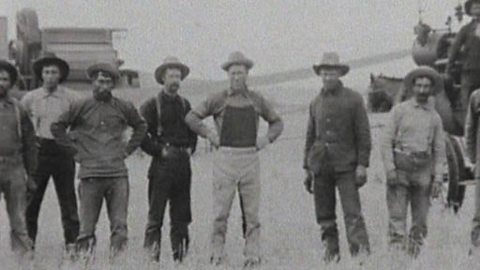
Narrator Andy Kershaw explores what life was like for 1920s migrant workers and the autobiographical nature of John Steinbeck's novel.
In Context: Of Mice and Men (pt 2/4) video
An analysis of how political, economic and agricultural developments shaped John Steinbeck's novel, Of Mice and Men.

In Context: Of Mice and Men (pt 3/4) video
An analysis of how the political climate of 1920s America affected the work of John Steinbeck. He was the son of a 1920s migrant worker, and we see the effects the Great Depression had on his family.

In Context: Of Mice and Men (pt 4/4) video
An analysis of why Of Mice and Men, by John Steinbeck, struck a chord in 1920s American society and its continuing resonance.

More on Of Mice and Men
Find out more by working through a topic
- count3 of 5
- count5 of 5
- count1 of 5