Applicable context
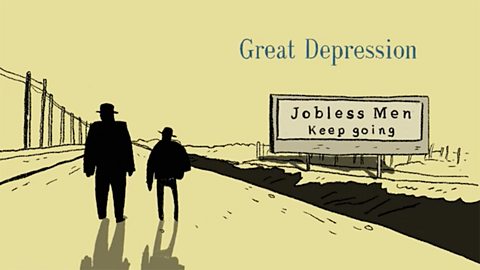
- A period from 1929 when, starting in America, countries around the world suffered huge unemployment and economic damage. started in the United States in 1929, after the stock market crash in October of that year. Following this, investment and spending dropped and unemployment rose, peaking at just under 13 million people in 1933. The Depression destroyed businesses and factories, and left many workers with no choice but to leave the cities and head out to the countryside looking for work on farms.
- Alongside the economic hardship of the Great Depression, a series of droughts and windstorms across the southwest farmlands of America rendered huge areas of land barren and unfarmable – the ‘dustbowl’. Those who had once owned farms and homes lost them to the banks, unable to pay their mortgages, and packed up to head for the more fertile land of the west – California.
- The plight of these migrating people roused sympathy in Steinbeck, who had laboured on farms as a young man despite being from a well-off family. He particularly understood the hopelessness of the men who found themselves homeless, forced to leave everything familiar behind and migrate to find work. Their lives were uncertain and lonely, and even if they found a farm to work and stay on, they would never earn enough to think of having a home or family of their own – meaning they had no chance of the love or sense of belonging that everyone needs.
The plot of Of Mice and Men
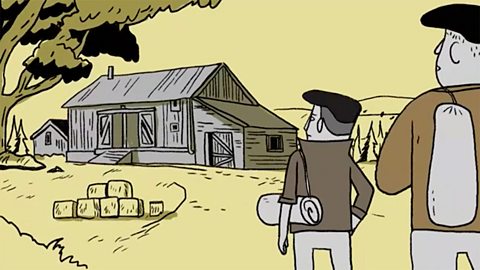
- George and Lennie stop by the Salinas River to sleep on their way to starting their new jobs at the ranch in Soledad. George tells Lennie off for keeping a dead mouse (which he has accidentally killed by petting it) and Lennie threatens to leave George, but George talks him out of it.
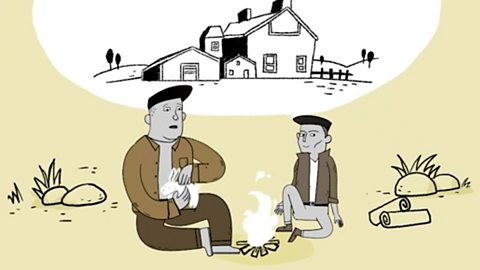
- Lennie asks George to tell him about their dream. George describes owning their own home and land, where they would grow vegetables and rear animals and become Able to provide what is needed yourself, without relying on others..
- The following morning, George and Lennie go to the ranch where they meet Candy (an elderly handyman) and the Boss in the A building for workers to sleep in, usually very basic. This is where the white workers on the ranch sleep and keep their belongings.. The Boss questions them and is suspicious when George answers for Lennie, but he allows them to stay.
- George and Lennie meet other people on the ranch, including Curley (the Boss’s son) who takes a dislike to Lennie, and Curley’s wife, who flirts with the men.
- After work, the ranch hands return to the bunkhouse and complain about the smell of Candy’s old dog. Carlson (a ranch hand) convinces Candy to allow him to shoot the dog, saying it is kinder because he is suffering.
- Candy, upset about the death of his dog, discusses the dream with George and Lennie. He says that he has some money put by and asks to join them in purchasing some land. The dream seems more possible.
- Curley enters the bunkhouse and picks a fight with Lennie, who cannot cope. George tells him to fight back and he crushes Curley’s hand.
- On Saturday evening, most of the men go to town to a A place where men visit prostitutes., leaving behind Lennie, Candy and Crooks (the only black man on the ranch). Curley’s wife also remains at the ranch. Lennie goes to speak to Crooks, joined later by Candy. They discuss the dream and Crooks also asks to get involved. Curley’s wife interrupts them and threatens Crooks when he asks her to leave. Upset and angry, Crooks tells Lennie and Candy to leave and says he no longer wishes to be part of the dream.
- On Sunday, Lennie accidentally kills a puppy that he has been given by Slim, the leader of a grain team. While he is trying to hide the puppy in the barn, Curley’s wife joins him. She talks to him and invites him to stroke her hair. While doing this, he unintentionally breaks her neck and kills her, then runs away.
- The body of Curley’s wife is found by Candy. He alerts the other men who go out to look for Lennie with guns, planning to shoot him. George finds him first (in the place they camped at the start of the book) and shoots him in the back of the head.
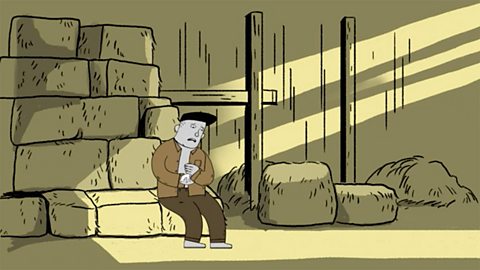
Watch: Plot summary
John Steinbeck's classic novella is set during the Great Depression – a time of mass unemployment across the United States. Low-paid workers like farm laborers were hit particularly hard by the crisis. George and Lennie, the main characters of Of Mice and Men, are, like many, drifting from ranch to ranch desperate for a job. But they have a dream…
George: "Someday—we're gonna get the jack [money] together and we're gonna have a little house and a couple of acres an' a cow and some pigs and—"
Lennie: "An’ live off the fatta the lan’… An’ have rabbits!"
The two are lost without each other – Lennie provides George with unquestioning adoration and George provides Lennie with tip-top advice – like not to squeeze things quite so hard. Lennie and George arrive at Tyler Ranch and get work as farm labourers. Unfortunately, the boss's son Curley is a nasty piece of work who likes to pick on bigger fellas. He attacks Lennie – who gives Curley's hand a squeeze – and Curley is left, as Steinbeck puts it, "flopping like a fish on a line."
Days later Lennie is sitting alone in the barn in mourning for a dead puppy he has also squeezed a little too hard. Curley's wife, who is extremely lonely, wanders in and asks Lennie to stroke her hair, but he hurts her. She screams and Lennie panics and, when Lennie panics, he – you guessed it – squeezes. George finds Lennie hiding by the waterhole. He calms him down and fills his head with rabbits. As Curley and his murderous mob approach George pulls out a gun and shoots Lennie in the back of the head.
The End.
Having worked on ranches himself Steinbeck knew how lonely many farm labourers were. He examines this by comparing the friendship of George and Lennie with the isolation of other characters in the book, such as Curley or Crooks. As George says; "We got somebody to talk to that gives a damn about us… If them other guys gets in jail, they can rot for all anybody gives a damn… But not us!"
George and Lennie's imaginary rabbit farm has a wider significance, representing as it does the American Dream – the reason to keep on struggling in the face of adversity – something shared by all the characters in the book, from Candy to Crooks to Curley's wife.
Though it may seem brutal, George's shooting of Lennie is in fact the ultimate selfless act – preserving his best friend's childlike innocence and happiness in the face of impending attack from Curley and his mob.
Test yourself
Further study
In Context: Of Mice and Men (pt 1/4) video
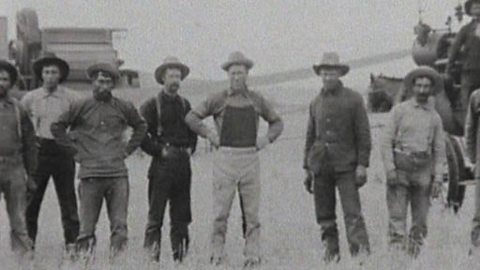
Narrator Andy Kershaw explores what life was like for 1920s migrant workers and the autobiographical nature of John Steinbeck's novel.
In Context: Of Mice and Men (pt 2/4) video
An analysis of how political, economic and agricultural developments shaped John Steinbeck's novel, Of Mice and Men.

In Context: Of Mice and Men (pt 3/4) video
An analysis of how the political climate of 1920s America affected the work of John Steinbeck. He was the son of a 1920s migrant worker, and we see the effects the Great Depression had on his family.

In Context: Of Mice and Men (pt 4/4) video
An analysis of why Of Mice and Men, by John Steinbeck, struck a chord in 1920s American society and its continuing resonance.

More on Of Mice and Men
Find out more by working through a topic
- count2 of 5
- count3 of 5
- count5 of 5