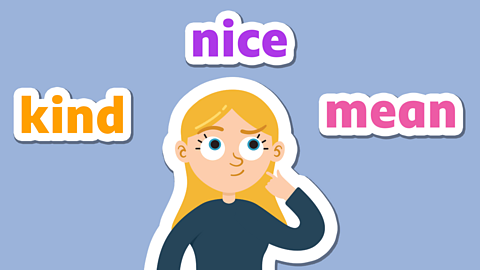
What is a noun?
This page has been put together to help you practise and revisit some of the brilliant skills you’ve learned all through primary school.
It’s a great way to boost your confidence in English and get you ready for the exciting next step into Year 8!
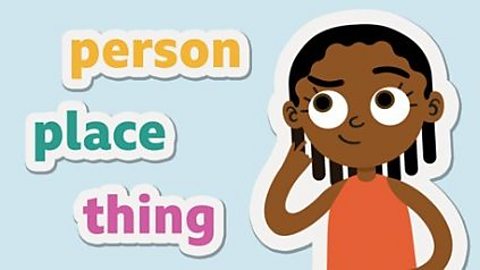
A noun is a naming word for a person, place, thing or animal.
Nouns can be common (general names), proper (specific names), collective (groups), concrete (things we can sense) or abstract (ideas and feelings).
Complete this page and you’ll unlock the skills to:
identify and classify nouns
change nouns from singular to plural
use proper nouns correctly with capital letters
apply rules for plural nouns and understand exceptions
What are common nouns?
A noun can name a person, place, thing or animal.
Common nouns are the everyday names for people, places, things and animals. Examples are words like: teacher, village, sandwich, puppy.
Common nouns don’t get a capital letter, unless they start a sentence.
Activity: Identifying nouns
What are proper nouns?
Proper nouns are the exact names of particular people, places, things and animals. Examples include: Michael, Belfast, Empire State Building and Spot.
Proper nouns always start with a capital letter, even if they appear in the middle of a sentence.
They also include the names of months, days of the week, religious words, and brand names. For example: September, Monday, Bible, Bitesize.
What are collective nouns?
Collective nouns are the special names for a group or collection of people, animals or things.
For example: a fleet of ships or a crowd of people.
Some collective nouns are wonderfully quirky and fun to say.
Have you heard of a parliament of owls, a crash of rhinos, or a tower of giraffes?
What are concrete nouns and abstract nouns?
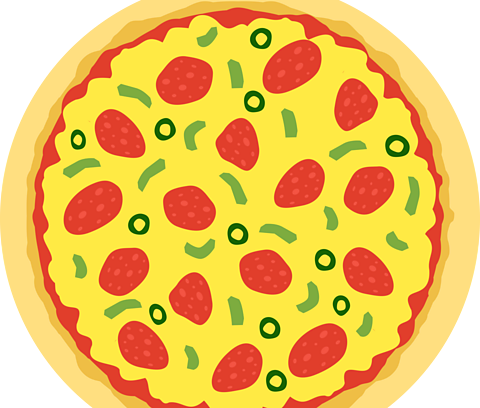
Concrete nouns are things that exist outside our mind.
They can be seen, touched, heard, smelled or tasted.
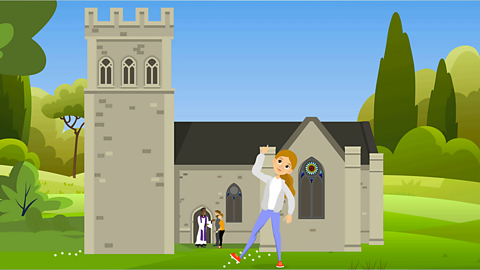
Examples: archway, motorbike, pizza.
Abstract nouns are nouns that are internal, for example, thoughts, feelings and ideas.
They’re called abstract because they can’t be detected with our five senses - you can’t see, hear, touch, taste or smell them.
Some examples of common abstract nouns are: happiness, bravery, anger, friendship and surprise.
What are singular and plural nouns?
To change a noun from singular to plural just add ‘s’, for example:
dog – dogs, pencil – pencils.
If the nouns ends in s, ss, sh, ch, x, z add an ‘es’, for example:
church – churches, box – boxes.
If the nouns ends in y, change the y to ‘i’ and add ‘es’, for example:
country – countries.
If the noun ends in a ‘f’ or ‘fe’ swap these letters for ves, for example:
knife – knives, half – halves.
If the noun ends in an ‘o’ then add ‘es’, for example:
tomato – tomatoes, potato – potatoes.
Some nouns the vowel sound change completely, for example:
man – men, foot – feet.
Some nouns change completely, for example:
child – children.
Some nouns don’t change at all, for example:
sheep, deer.
All of these rules have exceptions to them.
Here are several of these exceptions, but there are many more:
- Words ending in s, ss, sh, ch, x, z usually add “es”, for example, church - churches
Exceptions:
Some words ending in ch do not take “es” because they sound like “k” at the end:
for example, stomach - stomachs
Stomach keeps the “s” because it doesn't make the “ch” sound.
- Words ending in ‘y’ usually change y - i + es, for example country - countries
Exceptions:
If the letter before the y is a vowel (a, e, i, o, u), you just add “s”:
for example, boy - boys
toy - toys
Activity: Identify common nouns and proper nouns
Quiz: Identify the types of nouns
Brain boost
Think about these questions to stretch your thinking and sharpen your skills!
Why do you think proper nouns always start with a capital letter?
Can you think of an abstract noun that describes how you felt during a fun activity?
How do collective nouns make writing more descriptive and interesting?
Have a chat about your answers with a parent, teacher or your class.
More on Practise and revise KS2 English
Find out more by working through a topic
- count7 of 13
- count8 of 13

- count9 of 13
- count10 of 13