What is a verb?
This page has been put together to help you practise and revisit some of the brilliant skills you’ve learned all through primary school.
It’s a great way to boost your confidence in English and get you ready for the exciting next step into Year 8!
A verb is an action or doing word that tells us what someone or something is doing.
Verbs can be written in different tenses: past, present and future, and sometimes need auxiliary verbs to make sense.
Complete this page and you’ll unlock the skills to:
identify verbs in sentences
change verbs into past, present and future tenses
use Helping verbs such as: to be, to have, to do. For example, did it go well? correctly
Examples of verbs in action
Johndanced at the birthday party.
Fionaran up the pitch and scored a goal.
In each sentence, the noun (John / Fiona) performs the action shown by the verb.
Some verbs also describe actions that are happening over time:
Sophie was talking during the lesson.
Understanding verbs makes it easier to answer grammar questions and write great sentences.
Spotting verbs in context
Verb tenses
Verbs can change tense to show when an action happens, and can be past, present or future tense.
Past tense
This is used when an action has already happened.
Many verbs form the past tense by adding d or ed:
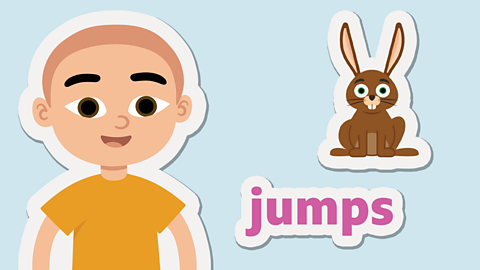
- jump → jumped
- walk → walked
- listen → listened
Present tense
These are used when an something is happening now.
I am typing a message.
Future tense
These actions haven’t happened yet - they’re in the future!
This tense often uses the Helping verbs such as: to be, to have, to do. For example, did it go well?will:
I will clean my bedroom tomorrow.
Irregular verbs
Some verbs do not follow regular tense patterns. These irregular verbs are very common in transfer tests.

Examples of irregular verbs:
| Base verb | Past tense | Perfect form |
|---|---|---|
| swim | swam | swum |
| write | wrote | written |
| eat | ate | eaten |
| go | went | gone |
Activity: choose the correct verb
Progressive (continuous) tenses
Progressive tenses show actions that are ongoing.
I am running. (Present progressive)
She was reading. (Past progressive)
Progressive tenses use am / is / are / was / were + verb + ing.
Perfect tenses
Perfect tenses show actions that are completed.
- I have eaten my lunch. (Present perfect)
- She had finished her work. (Past perfect)
Perfect tenses use has / have / had + past participle.
Auxiliary (helping) verbs
Auxiliary verbs help the main verb make sense.
Common auxiliary verbs: am, is, are, was, were, has, have, had, will, do, does.
Top tip
When answering verb questions, always check:
tense
type (regular or irregular)
whether the verb shows an action happening now, already completed or ongoing.
Quiz: How well do you know verbs?
Brain boost
Think about these questions to stretch your thinking and sharpen your skills!
Why is it important to use the correct verb tense when writing a story?
Can you think of three verbs that describe what you did this morning?
How do auxiliary verbs help us make sentences clearer?
Have a chat about your answers with a parent, teacher or your class.
More on Practise and revise KS2 English
Find out more by working through a topic
- count12 of 13
- count13 of 13
- count1 of 13
- count2 of 13