Learn all about adjectives
This page has been put together to help you practise and revisit some of the brilliant skills you’ve learned all through primary school.
It’s a great way to boost your confidence in English and get you ready for the exciting next step into Year 8!
Adjectives help us create vivid pictures in our minds by adding detail to people, places and things.
Once you've cracked this page, you'll know how to:
identify adjectives in sentences
use adjectives to improve descriptive writing
understand comparative and superlative adjectives
What are adjectives?
Follow along with this story about a football match to see how adjectives are used to describe what happens.
What do adjectives tell us?
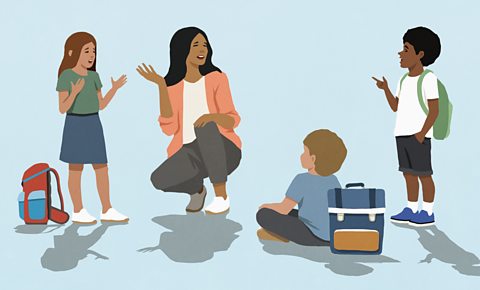
An adjective is a describing word that tells us more about a noun. For example:
- The caringteacher.
Caring is the adjective that tells us more about the noun, teacher.
You can also use more than one adjective to describe a single noun:
- The busy, trustworthyshop assistant counted the money at the end of the shift.
Busy and trustworthy are adjectives which describe the noun, shop assistant.
Adjectives in sentence structure
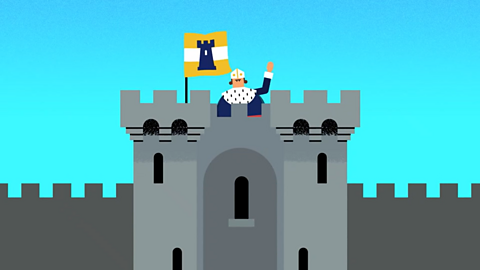
Adjectives usually come before a noun. For example:
- The ancient castle.
Adjectives can also come after a linking verb such as is, was, seems:
- The castle was ancient.
Understanding where adjectives appear in sentences will help you answer grammar and punctuation questions.
Complete the crossword
Why are adjectives important?
Adjectives help the reader to better imagine what is happening in a story.
Read the examples below and think about which sentence is better and why.
Example 1:
- The policeman chased the criminal.
- The brave policeman chased the dangerous criminal.

Example 2:
The dragon came out of his cavern.
The fierce, fiery dragon came out of his dark, vast cavern.
Sentences with adjectives help us to build a better picture in our minds.
Comparing adjectives
When we compare two nouns we use a comparative adjective.
For short adjectives, it is usual to add er to the end:
- Mr Fisher is taller than Mr Church.
For longer adjectives, use more:
- Sarah is more musical than Kathryn.
Comparative adjectives quiz
Real world examples

Comprehension texts can include descriptive language linked to history or science.
Examples:
- The ancient castle stood on the rugged cliff.
- The powerful volcano erupted, sending hot ash into the sky.
- The delicate fossils were carefully removed by the skilled archaeologist.
Think about how each adjective adds detail and meaning.
Irregular adjectives
Some adjectives do not follow the usual rules, and change their spelling instead.
Some common examples are:
| Adjective | Comparative | Superlative |
|---|---|---|
| good | better | best |
| bad | worse | worst |
| little | less | least |
| many | more | most |
Superlative adjectives
When comparing three or more nouns, use a superlative adjective.
Short adjectives usually add est:
- Niamh is the funniest person in the class.
Longer adjectives use most:
- The elephant is the most powerful animal in Africa.
Activity: Identify adjectives
When using more than one adjective in a sentence, it is most effective when the adjectives describe different things.
The team scored after a long, accurate cross from the wing.
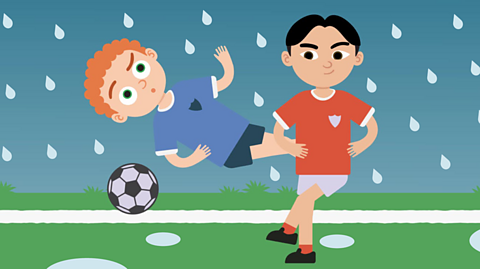
Look at this picture from the team’s football match. Can you think of five different adjectives to describe the action?
✓ Here are five adjectives you could choose to describe the scene from the football match.
- dramatic
- soaking
- tense
- exhilarating
- heart-racing
Your list may look very different. That’s because there are so many adjectives you can use to enhance your writing and help set the scene.
Quiz time!
Brain boost
Think about these questions to stretch your thinking and sharpen your skills!
Why do you think authors use adjectives in stories? How do they help readers imagine the scene?
Can you think of a time when you used adjectives to describe something exciting or unusual? Share your example.
How could using adjectives change the way someone feels about a character or setting in a story?
Have a chat about your answers with a parent, teacher or your class.
More on Practise and revise KS2 English
Find out more by working through a topic
- count2 of 13
- count3 of 13

- count4 of 13
- count5 of 13