What are adverbs?

This page has been put together to help you practise and revisit some of the brilliant skills you’ve learned all through primary school.
It’s a great way to boost your confidence in English and get you ready for the exciting next step into Year 8!
An adverb is a word that tells us more about a verb.
Adverbs can describe how, when or where something happens, making our sentences more precise and engaging.
Power through this page and you’ll be ready to:
spot adverbs of manner, time and place
recognise different types of adverbs and use them in sentences
use adverbs to add detail to actions
sort adverbs into categories based on their function
What are adverbs of manner?

Adverbs of manner tell us how something happens.
They often (but not always) end in –ly.
Example:
- Susan waited patiently for her pizza.
Patiently is the adverb because it tells us more about the verb waited.
Adverbs of manner help readers picture the action clearly and precisely.
Further examples of adverbs of manner:
The dog ate his dinner messily.
Jerry laughed heartily at the comedian.
You should always speak clearly when talking to a large crowd.
What are adverbs of time?
Adverbs of time tell us when an action takes place.
Example:
- Always brush your teeth before going to bed.
Always tells us when the action of brushing happens.
Adverbs of time help organise events clearly, which is particularly important in narrative and procedural writing.
Further examples of adverbs of time:
After you eat dinner, it’s time to get ready for hockey practice.
“Do your homework now!” shouted Dad.
Next, the magician disappeared.
Activity
Which of these sentences includes an adverb of time?
a) Princess Chloe always enjoyed playing in the garden.
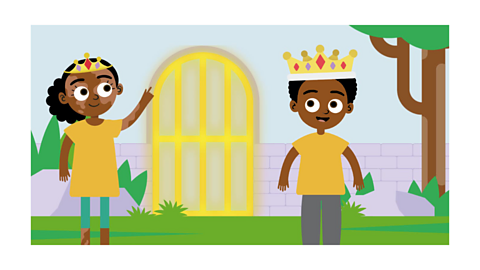
b) The children fell through a magic gateway.
c) From then on, the rabbit became great friends with the children.
✓ Here are the sentences which include an adverb of time:
a) Princess Chloe always enjoyed playing in the garden.
c) From then on, the rabbit became great friends with the children.
What are adverbs of place?

Adverbs of place tell us where something happens.
Example:
- The boys played basketball in the playground.
In tells us where the action of playing happened.
These adverbs often appear after the verb and give important spatial detail.
Further examples of adverbs of place:
· The eagle built its nest on the tree branches.
· William fell between the mobiles at lunch time.
· The choir sang in the church.
Position of adverbs in a sentence
Adverbs can be moved around in a sentence, but the meaning and impact can change.
Examples:
Quickly, the dog ran.
The dog ran quickly.
Both sentences are correct, but placing the adverb at the start can add emphasis.
Activity
Rewrite each sentence by moving the adverb:
Suddenly, the bell rang.
Carefully, the scientist poured the liquid.
Quietly, the children entered the hall.
✓ Suggested answers:
The bell suddenly rang. OR The bell rang suddenly.
The scientist carefully poured the liquid. OR The scientist poured the liquid carefully.
The children quietly entered the hall. OR The children entered the hall quietly.
Punctuation
When an adverb begins a sentence, it is usually followed by a comma.
Example:
- Suddenly, the lights went out.
The comma helps the reader pause and improves clarity.
Activity
Add commas where needed:
Slowly the tortoise crossed the road.
Eventually we reached the mountain summit.
Quietly she closed the door.
✓ Answers:
Slowly, the tortoise crossed the road.
Eventually, we reached the mountain summit.
Quietly, she closed the door.
Quiz: How well do you know adverbs?
Activity
Choose the most appropriate adverbs from the list below to complete this section of the story:
Princess Chloe and Prince Lucas were walking ________ through the palace gardens.
__________, they found themselves in a magical world filled with gemstones.
- merrily
- tomorrow
- suddenly
✓ Here are the sentences with the correct adverbs added:
Princess Chloe and Prince Lucas were walking merrily through the palace gardens.
Suddenly, they found themselves in a magical world filled with gemstones.
Quiz time: Test how much you have learnt
Brain boost
Think about these questions to stretch your thinking and sharpen your skills!
How does adding an adverb change the meaning of a sentence? Can you give an example?
Why might a writer choose to use adverbs when describing actions in a story?
Can you think of an adverb that describes how you worked during a recent piece of work? Share it and explain why you chose it.
Have a chat about your answers with a parent, teacher or your class.
500 Words
The UK's biggest children's story-writing competition for 5-11 year-olds is open for entries!
More on Practise and revise KS2 English
Find out more by working through a topic
- count3 of 13

- count4 of 13
- count5 of 13
- count6 of 13