Unit 4, Section A
The material on this page is designed to help you with revision and preparation for your CCEA GCSE English Language exams. It applies to Unit 4, Section A: Personal or creative writing.
- Unit 4 is assessed by a written exam, worth 30% of your final mark
- There is one task in Section A of the Unit 4 exam, worth 88 of the 150 marks available
- In this task, you will be expected to produce EITHER a piece of personal writing OR a creative essay – make sure NOT to attempt both
You can practice for your English Language GCSE exams with a range of CCEA past papers and mark schemes.
INTERIM SPECIFICATION – NOTE FOR YEAR 11 PUPILS
If you are in Year 12 and completing your CCEA English Language GCSE in summer 2027, the above information is correct.
However, if you're in Year 11 and began studying for your CCEA English Language GCSE in September 2026, an interim specification has been introduced.
All Bitesize material currently labelled Unit 4 (referring to the current specification) is now part of Unit 3: Personal or Creative Writing and Reading Literary and Non-fiction Texts, assessed by a written exam, which will be worth 40% of your final mark.
Key points about how to write fiction
- Writing fiction is an opportunity to come up with creative and original ways of using language; you might find inspiration from your own experiences or from your imagination
- Most stories follow a five-stage structure: exposition, rising action, climax, falling action and resolution.
- Use a range of vocabulary and literary devices to make your writing more lively and engaging
- Instead of telling the reader everything about a character or place, show them through descriptions and actions
What is fiction?
Fiction is writing that draws on your imagination. It might have some emotional truth, or might be inspired by reality, but the writing takes the reader somewhere else.
Fiction tends to use language that is more descriptive and often poetic.
Examples of fiction include:
- poetry
- plays
- novels
- short stories
You are likely to be working on shorter pieces of fiction writing in which you:
- describe a place
- describe a person
- write the opening section to a story, or something similar
An engaging opening
In a story or novel, the first paragraph has a lot of work to do. It needs to grab the readers’ attention and hook them into the story.
The opening sets the tone and creates intrigue. For example, The Hunger Games, by Suzanne Collins, opens with:
“When I wake up, the other side of the bed is cold. My fingers stretch out, seeking Prim's warmth but finding only the rough canvas cover of the mattress. She must have had bad dreams and climbed in with our mother. Of course, she did. This is the day of the reaping.”
This is an effective opening that offers threads for the reader to follow. Collins creates intrigue by giving enough detail to create a sense of place, but not so much that we learn everything at once.
We want to find out more about Prim – who is she? Why does she have bad dreams? We also want to know what the narrator means by ‘the day of the reaping’.
The details in this opening passage create a sense of place. We learn from the ‘rough canvas cover’ and the fact that the narrator shares a bed with her sister, that this is a poor family. The mother is mentioned, but not the father, so another question is posed – where is their father?
Story arc
Most fictional (and non-fictional) stories follow a recognisable pattern. One pattern that is familiar to readers is the five-stage story arc. This structure is also used in films and television shows.
A five-stage story arc takes the reader through the following stages:
- exposition – an opening that hooks the reader and sets the scene
- rising action – builds tension
- climax, or turning point – the most dramatic part of the story
- falling action – realises the effects of the climax
- resolution – the story is concluded
Think back to the last book you read – where were the five points to the story?
For example, think about the story of Cinderella.
- Exposition – Cinderella’s mother has died and the stepmother moves in with her two daughters.
- Rising action – the ‘ugly sisters’ make Cinderella do the housework and don’t invite her to the ball.
- Climax – with a little help from her fairy godmother, Cinderella makes it to the palace ball and dances with the prince.
- Falling action - the prince finds Cinderella’s glass slipper and travels the country to find her.
- Resolution – despite the efforts of the ugly sisters, the prince finds Cinderella. They get married and live happily ever after.
Next time you read a book or watch a film/television programme, notice how it fits into this story structure. What hooks you in at the start? What obstacles do the characters face? What is the most dramatic part or turning point in the story? How is the story resolved?
A convincing close
Aim to finish your story in a convincing way, tying up all the loose ends. Aim to resolve the story and leave your reader feeling satisfied with the way the story ends.
Note that cliffhangers can work well as chapter endings in novels, but they can be less satisfying at the end of a short story!
Watch: How to write a personal or fiction response
How to write a personal or fiction response, with poet Aliyah Begum
In your English language exam, you will be asked to create a piece of narrative or descriptive writing. Narrative writing tells a story. This could be made up by you or based on something you've experienced. Descriptive writing encourages the reader to imagine and empathise with an experience, object or place. In both cases, you will need to demonstrate creative use of language and structure, while using accurate and varied punctuation, to convey original ideas through your writing.
Let's look at some general strategies you can use for any creative writing task. Start with an interesting opening. This should place your reader in the action as soon as possible to grab their attention. You should avoid unnecessary and unexciting details or explanations. Throughout your piece, you should use a range of sentence and paragraph structures to vary the pace and impact of your writing, and you should use accurate spelling and varied vocabulary and punctuation throughout.
Here are a few strategies for crafting a narrative piece. Keep it simple. There won't be time to create a really complex story. One or two settings and one or two characters is enough.
Make sure you have a beginning, middle and an end to your story with a clear line of progress from one point in time at the beginning to another point in time at the end.
Most stories and narratives are driven by a character dealing with conflict or challenges. If your main character doesn't have a problem to solve, the story will be less interesting to read.
You should try and keep dialogue to a minimum and use it to help move the story forward or add emotion to your characters.
A clear ending is also important. You could make sure that your character has dealt with the conflict or challenge you started your story with.
Here are a few strategies for a piece of descriptive writing. You can use language related to your senses – sight, smell, sound, taste, touch – to help immerse the readers in the experience you are describing. You can zoom in on particular details of the experience, focusing on small moments in detail. This will help build atmosphere, reveal character, or add depth to descriptions of objects and places. Using imagery such as personification, metaphor, or simile can help create powerful images in the mind of the reader.
Whether you choose to write a narrative or descriptive piece, you should use language, structure and punctuation creatively to interest and engage your reader. Have fun.
Paragraphs
A paragraph is a group of sentences that all link to one topic or theme. For example in the opening to The Hunger Games, the entire paragraph focuses on the narrator waking up and realising that her sister is missing. The details of the bed, the name of her sister and the questions about bad dreams are all connected.
In fictional pieces of writing, paragraphs help the reader to move through the story.
When should I start a new paragraph?
Paragraphs are like signposts for your reader. A new paragraph usually indicates a change of time, place, topic or person.
Remember when to start a new paragraph with the A word formed from the initial letters of other words.TiPToP:
Ti – Time
- Start a new paragraph when you move to a new time in your The sequence of events in a plot; a story.. Your paragraph might begin with “Later”, “In the evening”, “That afternoon” or another time indicator.
P – Place
- Start a new paragraph when you move to a different place in your story.
To – Topic
- Start a new paragraph when you change topic, start a new piece of action, or move to a new idea in your story or descriptive writing.
P – Person
- Start a new paragraph when you focus on a different character, or when you use dialogue.
How can I use paragraphs for dramatic effect?
Paragraphs can also be used to highlight tense or significant moments within your writing. For example, a short one-sentence paragraph is likely to add A feeling of potential conflict between a group of people. In an audience or reader, a sense of potential conflict, or a feeling of anxiety due to what may be about to happen. or highlight a turning point in a narrative.
Language
Use a range of vocabulary
A wide range of vocabulary demonstrates a strong command of language and makes your writing more lively, engaging and interesting to read.
Keep a list of new words that you encounter and use them in your writing. Endeavour to make sophisticated vocabulary choices where you can.
A thesaurus or A synonym is a word or phrase that means exactly or nearly the same as another word or phrase. dictionary can be useful for expanding your vocabulary. However, always check the meanings of unfamiliar words and find out how best to use them in a sentence.
Key fact
Complicated doesn’t always mean better. Simple words are sometimes more effective. For example, which of these sentences do you think conveys its meaning more effectively?
“The petite feline devoured its daily nourishment.”or “The small cat ate its food.”
Figurative language and literary devices
Figurative language offers depth and colour to your fiction writing. Literal language states things as they are, whereas figurative language implies more layers of interpretation. You can use a range of literary devices to add depth to your fiction writing. Here are a few suggestions:
| Literary device | Definition | Example |
|---|---|---|
| Simile | Comparing one thing to another using ‘like’ or ‘as’. | The cat was as fat as a barrel. She felt like she was trapped in a box. |
| Metaphor | Using one thing to represent another. | His coat was a museum, stuffed with bus ticket memories and forgotten button dreams. |
| Alliteration | Repetition of the initial consonant sound in a series of words. | Kate kicked the cupboard door and cried. |
| Personification | Giving human attributes to non-human things. | The door reached open, inviting him in. |
| Onomatopoeia | Words that sound like the noise they signify. | The bell clanged and clattered through the house. |
Aim to match your language to the mood of your piece. For example, if you are writing about a topic that is sad or sinister, “the clouds gathered conspiringly overhead, the rumbles of thunder like whispers between them” would be more convincing than “the clouds above me floated by, each as fluffy as a marshmallow”.
Include the senses
Using senses in your writing is a good way to engage your reader.
As well as the visual aspects of a scene, you can include sounds, smells, feelings and (where appropriate) tastes to really bring your writing to life.
Compare these two descriptions:
“I walked through the forest. The trees were tall. The branches were green.”
“I walked through the forest, crunching the leaves underfoot. The tall trees oozed a smell of summer – fresh and sweet. The branches, covered in moss, were soft and green.”
Notice how the second version becomes more vivid with the inclusion of all the senses.
Use your imagination to put yourself in the place or next to the person you want to describe. Appeal to all the senses as you write.
Show, don’t tell
In real life we learn about people from their clothes and belongings as well as from the things they tell us. We understand someone’s mood from their facial expressions, movements and tone of voice – we don’t need someone to tell us they are in a bad mood… we can usually figure it out from the way they are shouting!
It is the same when you read. Instead of telling your readers everything about a character or place, try to show them instead.
For example:
Telling – “The woman walked into the room looking intimidating and angry.”
Showing – “The woman stormed into the room, her black coat flying behind her. Her scowl was fierce as she scanned the room. Her piercing eyes settled on Sarah.”
Telling – “It was midnight and she walked out to the garden.”
Showing – “The sky was cloudless and the stars filled every inch of it. The moon glowed on the roses, turning them silvery white as she tiptoed out into the dark.”
Sentence variety
Use different sentence types and lengths
Using a variety of sentences can help you to create interest and tension in your writing. Experiment with different sentence lengths and types to build atmosphere, mood and suspense.
Varying sentence length
Use your sentence lengths to reflect the pace of the action in the The sequence of events in a plot; a story.. On a basic level, short sentences can show a faster pace whereas longer sentences tend to slow it down.
Here is an example using a long sentence:
“He looked out of the window, noticing the girl who, at that moment, was walking towards the heavy door to the library.”
Notice the difference in pace when the same scene is described with short sentences:
“He looked out of the window. He noticed the girl. She was walking towards the library door.”
Varying sentence openings
Vary the way that you start sentences to keep your writing interesting and lively. For example:
| Start your sentence with a… | Example |
|---|---|
| verb – an action word | Running for her life, Sarah shouted at the bus to stop. |
| simile – comparing something to something else | As quiet as a whisper, he turned to me. |
| preposition – indicates the position of someone or something | Beyond the gate, the road stretched far away. |
| adverb – modifies or describes a verb, adjective or another adverb | Cautiously, he moved away from the lion. |
| connective – joining word | Despite the sunshine, Mr Tucker was wearing a heavy coat. |
Here’s a piece of writing that lacks variety:
“I woke up. The sun was beaming through the window and warmed my face. I turned towards it, closing my eyes to enjoy the moment. I stayed there for a moment and then got out of bed. I padded across to the window. I opened it to hear the birds outside. It looked like it was going to be a good day.”
Although this is well written, notice that most sentences start in the same way. The writer has mostly used simple sentences throughout.
Here is a second draft of this paragraph. Notice how the variety of sentences changes the feel of the piece:
“I opened my eyes to the warmth of the sun that was beaming through the window. Turning towards it, I closed my eyes. Moments later I got out of bed and padded across to the window. I opened it and heard the birds outside. I knew it was going to be a good day.”
Planning and proofreading
Planning and proofreading should bookend your writing process. In the planning phase you prepare your ideas and The sequence of events in a plot; a story. structure. When you have finished, proofread carefully to check that your writing is working.
Planning to write
Planning is an important part of the fiction writing process. Many professional writers use a plan as the basis for a first draft, which they will later edit several times before the work is complete.
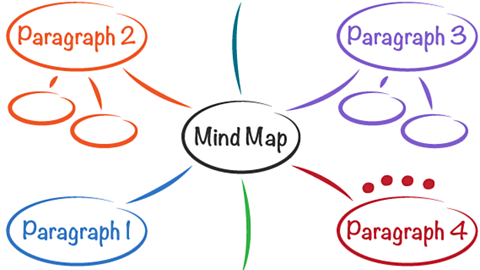
There are several different ways to plan a piece of writing. Try them all and find the one that works for you. You could:
- create a mind map
- bullet point your ideas
- create a flow chart of each stage
- create a table
What to include in a plan
A plan is an outline of your ideas. You could use the five-stage story arc to help structure your narrative.
You could also use your plan to remind you of key features you want to include – figurative language, variety of sentence structures, TiPToP paragraphs. You can also use your plan as a place to write down particular words and phrases to include.
Proofreading
When you have completed a piece of writing, it is a good idea to read over what you have created. Read once for sense, making sure the sentences flow and that the paragraphs are in the right places. If you are writing by hand and realise that you missed a paragraph break, insert the // symbol to indicate where you want the new paragraph to start.
Read a second time, checking spelling and punctuation. Read slowly to make sure you haven’t missed out any important words.
It’s easy to make mistakes when you’re in your creative flow! Make time to read your writing with critical eyes so you can spot your errors and put them right.
Sample question
Write the opening part of a story about a place during a storm.
Attempt one
It was windy and wet and the road was full of big puddles. Walking along whistling he was making his way home from school in a bit of a dream. He’d got out early because of the bad weather. Which is why he’s whistling. He doesn’t much like wind or rain but he likes being let out of school early. That’s when it happens this car comes out of nowhere and just drove right through the biggest puddle you’d ever seen. It splashed up him as he stands there drenched not knowing what had hit him, he just knew he’d be in for it when he got home because his new parka was filthy and his mum would be furious.
Feedback - basic
- Shows an awareness of the purpose of the task and begins to write an entertaining story.
- Uses some figurative language, eg alliteration – ‘windy and wet’.
- Uses some variety of sentence structure, eg starts with verb – ‘Walking along…’.
- Some variety of vocabulary.
- The ideas are linked well and the structure of the paragraph is good.
To improve
- More control of the The voice and tone of a piece of writing. is needed. Verb tenses vary from present to past and should use one or the other.
- More sentence variety would make this a livelier piece.
- More attention to punctuation needed – some confusion between commas and full stops.
- Vocabulary choices could be more ambitious.
Attempt two
The wind howled and the rain battered down. The roads were more like a lake than a city centre – full of puddles. Walking along whistling, a schoolboy was making his way home from school. He was in a bit of a dream. He’d been let out early because of the bad weather. He didn’t much like the wind or the rain but he was thrilled at being let out early. That was why he was whistling. You would think it was a summer’s day! That was when it happened. The car came out of nowhere and just drove right through what was more like a miniature lake than a puddle. The water just flew up from the road and showered over the boy who stood there drenched. He didn’t know what to do but he knew he’d be told off when he got home. He was wearing his brand new parka which his mum and dad bought him for his birthday at the weekend.
Feedback - improving
- Communicates in a clear and effective way and matches the purpose of entertaining with the story form and the intended audience.
- Images and ideas link to create a well-structured narrative.
- Sentences are more varied in length creating a lively voice and helping the story to flow.
- Vocabulary choices and imagery are increasing in variety and begin to be ambitious (eg ‘howled’, ‘like a miniature lake’).
To improve
- More variety in sentence types and structure is needed – many of the sentences in the first paragraph begin with ‘he’.
- Paragraphs could be used to build tension.
- The writer should try to include the senses and aim to use more Using a figure of speech not to be taken literally, usually a metaphor, eg 'a ton of homework'..
Attempt three
The wind howled like a banshee turning the rain into a salvo of bullets. Was this a November day in Oxford? It was more like the monsoon season in Delhi! The roads were covered in puddles the size of small lakes. Walking along and seemingly unaware of it all was a schoolboy. Whistling as he strolled along, hands in his pockets, he was casually making his way home from school. To say he was in a bit of a dream was an understatement. He’d been let out early because of the bad weather and, although he didn’t much like either wind or rain he was in his new parka and, best of all, he was thrilled to the core at being let out of school early. That was why he was whistling. To him it was a summer’s day!
That was when it happened.
A car came out of nowhere and drove right through a puddle that was doing a very good impression of a miniature lake. The water leapt up from the road with a life of its own and drenched the day-dreaming boy. He was jolted out of his reverie and stood there dazed and drenched. He didn’t know what to do, but he knew he’d be in for it when he got home. His brand new parka had turned from green to a kind of dirty khaki-brown. This wasn’t going to be fun. The parka had been a very expensive present from mum and dad.
Feedback - even better
- The story is absorbing and convincing.
- It maintains a consistent viewpoint.
- The tone, style and voice all match purpose, form and audience to create an engaging narrative.
- The sentences are varied in length and type to create a lively style.
- Punctuation is accurate throughout and sophisticated in places.
- Spelling is accurate and vocabulary choices are ambitious (eg ‘banshee’, ‘understatement’, ‘reverie’ and ‘khaki-brown’).
- The description is impressive with some good uses of figurative language eg ‘like a banshee’, ‘thrilled to the core’, ‘leapt up’ and ‘dazed and drenched’).
Quiz: Writing fiction
More help with your English Language
English Language past papers
CCEA past papers and mark schemes, plus top tips to help you prepare for your English Language GCSE.
English Language revision resources. revision-guide
Get ready for your English Language exams with help from Bitesize.

More on Unit 4: Personal or creative writing
Find out more by working through a topic
- count5 of 6
- count6 of 6

- count1 of 6

- count2 of 6