Unit 4, Section A
The material on this page is designed to help you with revision and preparation for your CCEA GCSE English Language exams. It applies to Unit 4, Section A: Personal or creative writing.
- Unit 4 is assessed by a written exam, worth 30% of your final mark
- There is one task in Section A of the Unit 4 exam, worth 88 of the 150 marks available
- In this task, you will be expected to produce EITHER a piece of personal writing OR a creative essay – make sure NOT to attempt both
You can practice for your English Language GCSE exams with a range of CCEA past papers and mark schemes.
INTERIM SPECIFICATION – NOTE FOR YEAR 11 PUPILS
If you are in Year 12 and completing your CCEA English Language GCSE in summer 2027, the above information is correct.
However, if you're in Year 11 and began studying for your CCEA English Language GCSE in September 2026, an interim specification has been introduced.
All Bitesize material currently labelled Unit 4 (referring to the current specification) is now part of Unit 3: Personal or Creative Writing and Reading Literary and Non-fiction Texts, assessed by a written exam, which will be worth 40% of your final mark.
Key points about techniques to plan your writing
- Mind maps can be useful for organising your ideas visually and joining up your thoughts as you go along
- Bullet points can help you organise your thoughts, structure your writing and ensure you cover all important aspects
- Flow charts can help you sequence your ideas and paragraphs logically
- Tables can be useful when you want to compare and contrast different arguments
- Always proofread your work, checking for capital letters, punctuation, spelling errors and omissions to improve the quality of your writing
Why should you plan your writing?
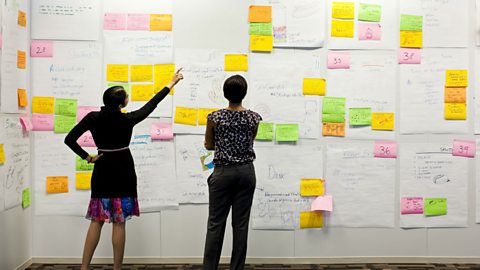
By failing to prepare, you are preparing to fail.
Benjamin Franklin
A plan should help you focus on what you want to include in your writing. It should also be a way putting your ideas in order and sorting out the structure before you begin.
Different methods of planning work for different people. Be willing to try out different approaches before deciding which one works best for you.
Mind maps help you organise your ideas visually
A mind map is a visual way of planning where keywords are used to connect ideas with lines. Mind maps are a flexible way of jotting down ideas and making links. You can easily add to a mind map as you go along. It can become a working document that you add to as you write.
Use a mind map to put down all the ideas you have around a topic. Separate branches could represent each subtopic and connect key words to each. It might also be useful to add in any specific A technique used to add depth and colour to writing. Includes simile, metaphor, alliteration (amongst others)., persuasive techniques or examples of vocabulary that you want to include.
Branches of your mind map could represent each paragraph of your writing - each branch can include ideas and key vocabulary.
Some people start with a mind map to get their ideas down, then use bullet points to put these ideas in order.
Bullet points lay out your ideas in short chunks
Question
Write an article for young people that offers advice on how to deal with the stresses of modern life.
Plan to include:
- causes of stress - mobile phones, social media, bullying, exam pressure, parents
- health problems - stress sometimes leads to: sleep deprivation, weight loss, isolation, confusion
- how to overcome stress - take a break from technology, sleep well, see friends, eat well
Remember to:
- use headlines – From Stress to Rest, Go Easy on Yourself, Take a Tech Break
- include - similes, interesting vocab, rhetorical question, alliteration
Audience:
- young people
Purpose:
- to inform/warn/advise
Article:
- headline
- more formal language
You could colour code or number your bullet points to put them in order for writing.
The five senses
Using your five senses to focus your ideas is a very practical way to plan.
You don’t have to use all five senses at once but you could choose two or three at a time.
Think about these questions:
- What do you see?
- What do you hear?
- What do you smell?
- What can you touch? What do you feel?
- What do you taste?
Take a break, stand outside and list things you can see, hear, smell, feel and taste for 15 minutes.
If you can’t do this outside, sit in your house and do it!
Flow charts show visually how your writing progresses
A flow chart is like a mind map that provides a visual structure for planning. It helps you to order your ideas and paragraphs into an effective structure.
Some writers find a flow chart helps them focus on each important stage of the writing process.
For example, this flow chart shows the planning for an article about social media.
- The writer will begin the article exploring the dangers surrounding social media
- This will be followed by the negative aspects - such as overuse and cyberbullying
- The focus will then shift to the positive side of social media, such as connecting with people and having a constant stream of news
- The third section of the article will focus on offering the reader advice about social media, encouraging them to take care online
- In conclusion, the writer will summarise what life was like before social media, balanced with the opportunities it now offers
Tables let you compare different sides of the story
A table can be useful if you’re writing a piece that covers different points of view, such as an article where you explore both sides of an argument.
Question
Write a feature article for a newspaper in which you explore the pros and cons of going to music festival.
| Introduction | For | Against | Summarise | Proofread |
|---|---|---|---|---|
| Explain what a festival is – refer to Glastonbury, Download and V | Fun, sociable – time with friends | Expensive – too much for teens | Conclude that festivals are worth it | Check spelling – include sophisticated vocabulary |
| Opportunity to relax – especially after stress of exams | Dangerous – big and scary, too many people, alcohol | Include range of punctuation | ||
| Introduction to new music | Have to camp – smelly, uncomfortable | |||
| 10 minutes | 10 minutes | 10 minutes | 5 minutes | 5 minutes |
Note how the writer of this plan has allocated a specific time for each section, and has also included a reminder to leave time to proofread their writing.
Key things to remember
- Try different plans and use the one that works best for you
- Include reminders of key areas to focus on within your writing
- Think about allocating your time carefully so you can complete your writing
Watch: What are audience, purpose and text type?
Poet Aliyah Begum looks at the three key elements of analysing and writing creatively
When you are asked to analyse or write creatively in your English Language exams, it is useful to start by looking at three key elements – audience, purpose, and text type. Each of these will affect the tone, structure, and language that you or the writer uses. The audience is the person or group of people the text is written for. Who the audience is will impact the tone, language choices, and what content is included in the text. The purpose is the reason why you or the writer are writing a text – whether that’s to entertain, inform, persuade, or argue a point of view.
A text can often have more than one purpose. For example, it may be to inform as well as to entertain the audience. The text type is the form that the text is written in. It could be an article for a magazine, a letter, a story, or a speech. Each text type has its own set of rules. To bring this to life, let’s look at a sample writing task you could get in your exam:
“‘School holidays are too long, they are boring for children and expensive for parents.’ Write a letter to your local newspaper, arguing for or against this view.”
The audience for this text is the readers of a local newspaper. This means you would probably use clear and formal language and make reference to local issues the audience will be interested in. The purpose of this piece of writing is to persuade the readers of your opinion. You would need to include ideas and evidence that supports your opinion, and counters the opposing view, while using persuasive language techniques. The text type for this task is a letter. A letter begins with ‘Dear’ and ends with ‘Yours sincerely’ as you do know the name of the person you are writing to. It would normally be written using formal language that is focused on the issue.
Now let’s take a look at an extract similar to the ones you may have to analyse in your exams:
“What will happen if the House allows this proposal to go through unchanged? The government have decided to leave it to a free vote of the house. I am glad of that, but the cabinet is composed of men, and they cannot be expected to realise how women think on this question. I want to warn them of the intensity of women’s feelings about it.”
The audience for this text is government ministers in 1945. The purpose is to persuade them to not pass a bill that would negatively impact women. And the text type is a speech. With all of these in mind, it helps explain why the writer has used formal language and persuasive devices, like rhetorical questions, to help convince them of her point of view.
Establishing the audience, purpose and text type will help you analyse an existing piece of writing and help you with the writing task in your exams. So keep these at the front of your mind when beginning to plan your answers.
Remember to edit and proofread your work
By the time I am nearing the end of a story, the first part will have been reread and altered and corrected at least one hundred and fifty times. I am suspicious of both facility and speed. Good writing is essentially rewriting. I am positive of this.
Roald Dahl
Proofreading
Proofreading involves reading back over your work to check for mistakes that you might have missed and to edit or improve what you have written. All professional writers revise their work over and over again to improve or alter it until they are satisfied.
Here are a few things to focus on in your proofreading:
Capital letters
Read back over your work and check that each sentence starts with a capital letter. Check that you have also used capital letters for names and places. If you have used the personal pronoun ‘I’, make sure it is a capital. Make sure you haven’t accidentally placed capital letters mid-word or sentence.
Omissions
It is quite common to miss words out when you’re writing under pressure, or even to miss out letters from words. Check your writing, to make sure that your sentences are complete.
Punctuation
Check that your sentences end with full stops. Check you haven’t put commas where full stops or connectives would be more effective.
Spelling
Even the most expert of spellers will make simple spelling mistakes when writing under pressure. Prepare thoroughly and learn spelling rules and strategies.
What to improve
When you proofread, try to imagine you are reading your work for the first time, or that you are reading someone else’s work. If you had to give that person advice on how to improve, what would you ask them to change? It is a really useful skill to be able to edit and improve your own work.
Quiz: Techniques for planning your writing
More help with your English Language
English Language past papers
CCEA past papers and mark schemes, plus top tips to help you prepare for your English Language GCSE.
English Language revision resources. revision-guide
Get ready for your English Language exams with help from Bitesize.

More on Unit 4: Personal or creative writing
Find out more by working through a topic
- count3 of 6
- count4 of 6
- count5 of 6
- count6 of 6