Unit 4, Section A
The material on this page is designed to help you with revision and preparation for your CCEA GCSE English Language exams. It applies to Unit 4, Section A: Personal or creative writing.
- Unit 4 is assessed by a written exam, worth 30% of your final mark
- There is one task in Section A of the Unit 4 exam, worth 88 of the 150 marks available
- In this task, you will be expected to produce EITHER a piece of personal writing OR a creative essay – make sure NOT to attempt both
You can practice for your English Language GCSE exams with a range of CCEA past papers and mark schemes.
INTERIM SPECIFICATION – NOTE FOR YEAR 11 PUPILS
If you are in Year 12 and completing your CCEA English Language GCSE in summer 2027, the above information is correct.
However, if you're in Year 11 and began studying for your CCEA English Language GCSE in September 2026, an interim specification has been introduced.
All Bitesize material currently labelled Unit 4 (referring to the current specification) is now part of Unit 3: Personal or Creative Writing and Reading Literary and Non-fiction Texts, assessed by a written exam, which will be worth 40% of your final mark.
Key points about audience, purpose and form
- Knowing the audience for your writing will help you choose the right language and style
- The purpose of your writing will influence how you write and what you include in your text
- Form is how and where your writing will be used, from a recipe to a novel; each form has its own conventions
What is meant by audience, purpose and form?
When you establish your audience, purpose and form, you can make sensible choices about language, tone and structure.
Audience refers to the reader(s), eg could be an individual, in the case of a text message, or a broader group of people in the case of a magazine article or blog.
Purpose refers to the reason for the writing, eg to persuade the reader, to entertain them, to share information, to warn, to advise, to explain.
Form refers to how and where the writing will appear, eg an email, a blog, a recipe, a leaflet, an article.
Language simply means the sorts of words you use, eg should your language be:
- Every day or formal?
- Poetic or straightforward?
- Descriptive or clear?
Tone refers to the mood or feel of your writing, eg should your tone be:
- Friendly and chatty, or distant and polite?
- Sarcastic, pleading, or dismissive?
- Upbeat and positive, or calm and controlled?
Structure refers to the way you present your writing, eg should you use:
- Full sentences and paragraphs?
- Subheadings and bullet points?
- A sequence of linked paragraphs that lead to a final conclusion?
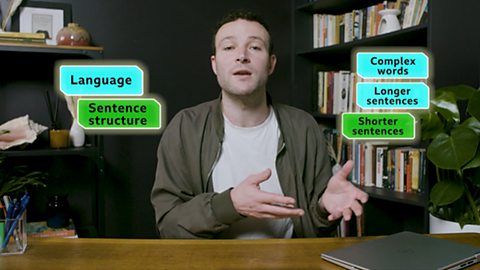
Watch: A quick explanation of audience, purpose and form
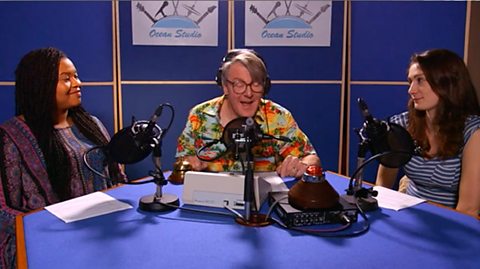
Writer Niellah Arboine discusses articles, speeches and letters
In your English language exams, you’ll be asked to evaluate or write a non-fiction text. Non-fiction is writing that is based on real-life events and consists of factual information and opinions about them. There are many different types of non-fiction texts. In this video, we’ll look at articles, speeches and letters.
Different types of non-fiction texts have distinct rules around how they should be written. An article is usually found in a magazine, in a newspaper or online. They often give a balanced factual account of a topic, or they sometimes give an opinion about a particular point of view or idea.
The language choices a writer makes will be influenced by the purpose of the article, and the audience who will read it. For an informative news article or sports report, you may want to use direct factual language. For an opinion piece such as a travel article or review, you could use more descriptive or emotive language to affect the reader.
The structure of an article will usually feature a memorable headline that sums up the topic or opinion of the article, an engaging opening that outlines the main point of the article, a detailed middle section that explores the topic in more detail and a conclusion that summarises the writer’s purpose.
Now let’s take a look at a speech. A speech is written to be communicated verbally to an audience, often to persuade them towards a particular point of view. The language used in a speech can be persuasive, humorous, or personal, and will often address the audience directly by using the pronoun 'you'.
Structurally, they usually have an engaging and motivational opening that is followed by an argument or opinion that could include opposite viewpoints. They usually end with a memorable conclusion that sums up the main purpose of the speech.
A letter is another type of non-fiction text. It is usually used to communicate with an individual reader. Letters have a well-established structural form. The language used will be standard English, but the tone of the language will depend on the purpose of the letter. Most letters start with ‘Dear followed by the name of the recipient you’re writing to. The opening paragraph will outline the purpose of the letter and the conclusion will summarise the main points or make any requests the writer may have. A letter is usually ended with ‘Yours sincerely’ if you know the name of the person you’re writing to and ‘Yours faithfully’ if you don’t.
Audience: Who is going to read your writing?
All writing has an The audience - individual readers, viewers or a broader group such as teenage skateboarders or middle aged golfers - who you expect to engage with your text. – from emails, to text messages, ingredients on a cereal package to political speeches. Even graffiti on a wall. The intended audience are the readers you expect to engage with the text.
In the case of direct messages – such as emails, texts or hand-written letters – the audience is usually the one or two people you address the message to. In this case the language and style of your writing will change according to a number of factors, including how well you know the recipient.
For example, you might use chatty language with emoticons and abbreviations in an email to a close friend. However in a job application email, you would be expected to use formal language with full words and sentences.
Other texts, such as newspaper articles, blogs or leaflets, are intended for a broader audience. In this context, you are unlikely to know your readers personally and so you need to make assumptions about them. Some writers have an ‘ideal’ reader in mind. You might consider the following things about your reader:
- age
- gender
- culture
- specialist knowledge
- hobbies
- political leanings
Knowing your audience allows you to choose language and a style that will appeal to them.
For example, an article for a magazine aimed at astronomers might include technical vocabulary to do with telescopes – language less likely to appear in a fashion blog for teenagers.
Similarly, a film review in a Sunday newspaper might be sarcastic in tone and use literary language – not so useful when writing instructions for baking a cake!
Purpose: What will your writing 'do'?
The purpose of a text is what it's being written for. There are many reasons for writing. You might be writing to:
- share information
- give instructions on how to do something
- persuade someone that you are right
- persuade a group of people to buy a product
- review a film or website
- explain why you’re the best person for a job
Think about your purpose before you start:
- What do you want your writing to achieve?
- How do you expect your reader to feel as a result of reading?
For example, if your purpose were to instruct a beginner how to fold an origami swan, your language would need to be clear and concise. Simple language and A verb in its command form, eg 'Go!' 'Stop!' 'Come with me!' would help convey your message.
If your purpose were to persuade a group of voters to support a political campaign, your writing would need to be exciting and dynamic. Language devices employed to convince and persuade an audience - eg questions, groups of three, alliteration. combined with facts and figures might help to sway your readers.
Form: How and where is it appearing?
Form refers to how and where a piece of writing will appear. Like audience and purpose, the form influences decisions writers make about language, tone and structure. Each form of writing has its own The normal standard practices for doing something..
Here are some examples of forms and their basic conventions.
Email:
- often more informal than a letter
- might include hyperlinks
- includes a subject line that summarises the content
Novel:
- follows a narrative arc
- includes imaginary characters
- is divided into chapters
Newspaper article:
- has a bold headline
- divided into short paragraphs
- reports a factual event
Recipe:
- includes a list of ingredients
- uses imperative language
- gives clear instructions
Quiz: Audience, purpose and form
More help with your English Language
English Language past papers
CCEA past papers and mark schemes, plus top tips to help you prepare for your English Language GCSE.
English Language revision resources. revision-guide
Get ready for your English Language exams with help from Bitesize.

More on Unit 4: Personal or creative writing
Find out more by working through a topic
- count2 of 6
- count3 of 6
- count4 of 6
- count5 of 6