Unit 4, Section A
The material on this page is designed to help you with revision and preparation for your CCEA GCSE English Language exams. It applies to Unit 4, Section A: Personal or creative writing.
- Unit 4 is assessed by a written exam, worth 30% of your final mark
- There is one task in Section A of the Unit 4 exam, worth 88 of the 150 marks available
- In this task, you will be expected to produce EITHER a piece of personal writing OR a creative essay – make sure NOT to attempt both
You can practice for your English Language GCSE exams with a range of CCEA past papers and mark schemes.
INTERIM SPECIFICATION – NOTE FOR YEAR 11 PUPILS
If you are in Year 12 and completing your CCEA English Language GCSE in summer 2027, the above information is correct.
However, if you're in Year 11 and began studying for your CCEA English Language GCSE in September 2026, an interim specification has been introduced.
All Bitesize material currently labelled Unit 4 (referring to the current specification) is now part of Unit 3: Personal or Creative Writing and Reading Literary and Non-fiction Texts, assessed by a written exam, which will be worth 40% of your final mark.
Key points about using language effectively
- Writers use language to create different effects; learning how to use these will make your writing more engaging
- Descriptive language helps your readers feel like they're part of the scene; techniques such as similes, metaphors and personification make descriptions more vivid
- Rhetorical devices are used for many different reasons, such as persuading, selling or inspiring emotional responses
Watch: How to improve your creative writing
Rapper and teacher Christian Foley on how to craft your creative writing
Each of your English language exams will feature a writing task. You'll need to write efficiently and effectively, so here are a few tips. In both fiction and non-fiction writing, language choices, sentence structure and punctuation influence the tone and style of the writing and impact on the reader.
Thinking about the form, audience and purpose of a piece of writing can really help you decide how to craft your writing. For example, a letter will often use formal language and follow a set structure, but a persuasive speech or an opinion article may use more dramatic or emotional language to help persuade or entertain your audience.
Let's start with a simple sentence and then see how we can use language, sentence structure and punctuation to craft it.
“Healthy school meals are important.”
The language you use will have a big impact on the reader. Hyperbole or exaggeration and metaphor can be used to make a powerful point. For example, “Healthy school meals are the fuel that powers the minds of students.”
You can use emotive language to create an emotional reaction in the reader, such as: “Healthy school meals are vital for children's growth and happiness.”
The more words you know, the more likely you'll be able to find the vocabulary that best suits the purpose of your writing. You can expand your vocabulary by reading widely or using a thesaurus when you revise.
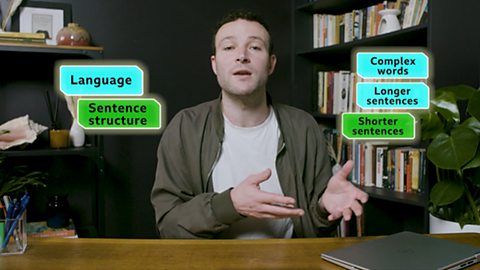
Sentence structure can also have a big impact. Complex words in longer sentences can convey important information and show off your knowledge.
“Nutritious lunches play a pivotal role in supporting academic achievement and healthier lifestyles for all students.”
Shorter, conversational sentences can be used for emotional impact or persuading your reader to agree with your point.
“Healthy school meals matter. They fuel our brains and bodies.”
Punctuation makes your writing clearer and can be used to create an effect on the reader too. You should aim to use a variety of punctuation and vary it across your sentences.
“Healthy school meals? They're crucial! A must-have for every child.”
So, language, sentence structure and punctuation can help you to craft your writing for the form, audience and purpose. And remember to leave time so you can proofread and correct your writing to make it as effective as possible.
Literary techniques to make descriptions shine
Descriptive language is used to help the reader feel almost as if they are a part of the scene or event being described. Description is useful because it helps readers engage with the world of the story, often creating an emotional response. It can help a reader visualise what a character or a place is like.
There are a number of literary techniques that can make descriptions more vivid and creative. Here are some examples:
| Technique | Examples |
|---|---|
| Simile - compares one thing with another using 'as' or 'like'. | The trees stood as tall as towers. |
| Metaphor - uses an image or idea to represent something else. | The circus was a magnet for the children. |
| Personification - a metaphor attributing human feelings to an object. | The sun smiled at the hills, ready to begin a new day. |
| Onomatopoeia - words sound like the noises they represent. | The autumn leaves and twigs cracked and crunched underfoot. |
| Alliteration - repetition of a consonant sound in a series of words. | The seahorse spiralled, seeking safety and solace. |
| Assonance - repetition of a vowel sound in a series of words. | He sneezed and wheezed, could hardly breathe. |
| Oxymoron - a phrase combining two or more contradictory terms. | There was a deafening silence. |
| Antithesis - putting two opposite ideas together to highlight contrasts. | ‘That’s one small step for man, one giant leap for mankind.’ (Neil Armstrong) |
| Parenthesis - a phrase that adds extra detail. | Jess, who was fifteen, loved her English lessons. |
How to use descriptive language techniques effectively
Female director: Bob, we need a bigger finish to this musical.
Male director: It's a happy ending to a lyrical love story. I can see the stage now. Big church, lots of flowers, sunlight streaming through a stained glass window.
Female director: Capture the feeling. Use descriptive language to create it; just saying it doesn't get it across. In lovely metaphors and similes and alliteration is what does it best. Back in 10; need the song by then.
DIRECTORS LEAVE THE ROOM
Bob the songwriter: They think I don't know the difference between similes and metaphors.
[SINGS] A simile is like a thing, and a metaphor suggests the thing. Ta-da!
A happy scene. Lots of sunlight and love. Huh, that's pathetic fallacy. Nature reflects how characters feel. They're angry and there's thunder; they're happy and it's sunny.
[SINGS] We're like two perfect doves, our hearts are as one. We fly up a stairway made of sunbeams, to a place of love and beauty and fun, a place that's always been in our dreams.
That's got a simile and a metaphor. Not much alliteration, though.
DIRECTORS RETURN
Female director: Did you write it?
Male director: Hold the press.
Female director: Slight tweak, Bob. Our producer says, “Could we do horror?” You know, horror musicals are the next big thing.
Male director: The church is now a deep, dank cave, and the main characters are zombies.
Female director: More use of hyperbole. You know, exaggerate so we can scare the pants off the audience.
Male director: Make it stormy and thundery. Need the song in ten, darling.
Bob the songwriter: [SINGS] Like damned demons on the edge of the abyss, we mingle our mangled limbs in dire communion. Let the storm power of our desire spark a last kiss, while the zombies howl in sweet derision.
Some nice alliteration there. “Damned demons”: cool. And hyperbole. “Storm power of our desire”: nice. Even an oxymoron: “Sweet derision”. Clever!
DIRECTORS RETURN
Female director: Slight change of plan.
Male director: Just a tweak-ette.
Female director: Can you do… Bollywood?
Bob the songwriter: [CRIES]
Example of a vivid description
In the example below, look at how the writer uses literary techniques to create a vivid description.
The ground crumbled like icing sugar under my feet as I heaved towards the summit. The trees below were dots to my squinting eyes. The sun was relentless and beat down on my back as I wiped drips of salty sweat from my neckline. The deafening silence of the chasm below filled me with dread. Suddenly, eagles came into view, breaking the silence, screeching in hunger.
Analysis
The writing opens with a A comparison using 'like' or 'as' to create a vivid image, eg as big as a whale; float like a butterfly, sting like a bee. to show the texture of the ground.
The sun is A type of imagery in which non-human objects, animals or ideas are given human characteristics.: it is described as ‘relentless’, giving it a ruthless personality.
The silence is described as ‘deafening’, an A phrase combining two or more contradictory terms, often used for emphasis - eg. 'deafening silence'. that helps emphasise how unbearable the situation is for the character.
Technique where the environment (usually the weather) reflects the emotions of the main character. has also been used here - the uncomfortable heat mirrors the character’s struggle as she continues on her journey.
These literary techniques make the writing more interesting and draw the reader into the details of the scene.
Quiz: Using language effectively
Rhetorical devices to persuade and inspire
Persuasive language is used for many reasons, for example to help to sell products or services, or to convince people to accept a view or idea. Politicians often use A rhetorical device is a technique that a writer uses to convey to the reader a meaning, with the goal of persuading them towards considering a topic from a different perspective. in their speeches. These techniques can be powerful tools for getting what you want.
Here are some types of rhetorical techniques and examples of how they can be used:
| Technique | Examples |
|---|---|
| Flattery - complimenting your audience. | A person of your intelligence deserves much better than this. |
| Hyperbole - exaggerated language used for effect. | It is simply out of this world – stunning! |
| Personal pronouns - ‘I’, ‘you’ and ‘we’. | You are the key to this entire idea succeeding - we will be with you all the way. I can’t thank you enough! |
| Imperatives - instructional language. | Get on board and join us! |
| Triples - grouping language in threes. | Safer streets means comfort, reassurance and peace of mind for you, your family and your friends. |
| Emotive language - language that appeals to the emotions. | There are thousands of animals at the mercy of our selfishness. |
| Statistics and figures - factual data used in a persuasive way. | 80% of people agreed that this would change their community for the better. |
| Rhetorical question - a question which implies its own answer. | Who doesn’t want success? |
How to use persuasive language techniques effectively
Lyle Bland, politician: Great slogan. I'd vote for me with a slogan like that. Is that my slogan?
Political advisor: It is, Lyle.
Lyle Bland, politician: What does it mean?
Political advisor: Here's your speech.
Lyle Bland, politician: Actually, I've prepared something myself.
[READS] My plan is a plan that has four plans rolled into one big plan that is going to change the way we plan our planning for the future.
Political advisor: Hold on, Lyle, hold on. Are you trying to send the nation to sleep? Because if they're asleep, they can't go out and vote for you.
Lyle Bland, politician: What?
Political advisor: If you're going to persuade people that you're worth voting for, that you know what you're talking about, you've got to sound like you know what you're talking about.
Lyle Bland, politician: But I don't know what I'm talking about. Who does, eh?
Political advisor: The point is to come across like you do. Just read my speech; my speech does the job.
Lyle Bland, politician: [READS] Progress, patriotism and people who pull together…
Political advisor: Emotive alliteration and the rule of three. Progress, patriotism, people. Ka-ching!
Lyle Bland, politician: [CONTINUES] …are my kind of people. The kind of people I believe in. The people who can remake this nation. Make it better.
Political advisor: The personal pronoun - me, I - makes people believe that you believe, and the repetition of key words slams home the message.
Lyle Bland, politician: [READS] You are the people I am talking about, each and every one of you here in this hall, out in the streets, in your homes, in every town and city and village in the country. You are the key.
Political advisor: Flatter the audience, bring them into the story, be plain and strong with your language. Ka-ching, they're on your side.
Lyle Bland, politician: [READS] A third of our nation is in dire need. Sixty percent say that they want to help. Only a tiny minority are stopping us.
Political advisor: No complicated numbers, just simple facts to make a powerful point. Keep the audience in the story.
Lyle Bland, politician: Yes. [READS] That is why we need to come together. That is why we have to work as one, however hard the path, however long the journey. Together, we can do great things. But I need your support.
Political advisor: However and but, signposted connectives. We can do great things; imperative vocabulary. It all works a treat.
Lyle Bland, politician: Vote Bland. [STOPS READING] Great. Brilliant. What's a connective?
Political advisor: You just say the words and get elected, and then we'll send you back to school.
Lyle Bland, politician: Cool.
Example of rhetorical techniques
William Wallace led the Scottish rebellion against Edward I in the 14th Century. His exploits were made into the film Braveheart. In this extract from his speech about freedom, notice the techniques he uses to convince his audience.
I am William Wallace. And I see a whole army of my countrymen, here in defiance of tyranny! You have come to fight as free men. And free men you are! What will you do without freedom? Will you fight? Yes! Fight and you may die. Run and you will live at least awhile. And dying in your bed many years from now, would you be willing to trade all the days from this day to that for one chance, just one chance, to come back here as young men and tell our enemies that they may take our lives but they will never take our freedom!
William Wallace, Braveheart
Analysis
Wallace uses personal pronouns (‘I, you, our’) to make the audience feel as though he is speaking to them on an individual level. The repeated use of ‘free’ emphasises the main themes of his speech. He also uses A question asked just for effect with no answer expected., one after the other, to impact the audience - they feel that they must fight to protect their freedom. The closing sentence is highly Language that makes the reader experience a certain emotional response to the writing. and asks his listeners to imagine a future version of themselves. He ends his speech with the key word ‘freedom’, making his point once again.
Quiz: Rhetorical devices
More help with your English Language
English Language revision resources. revision-guide
Get ready for your English Language exams with help from Bitesize.

English Language past papers
CCEA past papers and mark schemes, plus top tips to help you prepare for your English Language GCSE.
More on Unit 4: Personal or creative writing
Find out more by working through a topic
- count6 of 6

- count1 of 6

- count2 of 6
- count3 of 6