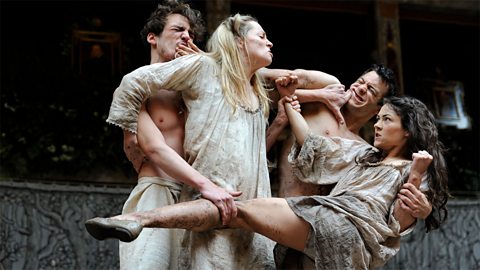
Love and marriage
Love in A Midsummer Night’s Dream is powerful, unpredictable and often irrational. Shakespeare presents love as a force that can elevate, confuse or torment those who experience it. From the outset, the play frames love as difficult and unstable. Lysander famously observes, “The course of true love never did run smooth” (Act 1, Scene 1), setting the tone for the lovers’ emotional turbulence. Hermia and Lysander’s desire to marry clashes with Athenian law, while Helena’s unreturned love for Demetrius exposes the pain of devotion without reciprocity. Her lament, “I am your spaniel” (Act 2, Scene 1), reveals the self‑destructive extremes to which love can drive her.
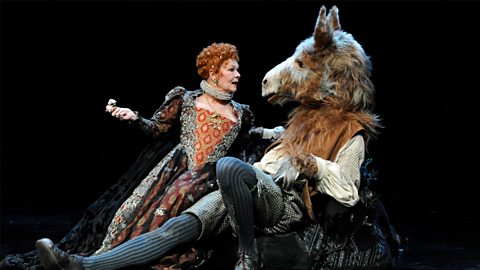
The magical interference in the forest further emphasises love’s volatility. Under the influence of the flower’s juice, Titania falls for Bottom, transformed with an ass’s head. Her enchanted declaration, “Thou art as wise as thou art beautiful” (Act 3, Scene 1), highlights how love can distort perception. Similarly, the sudden shifts in affection between the young Athenians show how fragile and changeable desire can be.
Yet the play ultimately restores harmony. Theseus’s decision to overrule Egeus and permit the lovers’ marriages brings resolution, suggesting that love – though chaotic – can end in unity. The triple wedding in Act 5 celebrates reconciliation, mutual affection and social order. Shakespeare’s portrayal of love is therefore both comic and profound: a force that bewilders but ultimately binds people together.
Appearance vs reality
Shakespeare repeatedly blurs the boundary between what seems true and what is true. The forest becomes a space where characters misinterpret what they see, and where illusions shape behaviour. Early in the play, Hermia warns Lysander that appearances can deceive, noting, “Things base and vile, holding no quantity, / Love can transpose to form and dignity” (Act 1, Scene 1). This idea becomes literal when Titania, enchanted, falls in love with Bottom. Her belief that he is noble and attractive – “Thou art as wise as thou art beautiful” (Act 3, Scene 1) – is a comic distortion of reality.
The lovers’ confusion in the forest also reflects this theme. When Lysander wakes under the spell and sees Helena, he insists, “Not Hermia but Helena I love” (Act 2, Scene 2). His sudden shift exposes how perception can be manipulated. Helena, meanwhile, believes the men are mocking her, interpreting genuine enchantment as cruelty. Her cry, “O spite! O hell!” (Act 3, Scene 2), captures her distress at what she perceives as deception.
The Mechanicals’ play further explores illusion. Their earnest but clumsy attempt to create theatrical “reality” leads to unintentional comedy. Bottom’s reassurance – “If we offend, it is with our good will” (Act 5, Scene 1) – highlights the gap between intention and effect.
Ultimately, the play suggests that reality is often unstable, shaped by emotion, magic, and misunderstanding. Shakespeare invites the audience to question how much of what they see – onstage and in life – is merely illusion.
Magic and the supernatural
Magic drives the plot of A Midsummer Night’s Dream, shaping relationships, identities and the play’s comic misunderstandings. The supernatural world, ruled by Oberon and Titania, operates according to its own logic, influencing the human world in unpredictable ways. Puck’s introduction – “I am that merry wanderer of the night” (Act 2, Scene 1) – establishes him as a mischievous agent of magical disruption. His mistakes, such as enchanting the wrong Athenian, create chaos among the lovers.
The magical flower, struck by Cupid’s arrow, symbolises the irrationality of desire. Oberon describes its power vividly: “The juice of it on sleeping eyelids laid / Will make or man or woman madly dote” (Act 2, Scene 1). This enchantment transforms the forest into a space where normal rules collapse. Titania’s enchanted love for Bottom – “Mine ear is much enamour’d of thy note” (Act 3, Scene 1) – shows how magic can override reason and status.
Magic also restores harmony. Oberon’s decision to reverse the spells and reconcile with Titania brings balance back to both fairy and human worlds. Puck’s final speech – “Give me your hands, if we be friends” (Act 5, Scene 1) – suggests that magic can charm, amuse and heal.
Shakespeare uses the supernatural not simply for spectacle but to explore how external forces – emotion, desire, chance – shape human behaviour. Magic becomes a A metaphor is a word or a phrase used for dramatic effect, to describe something as if it were something else. for the unpredictable, transformative power of love and imagination.
Dreams and imagination
Dreams permeate the play, blurring the line between fantasy and reality. Shakespeare uses dreams to explore uncertainty, transformation and the power of imagination. The forest itself functions like a dreamscape: a place where identities shift, emotions intensify and logic dissolves. When the lovers awaken, they struggle to distinguish memory from dream. Demetrius reflects, “These things seem small and undistinguishable, / Like far-off mountains turned into clouds” (Act 4, Scene 1), capturing the hazy unreliability of their experiences.
Bottom’s reaction is even more explicit. After waking from his enchantment, he declares, “I have had a most rare vision” (Act 4, Scene 1), and later resolves to have Peter Quince write a A traditional poetic form used in narrative poetry. A ballad normally features repetition, regular rhyme scheme and rhythm. They were traditionally penned to be sung or read aloud. called “Bottom’s Dream,” because “it hath no bottom” (Act 4, Scene 1). His humorous confusion highlights how dreams can feel profound yet indescribable.
The play’s title itself foregrounds the dream A recurring element or symbol in a text (or work of art), the repetition of which contributes to establishing a theme., and Puck’s closing speech reinforces the idea that the entire play may be understood as a dream. He tells the audience, “Think but this, and all is mended: / That you have but slumber’d here” (Act 5, Scene 1). This invitation to view the play as a shared dream emphasises the transformative power of theatre and imagination.
Dreams allow characters to explore desires and fears that cannot surface in the structured world of Athens. Shakespeare suggests that imagination is not an escape from reality, but a vital part of understanding it.
Nature, order and disorder
The contrast between the structured world of Athens and the wild, unpredictable forest underscores the theme of order versus disorder. Athens represents law, hierarchy and social constraint. Egeus’s demand – “As she is mine, I may dispose of her” (Act 1, Scene 1) – reveals the rigid authority governing Hermia’s life. The forest, by contrast, is a space where natural forces override human rules. Here, the lovers flee to escape Athenian law, and their emotions become chaotic and unstable.
The fairy world itself is in turmoil when the play begins. Titania describes the consequences of her quarrel with Oberon: “The seasons alter” (Act 2, Scene 1), explaining how their conflict disrupts the natural world. This cosmic disorder mirrors the emotional disorder among the lovers.
Yet the forest also allows transformation. Removed from Athens, characters confront their desires, insecurities, and identities. The confusion of Act 3 – where Helena cries, “O weary night!” (Act 3, Scene 2) – reflects the emotional turbulence unleashed by the forest’s disorder.
Order is restored only when the characters return to Athens. Oberon and Titania reconcile, the lovers’ relationships stabilise and Theseus overrules Egeus, allowing harmony to replace conflict. The triple wedding symbolises the re‑establishment of social and natural balance.
Shakespeare uses the movement between city and forest to explore how disorder can be both destructive and liberating, ultimately leading to renewal and clarity.
Performance, roles and theatre
The play is deeply self‑aware, constantly drawing attention to performance, role‑playing and the nature of theatre itself. The mechanicals’ earnest attempt to stage Pyramus and Thisbe provides comic insight into amateur performance. Bottom’s enthusiasm – “Let me play the lion too” (Act 1, Scene 2) – reveals his desire to inhabit multiple roles, highlighting the joy and absurdity of theatrical ambition.
Their rehearsal scenes parody the conventions of drama. Quince’s anxious direction – “This is Ercles’ vein” (Act 1, Scene 2) – shows how the mechanicals imitate heroic styles without fully understanding them. Their final performance in Act 5 is intentionally clumsy, yet Theseus and the court respond with amused generosity. Theseus remarks, “The best in this kind are but shadows” (Act 5, Scene 1), suggesting that all theatre is an imitation of life.
The lovers themselves “perform” shifting emotional roles under the influence of magic, while Titania’s enchanted devotion to Bottom becomes an involuntary performance of love. Even Puck acknowledges the theatricality of his mischief, telling the audience, “If we shadows have offended” (Act 5, Scene 1), framing the entire play as a performance that can be dismissed like a dream.
Shakespeare uses When a play reminds you it is a play. It tells the audience they are watching a performance, rather than trying to create a completely believable “real world”. to celebrate creativity, imagination and the communal experience of storytelling. The play suggests that performance – whether onstage or in life – is a way of exploring identity, emotion and human folly.
Test your knowledge of the themes in A Midsummer Night's Dream
Further study
The study of Shakespeare, controlled assessment guidance. activity
Unit 3 of the CCEA GCSE English Literature qualification is a controlled assessment unit based on the study of a play by William Shakespeare.
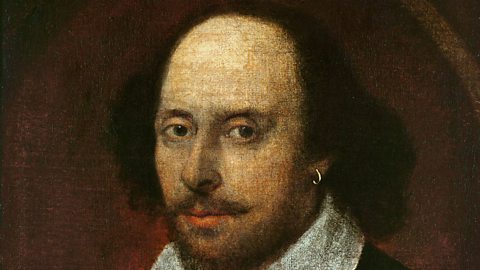
Shakespeare Unlocked - A Midsummer Night’s Dream. collection
Three key scenes from A Midsummer Night's Dream are performed and explored by actors and directors in workshops.
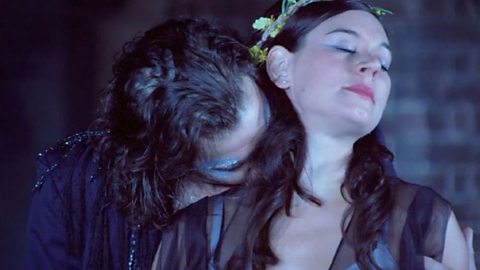
In Our Time. audio
Melvyn Bragg and guests discuss the ideas behind Shakespeare's comedy with its intertwining plots of royal marriage, crossed lovers, quarrelling fairies and rude mechanicals.
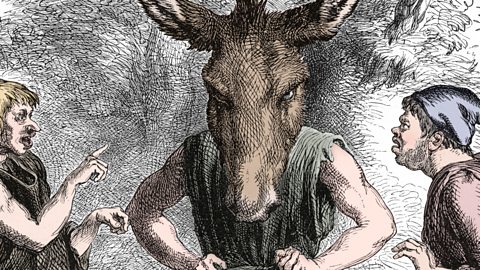
A Midsummer Night's Dream performed
A Midsummer Night's Dream. video
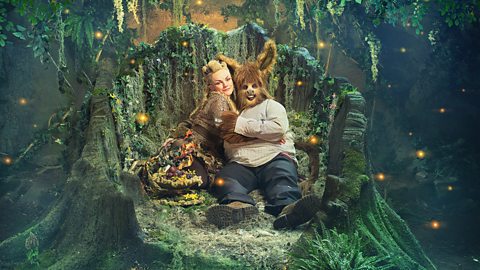
Classic Shakespeare play adapted for television by Russell T Davies.
KS3 English: A Midsummer Night's Dream by William Shakespeare. collection
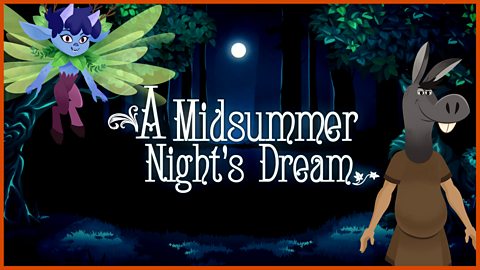
Shakespeare's romantic comedy A Midsummer Night's Dream is animated in 8 episodes for KS2 and KS3 pupils.
CBeebies: A Midsummer Night's Dream. video
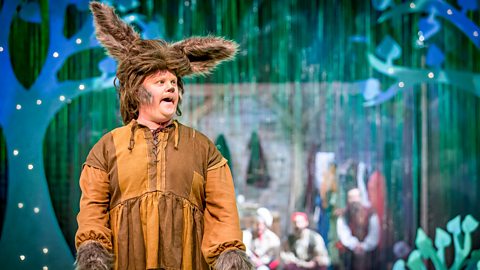
Fairies, magic, celebration and comical confusion! Join Swashbuckle's Cook and Line as they help William Shakespeare put together a magical production of A Midsummer Night's Dream.
More on A Midsummer Night’s Dream
Find out more by working through a topic
- count4 of 5
- count5 of 5
- count1 of 5
- count2 of 5