Overview of Little Girls by Len Pennie
- Little Girls by Len Pennie is a poem that deals with the subject of The hatred or dislike of women
- The main character of this poem is never named, always "she" or "the girl". It is clear that "she" represents all women and girls.
- The poet suggests the experiences described in the poem, and the reactions to them, are potentially happening to all women to some degree.
- The poem begins by describing what life is like for the ‘little girl’, and therefore many women, and the anxiety it causes.
- It moves on to describe how men try to drown out the girl’s testimony, make excuses, and A term used to describe how people can twist the truth and turn it back on and blame the victim, making them question their reality. the girl.
- The end of the poem sees the girl finally standing up for herself, rising up with others take back power and control.
This poem explores themes of:
- identity and power
- female and male relationships
- justice
- love
Looking for some quick revision? Try an interactive quiz for National 5 English.
Little Girls depicts abusive behaviour towards women, including physical abuse, which you might find upsetting. You might want to discuss this with your teacher or another adult you trust.
If you have been affected by these issues, the following page contains a list of organisations and information for young people that may be helpful: Information and Support: Bitesize
You can read Little Girls by Len Pennie on the Scottish Poetry Library website.
Context
Len Pennie
Len Pennie is a poet who writes and performs in Scots and English.
Her writing often explores themes of The hatred or dislike of women gender-based violence, and injustice in society.
Pennie was in a domestically abusive relationship in her early 20s and has written about this experience in her poetry. In an interview with The Guardian, Pennie explained:
“One of the things I’ve been very, very keen to do with both book tours and any time I do events is to create a space where domestic abuse is not a taboo word,” she says. “People say to me, what’s your book about? I’m supposed to say, ‘Oh, it’s a journey of healing.’ No: it’s about domestic abuse. And most people lean back, but some people lean in, and those are the people that I want to speak to because they feel seen and they feel like they don’t have to hide it.”
(Source: ‘I was writing at my lowest ebb’: Scottish author Len Pennie on domestic abuse and the power of poetry’, published in The Guardian)
Little Girls touches on challenging topics, which are often part of wider discussions about society, particularly in feminism.
What is feminism?
- Feminism is the belief that men and women should be socially, politically and economically equal
- There have been many An organised effort to oppose gender-based discrimination. Typically, a group of activists protesting for the rights and interests of women. throughout history, such as the The name given to women using peaceful protest to try and win the right to vote. and The name given to groups of women using direct action and more aggressive methods to try and win the right to vote. movements in the late 19th and early 20th centuries and the A feminist campaign for equal rights whose members believed in using more direct action to achieve its aims. in the 1960s and 1970s.
Form and structure
Little Girls is made up of three stanzas of differing length:
- Stanza one has eight lines.
- Stanza two has eighteen lines.
- Stanza three has ten lines.
The poem is written in tetrameter - there are four feet (beats) per line throughout. This gives a very regular, energetic rhythm which will particularly come across when the poem is performed or spoken.
The rhyme scheme is rhyming A pair of lines in a poem, usually rhyming and of the same length.. Many of these couplets are made up of one A sentence that uses parallel structures of approximately the same length and importance to create balance. , broken in the middle after one line. Some ideas are extended to take up two rhyming couplets.
The rhythm and rhyme create a "sing-song" feel, similar to some children's stories. This reflects the fable or fairy tale quality of the text.
Lines are of similar length, varying between ten and thirteen syllables. There is variation in stress and how the four beats break up each line. This allows the pace to vary, allowing the narrative to move along quickly, while also introducing pauses that stress key points, or reflect the words of different voices in the poem.
You can learn more about poetic metre with this guide to rhythm and metre in poetry.
The poem is written in the third person. This allows the speaker to reflect on what is happening in the girl's head as well as in real life. While the content of the poem is emotional, this adds a sense of objectivity and adds to the feeling that this is a universal, almost fable-like story being told to us.
Each of the three verses deals with different aspects of sexual inequality.
- The girl’s experiences and how they affect her.
- The men’s excuses and gaslighting; the girl giving in, keeping her head down and not causing trouble.
- The girl continues to submit to expectation before finally rising up (with others) and feeling empowered.
Stanza one
Lines one to eight
In the first line of Little Girls, Len Pennie places two contrasting ideas together, also known as To place two or more ideas/images close together to create further meaning for an audience.
The little girl stands on a knife-covered ledge,
The "little girl" echoes the title and represents innocence and purity. However, the image of the ledge suggests danger. The ledge being covered with knives heightens this danger.
A similar contrast is present in the second line of the A pair of lines in a poem, usually rhyming and of the same length.. Dancing, usually has connotations of innocence and joy, but here the girl is dancing to try to avoid the knives cutting her feet.
This opening image sets the The overall mood or 'feel' of the text or part of the text; this can be created by the writer or speaker's choice of words, pace, rhythm or imagery. for the poem. This is about young girls trapped in dangerous and harmful situations. They are simply living their lives but a sense of anxiety is felt by the reader straight away.
We move on to imagining the girl slightly older. She is described as:
licking her wounds since the first time she bled
This phrase "the first time she bled" links back to the image of dancing on knives, but also makes us think of menstruation. The suggestion of the girl's first period, positions her at the beginning the journey out of girlhood to becoming a woman.
She is "licking her wounds", which is a Describing something by saying it is something else. While a simile compares things using 'like' or 'as', a metaphor creates a direct comparison that compares her to an injured animal. It suggests no one is there to help her and she has to look after herself.
Line four expands the idea of injuries inflicted upon girls and women. It suggests that females are judged for everything they do, so perhaps that is why they have to look after themselves. The word "commit" is associated with crime and suggests that even in her inner life, the girl is subject to external laws and expectations.
Line five build on this idea:
starving herself since she started to eat
This could literally refer to issues relating to women and food, including eating disorders. It may also be seen as a metaphor, suggesting society’s demands that women deprive themselves to fit a certain standard of beauty. The idea of self-harm goes against the self-healing ("licking her wounds") in the previous couplet.
The repetition of "She’s been" throughout the first stanza emphasises an ongoing cycle of both harming herself and trying to heal herself. This confusion continues in the next line:
Connecting the dots of her heart’s every beat
A heartbeat is an indication of life and the heart is also symbolic of a person's soul and sense of self. The girl is trying to make sense of her life when there are so many contradictions in how she feels and how society wants her to be.
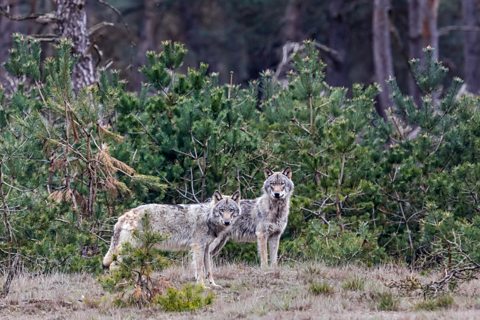 Image source, Getty Images
The last couplet in stanza one starts to shift focus towards the role of men. It examines different ways that men prey on her, likening them to:
- "fishermen hiding their net"
- "wolves" that she must run from
The fact that the fishermen hide their nets suggests stealth and secrecy - these men are trying to trap the girl.
A wolf is a very masculine image and often features in fairy tales. For example, in Red Riding Hood, the wolf disguises itself and pretends to be good whilst waiting to attack the unsuspecting target.
Both of these metaphors focus on deceit and trickery, portraying the men as frauds and liars.
running from wolves that deny they're a threat.
The phrase "deny they're a threat" introduces the idea of A term used to describe how people can twist the truth and turn it back on and blame the victim, making them question their reality.. If these men are really hunting like a pack of wolves, this denial is clearly twisting the truth and suggesting the girl misunderstands the situation.
Image source, Getty ImagesStanza two
Lines nine to sixteen
The new stanza continues the idea of men denying that they are a threat:.
And the men chime in
The word "And" suggests the story is continuing but "chime in" tells us their opinion is unsolicited (unasked for). There is no consent and the sound of the men is so loud that the "little girl" is "drown[ed] out" and overcome by them. In contrast to their loud voices, they demand silence from her.
Silence girl
The word "girl" is used as a put-down here, suggesting that young women are powerless and nameless. This idea is continued when the men say "Don’t make a fuss". This is dismissive and belittles the reaction of the girl to how she has been treated. The phrase suggests she is complaining about very little.
The second line of the couplet in line ten continues the idea of denial and gaslighting.
I'd never do this, it's not all of us.
This may be true but their previous instructions ("Silence" and "Don’t make a fuss") would suggest otherwise. This line alludes to the phrase ‘Not all men…’, which has been used, particularly on social media as #NotAllMen, as a response to discussions of misogyny and violence against women. It is a phrase that many women object to.
In this case, the men are taking control of the narrative. They impose their own opinions to "drown out her sorrow". They are more interested in saving their good name than offering empathy or comfort.
the male chorus sings
The "male chorus" makes clear that a number of men are speaking as one. This reminds us of "chime in" from line nine. The word "sings" suggests an existing set of words that they all know.
you're imagining things.
This refers back to line ten ("I'd never do this, it's not all of us."). This time there is a suggestion of gaslighting; the men imply that she is mistaken, making things up or exaggerating:
It was only a comment, a gesture, a kiss.
The word "only" creates a dismissive tone. Meanwhile, the three parallel words, phrases or clauses used in succession with equal length and/or rhythm. An example of the rule of three. , makes the point that abuse can grow from small seeds. A "comment", a "gesture", and "a kiss" are listed together, to establish that all can be abusive, and to suggest how abusive behaviour can escalates.
It was meant as a compliment - please take a joke
Stereotypical answers are again used to deflect accusations of misogyny and abuse. The men dismiss the girl, suggesting she misunderstands their intentions and they reduce their unwanted advances to a "joke".
The second part of this couplet is deliberately shocking, the portrayal of physical abuse making clear that this behaviour is neither a ‘compliment’ nor a ‘joke’
"Don't bite the hand" is an An allusion is when you refer to a person, place, event or idea that other people will know. For example to a famous story or piece of literature. to the phrase "don't bite the hand that feeds you". This, and the word "savour", suggest the men think women should be grateful for their attention.
The men's speech comes to a close here and there is no doubt about the speaker's opinion of them: what the men are saying is an attempt to excuse themselves and is untrue.
Lines seventeen to twenty-six
The focus returns to the girl as she "learns how to live", telling us that men’s actions dictate how she acts in order to survive. This is the second use of the word "learns", implying that the girl has to adapt to the outside world, and not be true to herself.
The speaker then explores the difficulties the girl faces:
the fragile knife edge she must constantly walk / Dictates every word she's permitted to talk
Word choice is important here:
- "fragile" is something that is easily broken or damaged, which suggests things could go wrong for the girl at any moment
- "constantly" suggests this is an ongoing state of fear; she can never relax or be herself.
- "dictates" and ‘permitted’ suggest the girl is being told how to behave by a society where men are in charge; she must look to them for permission and instructions on how to behave.
- "walk" and "talk" remind us that it is basic functions and all aspects of the girl's life that are impacted by misogyny.
- the metaphor "knife edge" reminds us of the sense of pain and danger suggested at the start of the poem. The speaker is telling us how difficult it is for woman's behaviour to match the expectations put on them.
The next line continues the idea that her basic habits are controlled by men. There is The repetition of the same sounds or consonants in two more words nearby each other. in "Each mouthful is measured". This refers both to "every word she's permitted to talk" as well as pressure on what she eats.
Line 24 refers to a Greek myth in which Icarus built a pair of wings and learned to fly. He rose so high that the heat of the sun melted the wax in the wings and cause him to fall back down to earth. The story of Icarus is often used as a metaphor for over-ambition.
Lest she melt off her wings just from touching the sky.
The fact that her wings have melted tells the reader there is a limit to what women can achieve or aspire to.
The stanza ends with a suggestion that this quiet way of living is not enough and that the person she "knows" herself to be wants to break free. This A technique used when writers give hints of future events. The reader may only realise that foreshadowing has been used after the future event happens. the end of the poem when she does finally break free.
However, as she considers the life she wants to live, she describes her growing distress.
her agony grows.
There is a painful conflict between:
- how and who she wants to be
- how and who she is forced to be by this A society in which men rule and hold power over women.
Stanza three
The final stanza continues the idea of women staying quiet and not causing any fuss, before dramatically portraying the girl breaking free of the forces suppressing her.
This last stanza has a mirrored structure:
- Lines 27 and 36 describe the girl's mood at different points, one resigned, one defiant.
- There are two tricolons (lines 28-30, and lines 33-35)
- There is a turning point, or A change in focus within a poem, perhaps revealing a ‘twist’ with further information, new detail or emotion that may make us feel differently about the first part., of two lines (lines 31 and 32).
However, the rhyming couplets and tetrameter are maintained throughout the structure of this last stanza, creating a sense of A gradual build-up, increase in intensity in the poem.
Lines twenty-eight to thirty
The first tricolon is made up of three lines that start with "Being".
These suggest a list of rules the girl must obey. Being "smaller", "meeker" and "careful" all limit how the girl acts and even the space she can take up.
Lines thirty-one and thirty-two
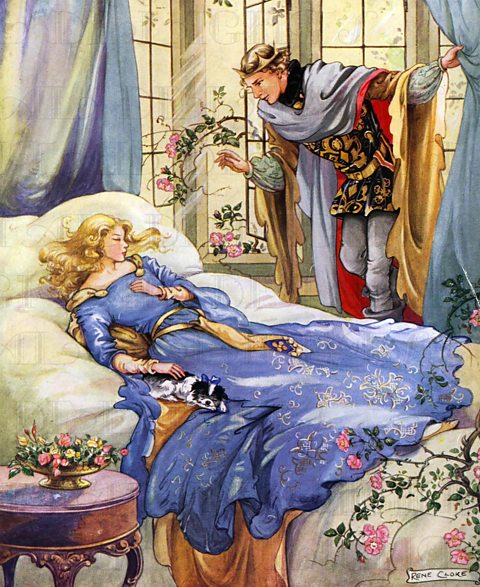 Image source, Pictorial Press Ltd / Alamy Images
"But" signals a turning point in the poem, telling us that something is going to change.
But the little girl vows that the curse will be broken,
The word "vows" supports this turning point, as it means to promise to do something.
The reference to the "curse" brings us back to imagery from fairy tales. Many fairy tales, such as Sleeping Beauty and Beauty and the Beast, contain curses. Just like these stories, the curse "will be broken". Unlike those fairy tales, the curse is not broken by a kiss, but by the girl's own action.
She'll break down the barriers, leave them wide open:
This suggests a permanent change and there is a sense she is also opening a way out for other women.
The words "broken" and "open" are a A rhyme in which the stressed syllables of ending consonants match. Also known as a half rhyme or imperfect rhyme. that links the images and makes them more powerful.
This couplet ends with a A punctuation mark (:) used to introduce a list, a quotation or an explanation., which introduces the second three parallel words, phrases or clauses used in succession with equal length and/or rhythm. An example of the rule of three. .
Image source, Pictorial Press Ltd / Alamy ImagesVideo - What are colons and semi-colons?
Pennie uses a colon at the end of the line (‘leave them wide open:’). The colon introduces a list of people for whom the girl is breaking barriers. The following list is then split up using semi-colons.
Brush up on your understanding of colons and semi-colons and why they are used with this short National 5 English revision video.
What are colons and semicolons? How and why would you use them?
Colons and semicolons
Punctuation marks that help show relationships between phrases within a sentence.
Colons can introduce an explanation.
“Life is like a box of chocolates: you never know what you’re gonna get.”
What follows the colon explains why life is like a box of chocolates.
A semicolon can link two related phrases.
“He picked the strawberry cream; his favourite.”
Semicolons are a bit like a soft full stop. They allow two related phrases to flow together; instead of them being separate sentences.
Some writers shy away from semicolons, while others, like Robert Louis Stevenson, scatter them generously throughout their writing.
In ‘Strange Case of Dr Jekyll and Mr Hyde’, Stevenson compares the two characters: “Jekyll had more than a father's interest; Hyde had more than a son's indifference.”
Grammatically, this semicolon could be replaced with a full stop and would still make sense, but Jekyll and Hyde are really the same person, and as Stevenson compares both their similarities and differences, it’s more effective to join these two phrases using a semicolon.
Later, Stevenson further explores the idea of duality:
“I have been doomed to such a dreadful shipwreck: that man is not truly one, but truly two”
Here, a colon is used to introduce an explanation, and expand on the idea of the shipwreck.
The ‘dreadful shipwreck’ Stevenson refers to is the burden of Dr Jekyll’s split personality, and the fact that eventually, it’ll destroy him.
Colons and semicolons have many uses: explanations, quotes, lists. Not just eyes for your smiley faces!
Lines thirty-three to thirty-five
As in the first tricolon, the three lines of the second tricolon all start with the same word.
The repetition of "For" lists the groups of women the little girl is acting for.
For the daughters of little girls you wouldn't hear
"Daughters" looks to the future, while the use of "little girls" refers back to the title. The speaker and others like her are taking a stand for future generations.
The direct address of "you" signals that the "little girl" is defiant. Rather than hiding away she has the confidence to face the men who have controlled her.
For the children of women you silenced with fear
This is a near repetition of the previous line. The use of "women" suggests that women are reclaiming their own identity and are no longer "little girls".
For our mothers we'll sing till the screams rip the air;
This line switches the pattern from children to parents, from the future to the past, and makes it personal with "our" and "we" instead of "the" and "she" in the previous lines.
As the momentum builds, we are getting closer to the issue and the intensity heightens accordingly. We are now "singing" and "screaming" to the point that the "air" surrounding us all is "ripped" which suggests fundamental, irreversible change, such is the power of this voice. The world will be different now.
The speaker returns to A verb tense expressing an action that has not yet happened, or a state that does not yet exist. (what "we’ll" do).
The final line (line 36)
The last line of the poem is in italics for emphasis - but we would recognise it as the climax we have been building to anyway.
We are the little girls you couldn't scare.
"We" is repeated at the start of the line this time and it seems to encompass both the speaker and the reader of the poem. The poem comes full circle, explaining that "we" are the "little girls" of the title and the poem - no longer put down, but strong and screaming and standing up for them/ourselves.
There is hope, too, that the balance might be redressed and that these women may have a much better future than their predecessors.
Themes in Little Girls and comparisons with other poems
Little Girls by Len Pennie explores many themes such as identity, power, feminism, justice and love. These themes can also be found in other poems in the National 5 Scottish poetry collection.
Identity
This theme runs through the poem as the "little girl" tries to work out who she is.
The contrasts at the beginning of the poem suggest confusion and danger. It later becomes clear that the girl fears being judged. There follows a description of gaslighting which makes the "little girl" question her feelings, her reality and her identity further.
At first she "keeps her head down" as she suppresses her true feelings. But this "smaller", "meeker" self is not her true identity:
She’d love to exist as the person she knows / Lives inside of her mind
The final lines of the poem suggest her breaking free and finally expressing who she is, alongside other women.
The switch from the pronoun "she" to "we" suggest that the girl's identity is shared with and made stronger by a sense of collective community with other women.
The theme of identity is also shown in the other poems:
| Auntie | The poet explores her own identity through that of her aunt and the culture she represents. The sense of female connection links with the collective action that ends Little Girls. |
| The Twa Corbies | The knight’s identity as a hero and lover is forgotten when he dies and becomes food for the crows. |
| The Bonnie Earl o' Moray | The title character's identity is both celebrated and mourned after his death. |
| Lochinvar | The protagonist is sure of his own character and abilities. He is celebrated for his 'masculine' action. This contrasts with the little girl whose identity and confidence are diminished by male opinion. |
Power
Power is key to identity, and it shifts in this poem, making it a theme in its own right.
From the start, the ‘little girl’ is in a vulnerable position, controlled by men who hold all the power. She "resigns herself" to this control until the turning point sees her "break down the barriers" to take power back, both for herself and for others.
The final line celebrates the girl regaining her power, emphasised by the use of italics.
The theme of power is also shown in the other poems:
| Auntie | The gentle power of the duas, tradition, and the speaker's relationship with her aunt are stronger than the stresses of modern city life. |
| A Red, Red Rose | Love is powerful enough to outlast nature: "Till … the rocks melt wi’ the sun". |
| Lochinvar | Lochinvar's romantic love, and his bravery, are powerful enough to overcome his opponents and win back the woman he loves. |
| The Bonnie Earl o’ Moray | The title figure has been killed through powerful forces acting against him. |
Female and male roles and relationships
The poem explores the impact of misogyny on the "little girl" through what she feels and what she experiences, before she takes back the power for herself.
The girl is shown as vulnerable and controlled by male attitudes and behaviour. Men are portrayed as "fishermen hiding their net" and "wolves that deny they’re a threat" to show that misogyny can sometimes be disguised.
We also see more obvious misogynistic behaviour through bullying and gaslighting, and there is a suggestion of men enjoying this – "relish their sins".
Towards the end of the poem we see power gained through The belief that men and women should be socially, politically and economically equal. as the ‘little girls’ start to stand up against the men putting them down.
Although the poem focuses on the relationships between women and men, it is significant that ultimately power comes through the relationships between women: it is by women acting together that they can regain control over their lives.
Female and male relationships are also shown in the other poems:
| Auntie | A strong relationship between women is at the heart of the poem. The aunt provides a quiet, nurturing power that supports and comforts the speaker. |
The other poems in the set are much more traditional, with male voices that focus on male characters and feelings.
| A Red, Red Rose | Focuses on the speaker's feelings for the woman he loves. We know that the two will part but we don't know why, and the woman's feelings remain unknown. |
| The Bonnie Earl O' Moray | The Earl is celebrated as bonnie (handsome) and gallant, a figure to be admired, and perhaps one that other men are intimidated by. The only female characters mentioned are the Earl's "lady" who passively waits in hope of his return, and the Queen, who also loves him, and may therefore, be part of the reason for his death. These women are defined through their relationships with men. |
| Lochinvar | Lochinvar is shown as a traditional ideal of a man: he a brave horseman and fighter, an excellent dancer with good manners, a gallant lover who risks all to rescue the woman he loves. We learn nothing about how the bride-to-be feels about her forced marriage, but she abandons the would-be-groom, her family, and even her country through the strength of her love for Lochinvar. The "bride-maidens" too seem overcome with admiration for the hero, while all the mother can do is "fret". |
| The Twa Corbies | This poem touches on the relationship between the dead knight and "his lady fair". She knows where he lies dead but does nothing to give him a proper burial, and she has "ta'en another mate". Is a female character being judged by a man, or male society, as in Little Girls? |
Justice
The idea of injustice or lack of fairness runs through this poem.
Women are under attack and dismissed when they try to call it out. Men "chime in […] to drown out their sorrow" without being asked to. They cover up their actions and pass them off as a "joke" or a "compliment".
In the second half of the poem the reader can see the damage that has been done to women. The reader feels a huge injustice here, that our "little girl", who symbolises all women and girls, would:
love to exist as the person she knows / Lives inside of her mind
By the end of the poem, the girl and other women take a stand, and there is a feeling that fairness and justice have been restored.
The theme of justice is also explored in the other poems:
| Lochinvar | The title character seeks to restore justice by winning back the one he loves. |
| The Bonnie Earl o’ Moray | The death of the Earl is portrayed as murder carried out against the King’s orders. The King's motivation is questioned, while the speaker seems to encourage him to put right the injustice committed. |
| The Twa Corbies | The fact the dead knight lies forgotten seems to break all the rules and laws of chivalry. This end to a brave life may seem unjust, but the poem calls into question human values in the face of the natural order of life and death. |
Love
Love is explored in Little Girls in the form of self-love. By the end of the poem, the little girls are no longer content "being smaller" and "using far less" than men and decides to assert herself in the face of male control.
we'll sing till the screams rip the air; / We are the little girls you couldn't scare.
This sense of revolution suggests the girls, and women, in this poem are valuing themselves and embracing self-love and female empowerment.
The theme of love is also explored in the other poems:
| A Red, Red Rose | The power of love is central to this poem. |
| The Bonnie Earl o’ Moray | There is a sense of the speaker's love and admiration for the title character. |
| Lochinvar | The hero risks all to be reunited with the woman he loves. |
| The Twa Corbies | The knight’s love had already left him for another before he died, making this sentiment the opposite of the pure and heroic love of the other poems. |
| Auntie | The love is for the family member but is no less believable or pure. |
In all of these poems we see human connections and human experience told in different ways from different points of view.
Revise Little Girls by Len Pennie
Revise Little Girls and other poems with interactive quizzes for National 5 English.
Information and support
If you, or someone you know, have been affected by the issues in this article, the following page contains a list of organisations and information for young people that may be helpful: Information and Support: Bitesize
More on Scottish poetry collection
Find out more by working through a topic
- count4 of 8
- count5 of 8
- count6 of 8
- count7 of 8