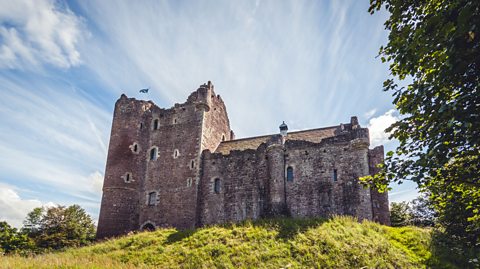
Overview of The Twa Corbies by anonymous
- The Twa Corbies is a traditional Scottish A traditional poetic form used in narrative poetry. A ballad normally features repetition, regular rhyme scheme and rhythm. They were traditionally penned to be sung or read aloud. which, like many others, comes from an unknown source.
- It has a long history and a set of traditions that were passed down through oral communication.
- It was published in Sir Walter Scott's Minstrelsy of the Scottish Border in 1812.
- In this poem, two crows plan to feast on the body of a a knight who has been killed
- Those who should mourn the knight have abandoned him, and moved on with their lives.
This poem explores themes of:
- heroism and reputation
- injustice, betrayal and defying social rules
- politics
- loss and mourning
- death and decay
Looking for some quick revision? Try an interactive quiz for National 5 English.
You can read The Twa Corbies on the Scottish Poetry Library website.
Context
The Three Ravens (English version of The Twa Corbies)
This ballad has a Scots version and an English version, called The Three Ravens.
In the English version, three ravens plan to eat a knight’s body but it is protected by his hawk, hound, and a pregnant deer. These animals are symbols of his nobility: a noble man would hunt with his hound and hawk, and the deer represents his faithful lover. The action of these animals ensure the knight is given a dignified burial.
The Scots version, however, is a much darker retelling. In this version, the hound and hawk, A symbol is an object, person, image or event used to represent something bigger. For example, doves are often used as a symbol of peace. of courtly ideals, have abandoned the knight; his ‘lady fair’ has already moved on, and the only things that have any interest in the knight are the crows who plan to eat his corpse.
The tone of the Scots ballad is therefore much bleaker, representing a detached (possibly cynical) observation about how our heroes are abandoned to their fate and how insignificant we are in the face of death.
Although The Three Ravens was published in 1611 and The Twa Corbies was not published until 1812, it doesn’t mean the Scottish ballad hadn’t existed as early as, or earlier than, The Three Ravens. It is possible they came from the same root, and the English version was printed on paper before the Scottish version.
It is also possible that The Three Ravens is a Christianised version of the harsher Twa Corbies.
The English version promotes chivalry, loyalty, and sacrifice;
- the knight lies "under his shield" in a "greene field", suggesting he has died in the field of battle .
- he is mourned and protected by symbols of loyalty (the hound), nobility (the hawks) and love (the pregnant deer).
- his love remains devoted after his death, ensuring he has something like a Christian burial, and dying herself, as if out of grief or faithfulness.
This is the opposite of what is shown in The Twa Corbies:
- the knight's body lies behind a wall rather than out in the open field of battle.
- his body lies forgotten and unprotected and will not receive a dignified funeral
- he becomes food for scavengers, and loyalty to him dies alongside him - his death has been in vain.
It is also possible that The Twa Corbies had a Mocking and critical. purpose, mocking the hypocrisy of the English knightly code represented in The Three Ravens, and bringing a dark, Scottish pessimism to mock the worldview of those who saw death in battle as a holy sacrifice.
Medieval setting and chivalry
The ballad is set in medieval times, when a knight would have held a high social status and many responsibilities that came with it.
Chivalry was the set of rules that a knight was expected to live by:
- Knights were expected to be loyal to their lords and kings, serving them faithfully and defending their lands.
- In battle, a knight must show both skill and courage, but also must act fairly and with justice.
- Knights were to behave in a way that built a honourable reputation, by being respectful to women, highly religious, and living righteous lives.
- They were supposed to defend the weak and vulnerable and treat everyone with courtesy and honour.
It was believed that God conveyed social status and that God’s favour was what allowed you to win a battle. If you lost, it meant that God was no longer on your side. This ‘chivalric code’ set society’s ideas about honour, masculinity, and heroism in Europe for hundreds of years. How close these ideals were to reality is open to question, as is perhaps suggested by this poem.
Form, structure and narrative of The Twa Corbies
Form
A ballad is a type of narrative poem which is part of the oral storytelling tradition. Ballads were passed down in families and shared in communities. They usually told dramatic, emotional, or tragic stories.
This ballad is a dark tale, in keeping with this style of writing. It includes direct speech, a feature of the genre, where the crows discuss the knight whose corpse they intend to consume.
The language is typically simple, in keeping with the oral tradition of storytelling. This poem is relatively short compared to many other ballads, and it has a minimal storyline, making it fairly unusual in the ballad tradition. It is also very cold and clinical in its tone, in keeping with the unsentimental crows who voice most of the poem. This is very different to the style of other ballads, which usually have a very emotive and romantic tone, with a sense of mourning or loss when dealing with death.
Structure
- The poem takes the form of five stanzas.
- Each stanza is composed of four lines A type of stanza - or a complete poem - consisting of four lines that have a rhyming scheme..
- Quatrains are the most commonly used structure for a ballad.
- Unlike other ballads, it uses an AABB rhyme scheme. (In a ballad, the rhyme scheme is usually ABCB but there are many variations)
- This simple rhyme perhaps reflects the clear, matter-of-fact attitude of the crows.
Repetition
Ballads usually have a A line or group of lines repeated throughout a poem, similar to how a chorus works in a song This poem is a little unconventional as it does not use one. There is some repetition, such as:
- the use of ‘mane’ in the opening and ending, which creates a sense of closure
- the focus on dining and dinner in stanzas one and three
- ‘bare’ and white bones referenced in stanzas four and five
- the idea that nobody knows about the body in stanzas two and six
This use of repetition enables the ballad to have a tight structure and a strong rhythm that effectively links ideas from one stanza to the next.
- The first twelve lines focus on the body’s location and isolation.
- In the second half, lines 13 to 16, focus on how the crows plan to use the body.
- The final stanza focuses on those who will miss the knight and how, ultimately, he will be left there alone forever.
Narrative voice
The first stanza is mainly written from the When the story is told from the point of view of one person using the pronoun 'I'. point of view of the human narrator, but after the first three lines, the speaker passes the story over to the A conversation between two or more people. of the two crows. An observer as a narrator is a commonly used device in ballads. It frames the tale as a personal discovery that the speaker wants to share with their audience.
For the remainder of the poem, though, the narrative voice comes from the two crows. It is perhaps unusual to have a story told from the point of view of a bird.
The crows
It is likely that the person who wrote the ballad would have observed the behaviour of crows in the wild and used this to attach personality and motive to what is, essentially, a simple need to eat.
A superstition grew around birds like crows and ravens because they would scavenge for food from corpses on battlefields, making them symbols of death and decay. They were considered messengers from an afterlife, and their instinctive cleverness made people concerned about their intentions. As a result, crows and other birds of this type are often considered to be birds of ‘ill omen’ – to be bad luck.
The poet uses Giving human characteristics to an animal. to give voice to these animals and their behaviour. The first crow speaks only once, asking:
Where sall we gang and dine today?
The rest of what happens is told from the point of view of the second crow, who seems more in charge and who has already investigated the scene and created a plan of where and how to eat. This narrative voice is very firm, and unsentimental.
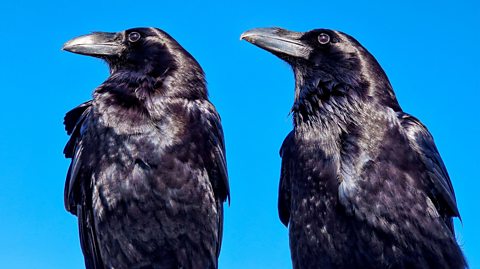 Image source, Getty Images
Characters
The crows
The narrator of the first three lines tells us that they had been alerted to the presence of the crows because they were “making a mane”, (moaning).
The word ‘mane’ has connotations, implying that they could be upset by the knight's death. As we get further into the poem, it is clear that the word reflects the birds' hunger, almost as if they are starving, and relish the idea of eating his body.
A pair of crows would only be concerned with feeding, and maintaining their nest. They are unaffected by the death of this nobleman, as his life experience is so different to theirs, and his battles are not their battles. This could perhaps represent the life of ordinary Scots at this time – they witnessed the battles of knights and nobles, but were more concerned about their ability to eat, feed their families, and survive.
The second crow tells its mate that it should ‘sit on his white hause-bane’ – to sit on the knight's collar bone – almost as a sentry, watching for any threat. Sitting on the knight's chest suggests a dominant hold, as if the crows were perched in victory on top of the knight - as if, for all his heroism or nobility, he has been defeated by symbols of death.
The crow indicates that “nane do ken that he lies there” except for the hound, hawk, and his "lady fair", and then notes that their lives have moved on without him. It is never questioned why they make no efforts to protect or bury his body.
From the crows' point of view, this is not condemned or criticised; it is stated without judgement. The crows understand that life has to go on and that there is little sense in mourning the dead.
To the crows, the body is only a source of food. The fact it is forgotten and lying hidden is helpful to the crows - it's safe for the birds to eat without threat. Their defining considerations, therefore, are survival and safety, not a sentimental reflection on the life and death of a knight.
Stanza one
The opening line establishes that the initial speaker is alone, helping to develop an unnerving tone.
As I was walking all alane,
The speaker’s solitude mirrors the theme of isolation. It is a central idea of the poem that we die alone.
I heard twa corbies making mane;
The tane unto the t’other say,
‘Where sall we gang and dine the day?’
“Making mane” is a Scots phrase meaning an expression of sorrow or mourning. This might initially suggest that their tone is sad, lamenting a death. However, it quickly becomes clear that this is not mournful, but is perhaps a moan of longing or excitement for the feast they are about to have. They are Birds that feed on the carcasses of dead animals., opportunists who see this as an opportunity for a great meal, indicated by the word choice of “dine.” The use of "dine" rather than a simple word like "eat" perhaps reflects the birds are on the hunt for something special to eat. This could refer to the knight's status and that a person of this rank is an unusual or special treat for the birds.
Stanza two
From the second stanza onwards, the poem reflects the words of the dominant crow of the pair.
We discover the crows plan, and its direct speech creates a conversational tone. However, as the poem progresses, we realise the coldness of its attitude - the callousness with which it describes consuming a dead body - indicates how unsentimental the birds are.
In behind yon auld fail dyke,
I wot there lies a new slain knight:
And naebody kens that he lies there,
But his hawk, his hound, and his lady fair.
A “dyke” in modern Scots would indicate a stone wall. However, in this case, the Scots word “fail” indicates the crow is referring to a turf or sod wall, a very humble, ordinary barrier. It is “auld,” suggesting it is unused and is not a place where people often go. This is a lonely and desolate place, and the knight has fallen in a humble location, one in direct contrast to his presumed nobility.
The dyke also serves a Something is metaphorical when you use it to stand for another thing. For example, Morrissey’s parents may not literally be living on separate hemispheres – but they are emotionally very far apart. function. The dyke can be seen as a boundary between life and death: the knight is ‘behind’ this boundary, in the land of the dead. As crows were considered to be messengers from the afterlife, this is also effective in creating a dark atmosphere.
The word choice of ‘new slain’ shows that the death is recent and also that it has been violent, implying a brutal death.
It seems that few people know about this tragedy:
But his hawk, his hound, and his lady fair.
This further highlights the isolation of the scene and how forgotten the knight is in death. The listing of three A symbol is an object, person, image or event used to represent something bigger. For example, doves are often used as a symbol of peace. of a knight’s life emphasises how abandoned the knight has been.
- Hawks symbolise hunting and nobility.
- Hounds symbolise loyalty and companionship.
- The lady represents the romantic ideals of a knight; his own loyalty and his role in defending the vulnerable.
Apart from the crows, it is only these three that know what has happened. The circumstance of how the knight was killed and how the animals and his love know where it took place are not explained. We may be left wondering if they were involved in his death.
Stanza three
The next stanza continues in a grim, unsentimental way, showing how little loyalty the knight’s companions actually had:
‘His hound is to the hunting gane,
His hawk to fetch the wild-fowl hame,
His lady’s ta’en another mate,
So we may make our dinner sweet.
The crows' observations have an Criticising or challenging traditional ideas, beliefs or institutions. function. In this poem, the crows challenge the romantic ideals of loyalty and noble death.
We hear that the knight’s animals have returned to their natural hunting instincts, no longer guarding or mourning their master. Like the crows they are unsentimental animals and have gone on with their lives.
The lady, who is supposed to symbolise fidelity and love, has instead shown that love is temporary. She has transferred her love to another. Again, the circumstances are unexplained. It is possible she had taken up with another man before the knight's death. Or has she moved on because her knight can no longer provide for or protect her?
Everyone in this poem sees the knight as transactional; they see him for what he can give to them.
The knight’s body is left where he fell, exposed to the elements and to predators. This lack of care for his body means that the crows can “make our dinner sweet.” This word choice indicates the pleasure the crows will take from this feast, made possible due to the neglect of those who were supposed to love and protect him.
Stanza four
The crows’ cold, practical attitude would be shocking to the reader who would, instead, have expected the knight to be treated with dignity:
‘Ye’ll sit on his white hause-bane, hause-bane:
And I’ll pike out his bonny blue een;
Wi ae lock o his gowden hair
We’ll theek our nest when it grows bare.
Eating the knight shows the natural cycle of life: the crows will carefully use all of his parts. His eyes will be eaten first, his blond hair will line the birds’ nest, and his collar bone/neck bone will be used as a perch.
Sentimental descriptions that humans would take from the “bonny blue een” and his “gowden hair” are used here only to show the luxury that this corpse brings to the crows. The plan to “pike” those eyes, suggesting a violent, spiking, poking action. The The repetition of the same sounds or consonants in two more words nearby each other. in “bonny blue” emphasises the knight’s beauty in life, in contrast to the violence of the bird’s plan. His hair being “gowden” creates the image of a crown, emphasising his nobility. But nobility and fine appearance mean nothing in death, or to the crows whose plans for the knight's body are purely practical.
It is likely, too, that the crow is telling its mate to sit sentry, watching for anyone coming to disturb the feast while the dominant crow eats:
Ye’ll sit on his white hause-bane
“Ye’ll sit” creates a commanding tone from the dominant bird. It has planned out how this is going to go, suggesting this is a familiar situation and that the knight being eaten is inevitable. It also changes the status of the knight: far from being a noble warrior, perched on his steed, he is now a feeding station, with birds perching on him. This shows no respect to the knight. His bones are described, suggesting his body is already in the process of being stripped by predators. The word choice of “white” suggests a skeletal image: a stark image of the finality of death.
Thecrow is very matter-of-fact about the plans: the two crows must work together to create domestic safety and survival. They will “theek our nest” together when it “grows bare.” As winter brings about hardship and decay, this death will allow them to live. At heart, life is an ongoing process of survival.
Stanza five
The final stanza is the only place where a sense of emotion comes into the poem; the crow ends on a (literally) chilling note, stating that many will mourn for him, but they will never know what happened to him. The only thing that will know where he has gone is the wind that will blow over his white bones forever.
‘Mony an ane for him maks mane,
But nane sall ken where he is gane;
Oer his white banes, when they are bare,
The wind sall blaw for evermair.’
This is the first part of the poem where there is any suggestion that anyone in his life valued the knight. The word “mane” is repeated from the first stanza, this time referring to the “mony” who will cry for him.
Similarly, “nane sall ken” links back to “naebody ken,” emphasising the knight’s isolation and abandonment in death. Over time, the knight will decay, from someone who “lies there” to becoming someone who “is gane.” He will physically decay, and the memories those who survive him will also fade. Some readers may take "where he is gane" to suggest what happens after death. It could be taken to mean that no-one knows what happens to a person, or even the idea of a soul, after their body has died.
The final couplet returns to the idea of his “white banes” being left on display. This creates a stark image of a vulnerable “bare” body, which is left unprotected. This harsh, desolate setting is no comfort to the dead. The last line introduces the idea of the wind – a force of nature that is unstoppable and eternal, existing independently of humanity, its battles, or its problems.
This uncaring wind will “blaw for evermair’” over “his white banes.” This creates a stark image of his unloved, lonely body, kept cold and alone for all of eternity. However we have lived our lives, we will all die and remain that way forever.
Tone in The Twa Corbies
This poem is famous for its callous, and cold tone. The crows are matter-of-fact about death and even often come across as gleeful about the fate of the knight. There is a strong sense of detachment from their point of view – there is nothing sentimental in this ballad. They see the discovery of a body as a routine, casual event.
The birds focus on the practicalities of their lives rather than suggesting any grief or emotion. They have no respect for honour or dignity. This emphasises the idea that death is a leveller – we all face it, and life goes on without us. It is further suggested that death (and therefore life too) has no meaning, and even the good and the great are forgotten.
There is also a tone of cynicism as the crows reflect on how little loyalty or grief is shown by the knight’s hawk, hound, or lady. There is nothing to suggest they mourn, that the knight’s death received justice or that he found any redemption. There is only decay and consumption.
Video - What is tone?
Brush up on your knowledge of tone and how writers create it with this National 5 English revision video.
What is tone? How is it created?
The attitude that a writer expresses towards a subject.
Tone always sends a message!
“What are you doing?”
A simple question, right? Adding a few extra words to this sentence can completely change the tone.
“What the hell do you think you’re doing?”
Whoever sent this message is not happy, and their tone gets this message across.
Everything we say or write has a tone. It’s shown in lots of different ways through word choice, imagery, sentence structure and even punctuation.
Tones can be driven by emotion. What we say and how we say it can change depending on whether we’re worried, excited, upset or affectionate.
But tone isn’t just about emotions. The situation is important too.
This can affect whether you choose a formal or informal tone.
“Dear student, It is with great pleasure that we offer you a place on your chosen university course…”
Though this is a very exciting letter to receive, it’s still written with a formal tone. The message you send your friend right after it might be a tad more informal, though:
“OMGGG!! I GOT INTO UNI! ”
Tone can say a lot in poetry.
In Liz Lochhead’s poem, My Rival’s House, she describes a simple scene of visiting her lover’s mother for tea.
“my rival thinks she means me well. But what squirms beneath her surface I can tell.”
Lochhead’s tone here is hostile and critical, as she feels her partner’s mother is trying to undermine her. The word “squirm” suggests discomfort.
“Deferential, daughterly, I sip and thank her nicely for each bitter cup.”
On the face of it, “deferential, daughterly” and “thank her nicely” all sound pleasant enough, but the word choice and imagery of "bitter cup” brings this surface tone into question.
It shows there is a poisonous attitude between the two women, as the speaker feels she is being forced to be submissive in the older woman’s presence.
Lochhead’s attitude is expressed clearly here through lots of different techniques!
The next time you’re at someone’s for tea, watch your tone!
Or you’ll no get yer puddin’!
Themes and comparisons with other poems in the collection
Heroism and reputation
This ballad offers an entirely different view of heroism from many other ballads, as it To use ridicule, irony, humour or exaggeration to make fun of other people or their ideas. ideas of social status and rank. Instead of being a romantic celebration of chivalry, this ballad creates a sense of realism and a cold, dark tone. The knight doesn’t get an honourable burial in this poem; instead, he is food for the animals, taking his place in the natural cycle of life and death.
There is no romanticisation of his death, only a gruesome description of how the birds plan to eat him. His romantic qualities are only given mention as part of a delicious treat for them or a way to make their nest more comfortable. His heroism means nothing to these birds; their only instinct and imperative is to survive. The knight loses his social status and nobility in death and is now equal to any other animal. This knight’s reputation means nothing – it hasn’t protected his life or kept his companions loyal. He will be remembered by some who will mourn him, but no one will come looking for him.
The themes of heroism and reputation are also shown in the other poems:
| Lochinvar | Lochinvar’s reputation goes before him. He is well known as a good fighter and a faithful lover and no one wants to take him on when he arrives. |
| The Bonnie Earl o’ Moray | The Earl is well known as a noble and charming man who had a reputation for his kingly values. |
| A Red, Red Rose | The speaker is romantic and constant in his affections, like a knight was supposed to be. |
| Little Girls | Heroism is shown through survival against the harm society causes girls. Reputation is weaponised – girls are judged differently to men. |
| Auntie | The aunt is a hero to the speaker because of her quiet, yet impactful, presence in her life. There is no public celebration of the aunt, but she has left a legacy of affection and connection. |
Injustice, betrayal and defying social rules
In The Twa Corbies, injustice is suggested through the lack of loyalty shown to the knight by "his hawk, his hound, and his lady fair". For all the knight's chivalry and values, he is left unburied and without commemoration. His loyal animals and love abandon him for survival, illustrating that survival instincts outweigh loyalty and love, which appear fleeting and false.
Society expects mourning and honour, yet the knight is forgotten. His death only interests scavengers. This highlights the difference between human values and emotions and the unemotional practical reality of nature.
The themes of injustice, betrayal and defying social rules are also shown in:
| The Bonnie Earl o’ Moray | His murder is a betrayal; he does not get to face justice or get justice for the murder. His relationship with the queen potentially defies social rules. |
| Lochinvar | Ellen's departure with Lochinvar can be seen as betrayal - she betrays her family and bridegroom. |
| Little Girls | Systemic misogyny, victim-blaming, and the silencing of girls and women is a key theme, but at the end, they scream in rebellion. |
Politics
Knights were crucial to the A political and economic system where a monarch owns all the land but passes control of different areas to barons and earls in exchange for their loyalty. Barons can then divide up their land for knights to control. At the bottom of the system are ordinary people, often called peasants. in medieval politics, serving as warriors, role models, and enforcers for kings and lords, especially in the Scottish Borders. They held land in exchange for service, committing their loyalty to specific leaders. Their marriages and alliances shaped politics, establishing power and trust.
In The Twa Corbies, the unnoticed death of a knight symbolises decline in noble power, hinting at the loss of established moral and social values. This reflects societal uncertainty: if knights can’t protect themselves, how can they protect others?
The poem can be seen as a criticism of the feudal system and social Any system of persons or things ranked one above another., with received ideas of loyalty and honour seem empty. To ordinary people, represented by the crows, ideas of chivalry and nobility mean nothing.
The theme of politics is also shown in :
| The Bonnie Earl o’ Moray | The Earl was killed while under order of arrest from the King. The King's inaction following the murder is called into question. |
| Lochinvar | A Scottish knight crosses the border to steal away the daughter of an English nobleman, part of the historic border conflicts. |
| Little Girls | Systemic misogyny, victim-blaming, and the silencing of girls and women is a key theme. |
Loss and mourning
This ballad lacks traditional mourning, which makes it effective by depicting death with detachment and indifference.
The knight’s death is unacknowledged; his hawk, hound, and lady have moved on, suggesting societal shifts where death no longer prompts sorrow. The tone, delivered by the corbies, denies the knight dignity, emphasising survival over loss. In death, he loses his identity and status, becoming just another source of food for the birds. Through the hawk, hound and lady fair, there's a focus on replacing what's lost and moving on, reflecting a view of humans as lacking emotional connection.
The final stanza hints at some grief, with the crow noting many mourn but none know his whereabouts.
The themes of loss and mourning are also shown in:
| Lochinvar | Rather than mourning the loss of of the woman he loves, Lochinvar takes control and wins her back. |
| The Bonnie Earl o’ Moray | The loss of his potential, his grace and his many positive qualities were mourned by all those who knew him. |
| A Red, Red Rose | The speaker sees the loss of his love as a temporary thing that he will return to as soon as he can. |
| Little Girls | Mourns the lost voices of little girls and the loss of innocence they experience. |
| Auntie | Mourns the absence of the speaker's aunt, whom she fondly remembers. |
Death and decay
Death is presented in a very unsentimental way, again, unlike the emotional tone of many other ballads: life is frail, and death reduces us all to nothing.
The body is left unburied and uncommemorated, left only to be food for the crows. Nature does not care – the birds see food, not any sense of tragedy. The cycle of life is represented here. We see, though, decay and death in a metaphorical sense: feudal values are decaying, and we see the death in traditional values.
The themes of death and decay are also shown in:
| The Bonnie Earl o’ Moray | The death of the Earl is the key focus of the poem. |
| A Red, Red Rose | Love will survive death and even the end of the world. |
| Little Girls | Decay is seen in the loss of identity and autonomy. |
| Auntie | While not explicitly stated, it could be interpreted that the aunt has died, and the speaker remembers her after she is gone. It could also be that she simply lives out of reach of her niece. |
Revise The Twa Corbies by anonymous
Revise The Twa Corbies with this interactive quiz for National 5 English
More on Scottish poetry collection
Find out more by working through a topic
- count7 of 8
- count8 of 8
- count1 of 8
- count2 of 8